



A response to ‘lessons to be learnt from the Syrian Revolution and lessons which should have been learnt long before’by Nikolaos van Dam
In ‘lessons to be learnt from the Syrian Revolution and lessons which should have been learnt long before’, published by Harmoon Center for Contemporary Studies,[1] Nikolaos van Dam undertakes the challenging quest of signifying conclusions and meanings of the Syrian tragedy. In the absence of political, military, judicial, or civil solutions, the urgency to reach conclusions, meanings, and methodologies is unavoidable, for it is hard to accept that what has been happening in Syria is meaningless, or fails to provide guidance on addressing similar challenges.
In addition, a foremost part of the challenge is van Dam’s awareness of the sensitivities his lessons would provoke, especially when they would be contextualized by postcolonial discourses (which blames the West for looking to the East merely from a static preconception and to the benefit and the interest of the West). Also, to name his conclusions as lessons is another risky announcement that can provoke sensitivities against ‘Westerners who want to lecture us’.
To start with, the following does not intend to engage with the sensitivities of outsiders lecturing on a national tragedy, just because what has been happening in Syria is not specifically Syrian and is not limited to the borders of the country, but rather can be taken into a global serious investigation. State violence, collective punishment, political prisoners, forced confinement, refugees, identity politics, newborn states, declining states, third millennium revolutions, military ethics, and freedom of expression are all topics that were encapsulated in Syria, but they are not necessarily Syrian.
Van Dam’s key lessons are guidance to the Syrians to not protest, to build a dialogue with Al-Asad, to lift the sanctions, and to start rebuilding the country. The reasons for this relinquishment are the regime’s brutality, the alliance sectarian groups with the regime, and the return to the Arab committee, concluding that Al-Asad is strong and it is hard to topple the regime.
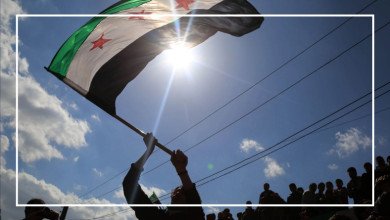
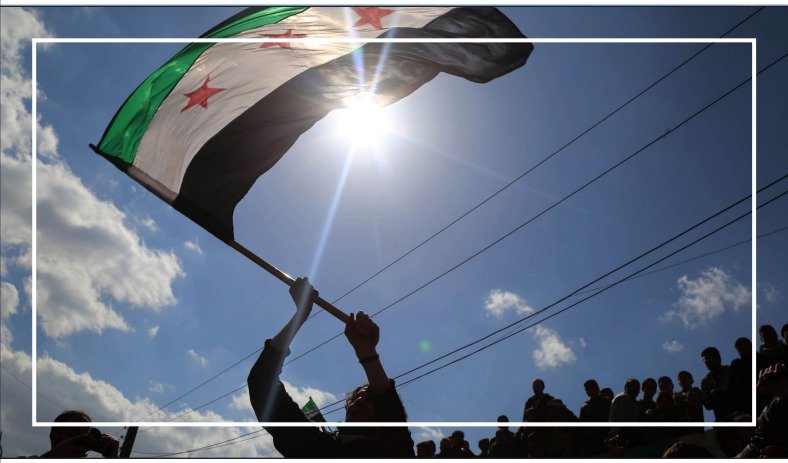
Quite paradoxically and symbolically, a few days after the publication of the lessons, people in Al-Suwayda started to protest, carrying slogans that appeared in 2011. Although they recognize Van Dam’s description of the regime, they just did the same thing; they protested. Would the lessons for Al-Suwayda be to abandon their calls? Is there a more deserving topic that warrants investigation to comprehend why Syrians still find it important to protest?
Although his lessons end with a euphemistic statement ‘[i]t is the Syrians themselves who have to come to a political solution, but much depends on who is the most powerful,’ Van Dam does not mention any Syrian name as a reference in his conclusions. The only mentioning of the Syrian voices are the silent Syrians who had nothing to say about the conflict. Those who sided with the regime and those who protested are not worthy of attention.
One of the major questions these lessons provoke is who these lessons are addressed to? The lessons, it seems, are directed towards the protesting Syrians and the international community. As it seems, the lessons are not addressed to the Al-Asad regime, Iran, or Russia, as they appear to be mastering what they do, and therefore are exempted from the class. Quoting David Lesch, a Syrian expert, Van Dam affirms that Al-Asad does not like to be told what to do. Although agreeing on this realization, Van Dam makes this step asking the regime what to do, as such;
The regime should, if it really had wanted a solution, have started to implement UN Security Council 2254 (2015) without delay, and immediately allow humanitarian agencies rapid, safe and unhindered access throughout Syria to reach people in need; release any arbitrarily detained prisoners; immediately cease any attacks against civilians and civilian objects as such, including attacks against medical facilities and personnel, and any indiscriminate use of weapons, including through shelling and aerial bombardments.
This quotation is the only mentioning of what Al-Asad should do in the more than 6000-word paper. The rest, however, lists what the whole world should do. Although short and mentioned in passing, these requirements are, in fact, what the criticized Syrians have been calling for. But knowing that these necessities will not be considered by the Syrian regime and realizing that Al-Asad does not like to be told what to do, the rest of the 6000-word lessons appear to be imposed on the ones who were defeated. Syrians, according to Van Dam, should live under oppression, just because the oppression could get worse. In this context, and Since Al-Asad does not like to be told what to do (does this apply to the relationships with Russia and Iran?), the defeated Syrians should like what they are told to do. And what they are told to do is not to protest because Al-Asad is violent, as if no one knows this observation in Syria.
Where to attend the class about the detainees?
Syria is considered one of the countries that has been under a state of emergency for the longest period of time. The state of emergency is taken for granted and as a status quo in the Syrian case. Living with the threat of the secret police not only influenced the Syrians’ ability to construct a political life but also their ability to communicate. Salwa Ismail describes in The Rule of Violence Subjectivity, the consequences of the Syrian regime’s atrocities and its influences on the Syrian daily interlocutions as thus:
One can imagine that distrust-guided communication creates a fertile ground for Kafkaesque exchanges where doubts and different planes of enunciation and reception structure exchanges and could culminate in mutual indictments (Ismail 2018, p.78).
Living for decades under a state of emergency is a systematic destruction of not only the ability to build a dialogue but of life itself. Lisa Wedeen, in her discussion of spectacles, symbols, rhetoric, and cult under totalitarian regimes, affirms that one of the main means of influence was the Syrian regime’s ability to ‘compel people to say the ridiculous and to avow the absurd.’ (Wedeen 1999, p.12). Not only striving to grasp judicial legitimacy, being in a state of exception for decades means that the country has to leave law aside and treat one another in the context of the political rather than under the umbrella of law. Syrians should live also under the condition of necessity has no law, or to use Agamben’s words to live in a legal civil war.
While mentioning the detainees only once in the long paper, Van Dam suggests that the sanctions do not reach political solutions because ‘rather than hurting the Syrian regime elite, they hurt numerous innocent Syrians under his rule much more’ and because ‘[t]he sanctions against the Syrian regime are supposed to force it to change its behavior, but have not achieved anything positive yet, rather the contrary.” These remarks are quite urgent, especially when no one wants to harm Syrians while trying to help them. The danger of converting the discussion to only negotiate the sanctions is that it is gradually making the case of the detainees unimportant.
The reasons for the sanctions, as it was stated, came in accordance with the Caesar photos. Whether this is another conspiracy or a real concern about the detainees, no one can deny the existence of random detentions, collective punishment, and forced confinements in Syria. In fact, the main trigger of the Syrian protests in 2011 was the arbitrary behavior of the secret police (Al-Mukhabarat). Furthermore, one of the main calls of the Syrian protests was: DEATH AND NOT HUMILIATION!
Thus, instead of converting the discussion to question the sanctions, we should not forget the reasons that originated the sanctions; namely the detainees. While worrying about the Syrians who are the victims of the sanctions, other solutions should be created to provide justice to the detainees, the ongoing victims of compulsory confinement. Ignoring the detainees is another assertion that Syrians should live in political conditions where laws have no space.
In The Impossible Revolution (2017), Yassin Al-Haj Saleh attempts to take the same mission wondering how solutions and justice can come together and how Syrians long for perceptions to the bewilderment and confusion they have been through. According to Haj Saleh, “[w]hen the accompanying structure of ‘reason’ is disabled or is turned against people and used to rob them the ability to understand their situation, they tend to use outdated and unsuitable tools: ‘un-reason’ (Haj Saleh 2017, p. 183).
When Europe opened borders to the Syrians, they asked the refugees to use all available means offered by the black market to reach Europe—an approach that further separates Syrians from legal treatment. Instead of putting in extra effort in European embassies in the Middle East to enlarge the staff and treat the victims respectfully in terms of visa and safe travel, they were, again, asked to accept all sorts of irrational conditions to stay alive.
Van Dam accuses the opposition of wishful thinking and accuses those who call themselves ‘friends’ for preferring ‘non-realistic picture in which (right) ideas about justice prevail over the realities on the ground.’ But the question is still there: were his lessons really based on the realities on the ground? And can they be read as other wishful thinking too?
The Corruption Hub
While ignoring the Syrian unique experience under the state of emergency and the question of the detainees, Van Dam’s main concerns seem to center around the war, the victims of the war (in specific), the money spent on this war, and the refugees. These topics, it seems, are the ones that affect what lies beyond the Syrian borders, influencing the international community. Neither Van Dam nor diplomatic official statements state that what signifies the role of Al-Asad and dignifies the efficiency of the opposition is the topic of blackmail and corruption.
A major part of what kept Al-Asad in power is his ability to destabilize other countries, whether through the militias supported by the Syrian regime or the most up-to-date threat, drug trafficking, and the manufacturing of Captagon. Van Dam, surprisingly, does not mention this factor when he reasoned how Al-Asad remained in power, although Syria has become one of the world’s largest producers of this drug. These unstated reasons to reconcile with the regime are also the reasons that involve how Syria affects what lies beyond its borders, not only to the Arab states but also to Europe. And while diplomats do not speak about it publicly, one would wonder why it is concealed in an academic approach.
The major question that arose while following Van Dam’s lessons is why he has decided to conclude his lessons in 2023? What makes this year different? Is 2023 the deadline for political change in Syria? History has taught us that protests and revolts vary in their achievements of immediate objectives or long-term processes, a development that ascertains the complexity of social and political changes and their variations and evaluations. The main reason to give this lesson in 2023 is that “Arab countries that in vain tried to help topple the Syrian regime for over a decade are now reestablishing diplomatic relations with Damascus.”
What makes this step so significant that it deserves to be treated as a measure to predict the future? In fact, my writing process was interrupted by several events that diverted attention and shifted various conclusions from the demonstrations in Al-Souyada to the tension at the Syrian-Jordanian borders due to Captagon, the increased frequency of bombings inside Syria, the Arab world’s hesitant relationship with Syria, and Gaza. These events have altered many conclusions about Syria and will have lasting effects on the country’s future. Thus, waiting for a single sign to draw conclusions or establishing a specific time frame to judge political and social changes is a reductionist approach to an ongoing narrative that characterizes what is happening in Syria and the international attention to the country.
Syria, which has always been an obscure country, has served as a hub for international corruption. The Syrian regime not only knows who to threaten with drugs but also has a unique control on sensitive issues, such as Al-Mujahideen who fought in Iraq, the drugs in Lebanon with its international trafficking, nuclear waste, strong liaisons with unofficial militias, and political assassinations.
In 2005, Abdul Halim Khaddam, who was the vice president then, turned against Bashar Al-Asad and fled Syria. State media as well as the Syrian parliament re-opened a file that was forbidden to discuss in Syria, i.e. the disposal of nuclear waste back in the 1980s. Khaddam was accused of importing nuclear waste from “abroad” to bury it in Syria. Whether Khaddam did it or not, the announcements confirmed the rumors Syrians used to speak about in their scared indoor talks. Khaddam, however, was the only one to blame for a catastrophe that affected the health of the Syrians. But was Khaddam alone in this mission? And what does this “abroad” refer to? Certainly, such a process would involve numerous international entities, and to really follow the leads of this corrupt action would involve many parties, including European countries. This would apply to many cases that would involve Western countries in the Syrian corruption.
Hence, the unanswered question of who can replace Bashar Al-Asad validates when we rephrase the question (maybe with the same grouchy tone): And who will be in charge of these critical files of Mujahedeen, drug trafficking, nuclear waste, and other international corruption, some of them we probably still do not know about.
Van Dam’s main solutions to the Syrian predicament are establishing dialogue with Al-Asad, lifting of the sanctions, and supplying money to reconstruct the country. Let alone the complexity of building a fruitful conversation, what is the fate of the money that will be sent to rebuild Syria? Not only Syrians but also international and Arab leaders have numerous comments on what is called the regime’s lies, including the Russians when their press complained about its deception in 2020. Who would guarantee that the money given to reconstruct Syria would not be affected by the infamous Syrian corruption? Syrians have learned through decades that the money that is sent to help them has disappeared with no tracking to who benefited from international aids. Whether a natural disaster, such as the 2023 earthquake, or a human-made disaster, such as the war, Syrians only hear of the aids.
Sourya Al-Asad
Like Bashar Al-Asad, Van Dam states that Syria is different from Egypt, Tunisia, and Libya. It is quite hard to understand what is meant by this statement. Even the reasons brought by Van Dam, such as the strong intra-Alawi solidarity and the regime’s long experience in suppressing any dissent or opposition, do not specify how Syria is different. Other regimes were also strong in comparison to their subjects. They were also aligned with sectarian and tribal groups and international forces, as well as having an equally long experience in oppression and annihilation.
Syria is not an alien country, and what has been happening in Syria is not necessarily Syrian in nature. The reactions to state violence are not necessarily Syrian also. Syria is not the only country that has various types of opposition, rebels, freedom fighters, terrorists, manipulated opportunists, and revolutionaries. These groups exist all the time and in many countries. Syria also is not the first country that encapsulate several turmoils one after the other.
Perhaps, what is specific about Syria is that Bashar Al-Asad is not Mubarak, Gaddafi, or Saddam Husain. What made Syria different from other nation-states is the existence of Bashar Al-Asad and Hafez Al-Asad. Iraq, Libya and Egypt were not named after their presidents’ name as was the case in Syria, which became known as سوريا الأسد Sourya Al-Asad (Syria of Al-Asad). And when the Syrians had no choice but to accept this identification, the international community has also treated Syria and the Syrians as Sourya Al-Asad.
Even after 2011, Syria was associated with the destiny of Bashar Al-Asad. I recall many reports that explained how Syria is different when the attention to the country turmoil was given to Al-Asad, observing how long he can remain in power. News followed the revolting Egyptians and Tahrir square rather than calculating the durability of the Mubarak’s regime, and this had been the case when covering movements in central Asia, West Africa, East Europe, South America as well as national liberation movements. I also recall that since 2011, several news agencies (Arabic and international) used to conclude their reports on Syria with phrases like “and these protests are the most difficult challenge Bashar Al-Asad has ever encountered.” Even if the report or the news does not explicitly mention Bashar Al-Asad, this statement was frequently the concluding one. The international attention to Syria kept the same routine of focusing on Bashar Al-Asad, as it had been the case before 2011, when he had been the most spoken about figure in Syria.
Centralizing Bashar Al-Asad has also been given in the famous cynical debate; and who will replace Bashar Al-Asad? – an exam most of the global revolting movements did not have to go through. Proposing this question centralizes Bashar Al-Asad as the key factor in the whole tragedy happening in Syria, and therefore assuming that the Syrian narrative is the story of Bashar Al-Asad.
What made Bashar Al-Asad different is a quality that he inherited from his father, who had, perhaps, inherited it from Gamal Abdel Nasser during the Non-Aligned Movement in the Cold War era. The Al-Asad dynasty possessed this property of being able to communicate with world powers using mutual languages with them. Thus, they were able to communicate with socialist countries, imperialist corporations, Sunna, Shia, Christians, Arabs, Turkey, China, and unofficial militias in the same familiarity. And this quality was not possessed in the same degrees by the other overthrown Arab dictators during the Arab spring nor by the Syrian oppositions.
While Al-Asad can communicate with many international powers, Syrians were not allowed to communicate not only with external groups but also among each other. The opposition, on their side, insisted on avoiding this quality for reasons that range between principles and hypocrisy. Thus, those who liaised with Saudi Arabia were not able to communicate with European elites, and vice versa. The opposition also rejected communicating with influencing powers like Iran, Russia, and China, believing that this standpoint is a value on its own. Van Dam has also joined this request, asking the opposition to not trust and not to communicate with the international community.
Reducing Syria to the narrative of Bashar Al-Asad is another oversimplification often adopted by Western academics in their pursuit of rational objectives. Subhi Hadidi has consistently criticized this Western simplification, which tends to be presented with humanitarian and rational undertones. Hadidi points to Chomsky’s introduction to Reese Erlich’s book Inside Syria: The Backstory of Their Civil War and What the World Can Expect (2014). Despite the book providing extensive details and facts about Syria, Chomsky simplifies Erlich’s comprehensive descriptions of Syrian life to a mere conflict between Sunni and Shia. In this reductionist approach, Chomsky deems it sufficient to characterize Al-Asad’s actions as a vicious reaction.[2]
This centralization has led to a systematic division among Syrians, nurturing mutual fear among them, and resulting in heightened tension and a cold civil war. Yasin Haj Saleh reminds us in The Impossible Revolution, that this structure exploded twice in three decades, because this structure cannot but produce explosions one after the other since it is based on the isolation of the people and intensifying mistrust and fear among them, as well as the central possession of Syrian resources by a few beneficiaries (Haj Saleh 2017, p.252).
Syria-ology
Since 2011, academics, reporters and Syrians alike have been puzzled attempting to characterize what has been happening in the country, using a range of terms such as war, revolution, civil war, proxy war, armed resistance, war on terrorism, protests, intifada, rebellion, unrest, conflict, conspiracy, and more. This nomenclatural confusion extends beyond Syrians to international diplomats and academics. Despite numerous studies and initiatives on conflict resolution, the Syrian tragedy, spanning twelve years, and the enduring Palestinian issues resist not only solutions, but a clear characterization. Strangely, Western academies are certain about identity politics and adept at labeling sexual identities and skin colors, yet they seem lost when coining new words for critical social and political issues.
Van Dam suggests that Western interferences may have exacerbated the issues, emphasizing the difficulty of creating justice compared to reality. The question arises: does the hesitant discourse on Syria by Western establishments stem from the complexities unique to Syria, or is it a broader communication challenge in addressing critical global issues?
The stammering communication on Syria prompts broader questions about Western approaches to critical issues like the Kurdish problem and Palestine. The lack of clarity in describing the Syrian tragedy mirrors the Kafkaesque exchanges within the country, creating a pattern of uncertainty and mistrust. If we acknowledge that Syria is unlike any other country, why doesn’t academia establish a new department or discipline called Syriology, for instance? If we agree that events in Syria are not necessarily unique to Syria—in terms of war, state violence, populism, state of emergency, and the prioritization of solutions over justice—how could the events and questions arising from Syria contribute to our understanding of the issues this century might bring, such as war ethics, legitimacy of states, the necessity of states, revolution, public opinion, and, again, states of emergency?
Globally, the education system seems to lag behind, grappling with the challenges of adapting to our rapidly changing world. Schools, in Europe and worldwide, are undergoing a transformation into some of the most conservative institutions, reminiscent of the army and religious establishments. Although attempts are underway to introduce new pedagogies and educational models in schools, the aim is to establish interdisciplinary fields that can better address the complexities of contemporary issues. The call to refrain from adopting a singular methodology to comprehend Syria is an invitation to embrace an interdisciplinary approach to address the unanswered questions. Undoubtedly, a single answer is insufficient to comprehend Syria, as well as issues such as Palestine and Israel, the Arab Spring, #MeToo, or the yellow vests movement. This invitation is not solely about understanding but also about preparing for forthcoming events that could unfold at any time and in any place.
This discussion does not aim to criticize Western lecturing but seeks to open dialogues on overlooked issues. I don’t assume that I have solutions, and I don’t know what is doable—reality or justice. Is Bashar Al-Asad still the safest solution for Syria, or would Syria change its maps, or become an international political reserve? How can we encapsulate Captagon and the right of a people to self-determination in one class? No answer guarantees validity. The question remains: do we need to understand how things happened, or do we need to understand irrational realities, trying to adapt to one explosion after the other?
[1] https://www.harmoon.org/?p=34870
[2] https://tinyurl.com/5n6mu2fd
References
- Agamben, Giorgio. State of Exception. Tr: kevin attell. Chicago and London: the university of chicago press. 2005.
- Erlich, Reese Inside Syria: The Backstory of Their Civil War and What the World Can Expect. New York: Prometheus Books. 2014.
- Haj Saleh, Yasin. The Impossible Revolution. Chicago, Illinois: Haymarket Books. 2017.
- Ismail, Salwa. The Rule of Violence: Subjectivity, Memory and Government in Syria. Cambridge: Cambridge University Press. 2018.
- Wedeen, Lisa, The Ambiguities of Domination. Chicago: The University of Chicago Press. 1999.