



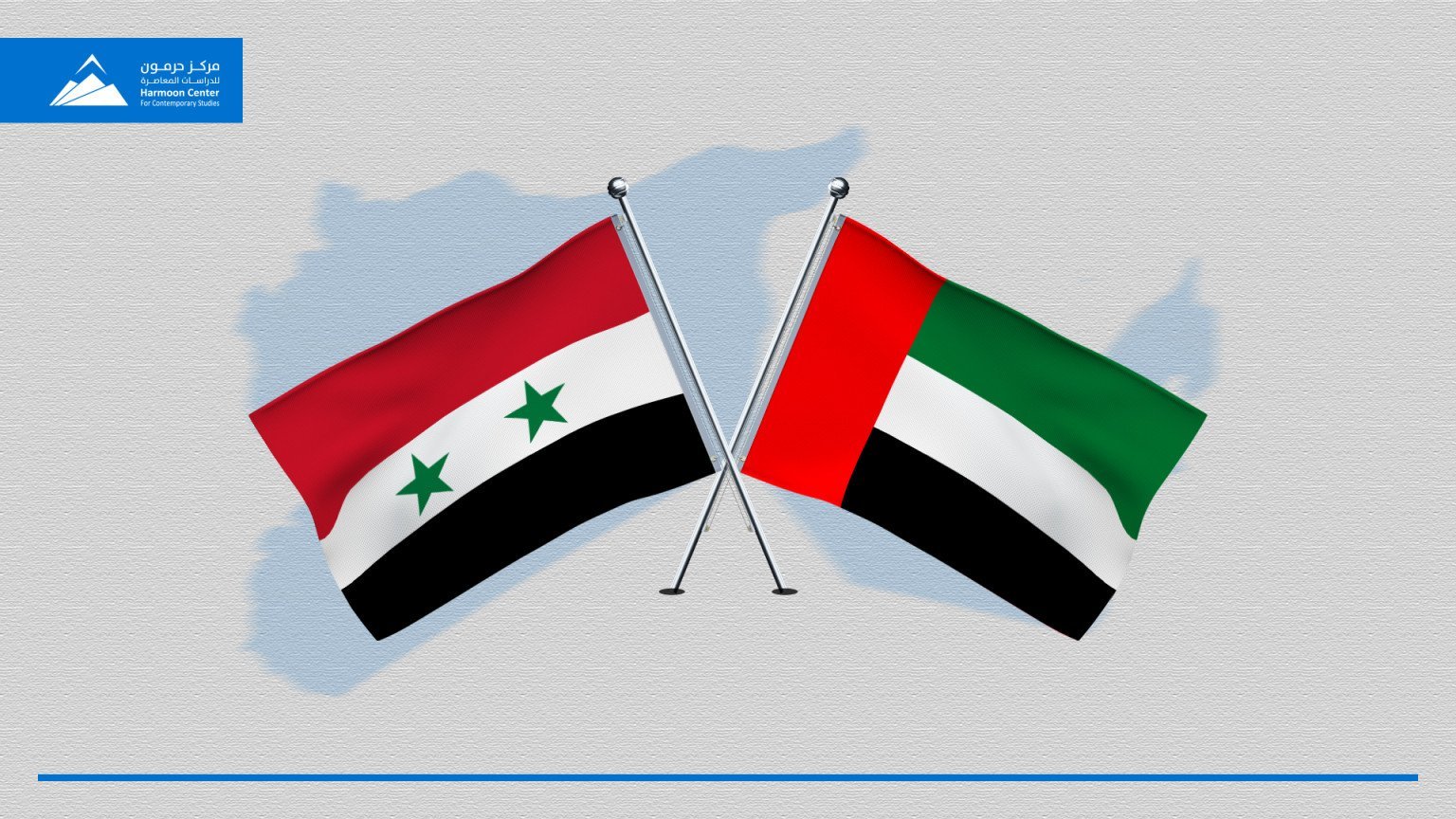
When the mass protests in Syria intensified starting in 2011, and the response to these protests became violent, many states and organizations cut or downgraded ties with the Syrian regime. Examples include but are not limited to the European Union (EU), the Arab League, the United States (US), the United Kingdom, the United Arab Emirates (UAE), Saudi Arabia, Turkey, and Qatar.[1] However, even at the peak of the protests and violence, several Arab states—including Algeria, Iraq, and Oman[2]—did not completely cut ties with the Syrian regime.
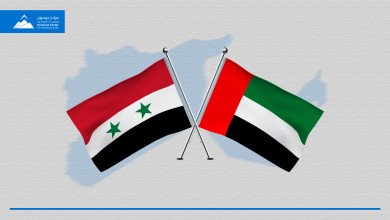
However, starting in 2018, the states and international organizations, such as the Arab League, that sanctioned or downgraded their relations with the regime began the process of normalization. The UAE was one of the Arab states that took the lead; for example, it reopened its embassy in 2018 and appointed an ambassador in 2024.[3] In 2022, the UAE became the first Arab country visited by al-Assad since the beginning of the war, and the only country except for Russia and Iran.[4] Indeed, al-Assad visited the UAE for the second time in March 2023, indicating that the normalization was concrete and that al-Assad’s isolation, at least diplomatically, was nearing an end. Moreover, in addition to normal bilateral relations, the UAE was the leading power in returning Syria to the Arab League. The UAE insisted on Syria’s re-admission to the Arab League after the 2023 earthquake,[5] even when Saudi Arabia and Egypt, the two states that have now established ties with Syria, objected to it.
Maybe more importantly, the UAE, along with Saudi Arabia, is now lobbying for al-Assad in Europe, seeking to lift sanctions.[6] While diplomatic moves such as opening the embassies, visits, and calls are significant, without the lifting of sanctions, these would not have an everyday effect on the Syrian regime, as the regime is looking for financial aid and investment after a decade of destruction across all parts of the country. However, the EU does not appear to be preparing to lift the sanctions at present. The sanctions significantly impact the regime, with the cost of sanctions believed to be around 300 billion USD from 2011 to 2020.[7]
This analysis examines the motivations behind and challenges of the UAE’s normalization with the al-Assad regime. What were the underlying reasons for the rapprochement, how was it concretized, what are the challenges, and finally, what is the current situation?
UAE Foreign Policy: Countering Iran and Identity Formation
One of the explanations for the UAE’s normalization with Syria under Bashar al-Assad is to counter Iranian influence in the country, as Iran has gained a significant position within the al-Assad regime.[8] The Syrian military required help from Iran to win its fight against the opposition, and the Iranian military exists in Syria through the Islamic Revolutionary Guard Corps (IRGC) and its affiliated Shia militants such as Hezbollah.[9]
Iranian influence has not been only military and political. Iranian elites, for example, benefited from the economic crises in Syria. Bakkour and Sahtout stated that some Iranians considered the depreciation of the Syrian currency as an opportunity to invest in real estate in Syria, especially in significant and strategic cities such as Damascus, Aleppo, and Daraa.[10]
Reports suggest that the UAE’s policy has borne fruit, as Syria avoided confrontation against Israel in its aggression since 7 October, an essential element of not wanting to be an Iranian proxy.[11] It was also reported that it was partly the UAE’s advice that al-Assad stay out of the war, as Andrew Tabler claims that “Russia and the United Arab Emirates have urged (Assad) to stay away from the conflict.”[12]
Even though Iranian influence is still significant in Syria, al-Assad tries his best to avoid confrontation with Israel. Moreover, the natural divergence from Iranian influence will likely occur if escalation between Iran and Israel intensifies. It is at this point, then, that the Syrian regime would “distance itself from Iran’s regional adventurism.”[13] While al-Assad has distanced himself from the Gaza War, this has not prevented Israel from attacking Syrian lands. Only between 3 August and 10 October, Israel conducted around 20 attacks on Syria, claiming to target Iranian and Hezbollah forces.[14] Despite al-Assad’s relative silence in Israeli assaults on Gaza and beyond, the continuation of Israeli assaults on Syrian soil—even in cases where they target Iranian and Hezbollah forces—might make al-Assad review his relationship with Iran. Indeed, if Iran and Israel’s fights intensify, not only Syria but also other Iranian allies, such as Russia, are expected to re-evaluate their gains and losses and downgrade their relationship if their alliance with Iran brings them into a fight in which they do not want to take part.[15]
There have been some initiatives that Syria has taken to show that it is going back to the Arab fold. Even though it is symbolic and does not have much practical effect in the real world, Syria signed the Arab League Declaration in Bahrain in May 2024, which affirms that the three disputed Gulf islands (Abu Musa, Lesser Tunb, and Greater Tunb) belong to the UAE and not Iran. While this move alone is not expected to create a turning point for Syria-Iran relations, some Iranian media platforms accused Syria of a stab in the back.[16] Of course, the issue of the three islands is symbolically important, as siding with Iran might mean that Syria is abandoning the pan-Arab ideology. However, one should remember that even the UAE itself has little practical demand from the islands other than issuing regular condemnations and continuing to raise its claims for the islands. Therefore, this case alone should not be interpreted as the regime abandoning the Iranian alliance.
Even though the UAE’s normalization with Syria can be considered a significant step, it is parallel to the UAE’s foreign policy of the last five to six years. The UAE has undertaken more dramatic normalization with other parties, such as its normalization deals with its regional archenemies, Turkey and Qatar. Even more challenging and hard to justify to the public, the UAE signed an agreement with Israel and became the third Arab state to recognize it. Therefore, when it comes to normalization and rapprochements, the UAE has shown a flexible approach if it considers that it will bring them elasticity in foreign policy or gains in economic or security terms.
The UAE can utilize the normalization and rapprochement policies as a part of its national identity and identity construction. One of the UAE’s ideological tools to fight political Islam, especially since 2010, has been the extensive use of discourses such as peace, harmony, tolerance, and rapprochement. Indeed, when the UAE signed the Israeli normalization, its justification occurred with those notions. Syrian normalization also plays a significant role in identity politics.[17]
Postwar Reconstruction
While creating a relative distance between Syria and Iran is one of the targets, at least preventing Syria from becoming a direct Iranian proxy, the UAE’s other motivations include taking part in postwar reconstruction. At present, the UAE has little to gain or offer to the regime because of the US Caesar Act, which became law in 2019 and is valid for five years, and its associated sanctions. The Caesar sanctions prevent foreign investors from joining reconstruction contracts following the civil war.[18] The UAE’s lobbying for the regime in Europe and its efforts to bring Syria back to the Arab League are related to this. The UAE wants to show the US and European governments that the Syrian regime is regionally legitimate, and by doing so, this might convince the US not to renew the Ceaser Act.
The US and EU’s ongoing sanctions on Syria have still prevented the UAE and other Gulf nations from reestablishing economic relations with Syria (even if they have established diplomatic ties), particularly by investing in the stalled reconstruction of Syria that Assad so desperately wants.
In short, the UAE’s normalization with Syria has many motivations; from taking Syria from being in Iran’s direct orbit to the domestic legitimization of its Abraham Accords and from economic expectations to Arab leadership. However, time will tell whether it will be able to convince the US and European governments to lift sanctions. Moreover, if Iran lost its power in its fight against Israel, Iranian forces might leave Syria. If this happened, how would this help the Syrian opposition, and would al-Assad survive without the help of Iran? These are essential questions to keep in mind.
Endnotes
[1] Zachary Laub and Jonathan Masters, ‘Syria’s Crisis and the Global Response’, Council on Foreign Relations, 9 November 2013, https://www.cfr.org/backgrounder/syrias-crisis-and-global-response.
[2] Muriel Asseburg and Sarah Ch. Henkel, ‘Normalisation and Realignment in the Middle East: A New, Conflict-Prone Regional Order Takes Shape’, SWP Comment (Stiftung Wissenschaft und Politik, 2021), https://www.swp-berlin.org/10.18449/2021C45; Hassen Houicha and Hassan Jebril, ‘Syria’s Assad Thanks Algeria for Arab League Readmission’, Anadolu Agency, 8 May 2023, https://www.aa.com.tr/en/middle-east/syria-s-assad-thanks-algeria-for-arab-league-readmission/2892166; Dana Taib ـ Menmy, ‘The Opportunities and Obstacles of Revived Iraq-Syria Relations’, The New Arab (The New Arab, 27 July 2023), https://www.newarab.com/analysis/iraqs-balancing-act-reviving-relations-syria; Aman Madan, ‘Oman Set to Play Big Role in Post-War Syria’, Al Bawaba, 18 December 2017, https://www.albawaba.com/news/oman-original-syria-iran-russia–1063100.
[3] Bassem Mroue and Aya Batrawy, ‘UAE Reopens Embassy in Syrian Capital Closed in 2011’, AP News, 27 December 2018, https://apnews.com/article/b4cf247475a648a1a6ba728a60a05f4d; Aji Albert, ‘The UAE Ambassador to Syria Takes Post in Damascus after Nearly 13 Years of Cut Ties’, AP News, 30 January 2024, https://apnews.com/article/syria-emirates-embassy-uae-reconciliation-assad-b2017cb6248340c187626cfdc5c4a6f6.
[4] ‘Syria’s Assad Visits UAE, First Trip to Arab State since War Began’, Reuters, 19 March 2022, https://www.reuters.com/world/middle-east/syrian-president-assad-met-dubai-ruler-syrian-presidency-2022-03-18/.
[5] Saban Kardas and Bulent Aras, ‘What Drove Syria Back into the Arab Fold?’, Middle East Policy 30, no. 3 (September 2023): 70–80, https://doi.org/10.1111/mepo.12704.
[6] ‘Saudis, UAE Lobby Europe to Restore Ties with Assad’, The New Arab (The New Arab, 16 June 2023), https://www.newarab.com/news/saudis-uae-lobby-europe-restore-ties-assad.
[7] Samer Bakkour and Rama Sahtout, ‘The Dimensions and Attributes of State Failure in Syria’, Journal of Balkan and Near Eastern Studies 25, no. 6 (2 November 2023): 1020–36, https://doi.org/10.1080/19448953.2023.2167337.
[8] Giorgio Cafiero, ‘Why Did the UAE Come to Assad’s Aid and Ease Syria’s Isolation?’, DAWN (blog), 6 March 2024, https://dawnmena.org/why-did-the-uae-come-to-assads-aid-and-ease-syrias-isolation/.
[9] Samer Bakkour, ‘The Last Jihadist Battle in Syria: Externalisation and the Regional and International Responses to Hayat Tahrir al-Sham in Idlib’, Religions 14, no. 9 (24 August 2023): 1098, https://doi.org/10.3390/rel14091098.
[10] Bakkour and Sahtout, ‘The Dimensions and Attributes of State Failure in Syria’.
[11] ‘Iran Ally Syria Strives to Stay out of Gaza War: Experts’, France 24, 26 April 2024, https://www.france24.com/en/live-news/20240426-iran-ally-syria-strives-to-stay-out-of-gaza-war-experts.
[12] ‘Iran Ally Syria Strives to Stay out of Gaza War’.
[13] Faysal Abbas Mohamad, ‘Amid Escalation Between Iran and Israel, Will Assad Look to the Arab States?’, Carnegie Endowment for International Peace, 23 April 2024, https://carnegieendowment.org/sada/2024/04/amid-escalation-between-iran-and-israel-will-assad-look-to-the-arab-states?lang=en.
[14] ‘Israeli Escalation Against Hezbollah and Iran in Syria and Potential Scenarios’, Harmmon Center For Contemporary Studies, 22 October 2024, https://www.harmoon.org/en/researches/hezbollah/.
[15] ‘Israeli Escalation Against Hezbollah and Iran in Syria and Potential Scenarios’.
[16] Newsroom, ‘Syrian Support for UAE’s Claim over Iranian Islands, Stirs Backlash’, Iran International, 18 May 2024, https://iranintl.com/en/202405189854.
[17] ‘The Abraham Accords: Unlocking Sustainable and Inclusive Growth Across the Middle East’, UAE Embassy in Washington, DC, accessed 3 November 2024, https://www.uae-embassy.org/abraham-accords-sustainable-inclusive-growth.
[18] Emily Milliken and Giorgio Cafiero, ‘What the Caesar Act Means for Gulf States’, The New Arab (The New Arab, 24 July 2023), https://www.newarab.com/analysis/what-caesar-act-means-gulf-states.