


Introduction
Since the conflict in Syria began in 2011, there has been renewed scholarly attention to the dynamics of ethno-religious belongings and their politicisation within state-society relations, mainly through the framework of sectarianism, albeit in different guises. While a substantial part of the literature has treated sectarianism in often reductionist and rigid ways, there has been a recent complexification of the issue through the introduction of emplaced qualitative methods, ethnographies, and detailed attention to the nuances of social life and their political contingencies (Zeno 2022; Hadaya 2020; Akdedian 2019a). Nonetheless, the focus on how processes of sectarianisation have shaped either the Syrian revolution or the Syrian regime has obscured more attentive, in-depth analyses of specific communities, particularly those that are more peripheral within Syrian politics.
This paper aims to contribute to the existing literature on ethno-religious communities in the Syrian civil war by focusing on the experiences, politics, and transformations of the Syrian Armenian community. While the presence of Armenians in Syria predates the Arab conquest of the Levant, the Armenian community of Syria can trace most of its presence in the country back to the mass deportation of the survivors of the Ottoman Genocide. Benefiting from semi-structured, in-depth interviews and first-hand accounts in the form of wartime diaries, the paper substantiates three arguments.
First, I suggest that Syrian Armenians and their relationship vi-à-vis the state and nation-building in Syria can be understood within the framework of diasporic communitarianism, which is profoundly shaped by the sense of loss, collective trauma and the need to reconstruct and preserve the community after the genocide. However, this should not be interpreted as opposed to the community’s participation in Syria’s larger social, economic, cultural, and political life throughout the decades. Instead, I argue that the community has always sought to display its agency under any political circumstance.
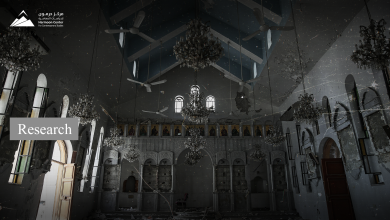
Second, the paper argues that the civil war has activated sedimented communitarian fears, reinforced ethno-religious belonging, and created new relations of enmity. The participation of external actors in hostilities and the material destruction of important communal lieux de mémoire, such as Aleppo or Kessab, were crucial triggers for the Syrian Armenian community. However, as Akdedian (2019a) reminds us, processes of otherisation and the hardening of socio-cultural boundaries in everyday life overlap with more ‘pluralistic narratives that expose the limits of dehumanization and sectarianization’. Moreover, the community has displayed different political subjectivities across time and space. While an important social segment and leadership has supported al-Assad, this has not been a complete collective endorsement.
Finally, the paper shows how the civil war has impacted the Syrian Armenian community. When explored from the present, the Syrian Armenian community must be understood in its resilience and re-diasporisation. In Syria, a shrunk community seeks to reconstruct its local spaces and sites and find new ways of expressing its agency under different political authorities. In the diaspora, hundreds of thousands of Syrian Armenians have found refuge in Armenia and elsewhere, prompting a reconfiguration of the community that seeks to reconstruct Syria in transnational ways.
You can read the entire study by clicking on the “Download” tab.