



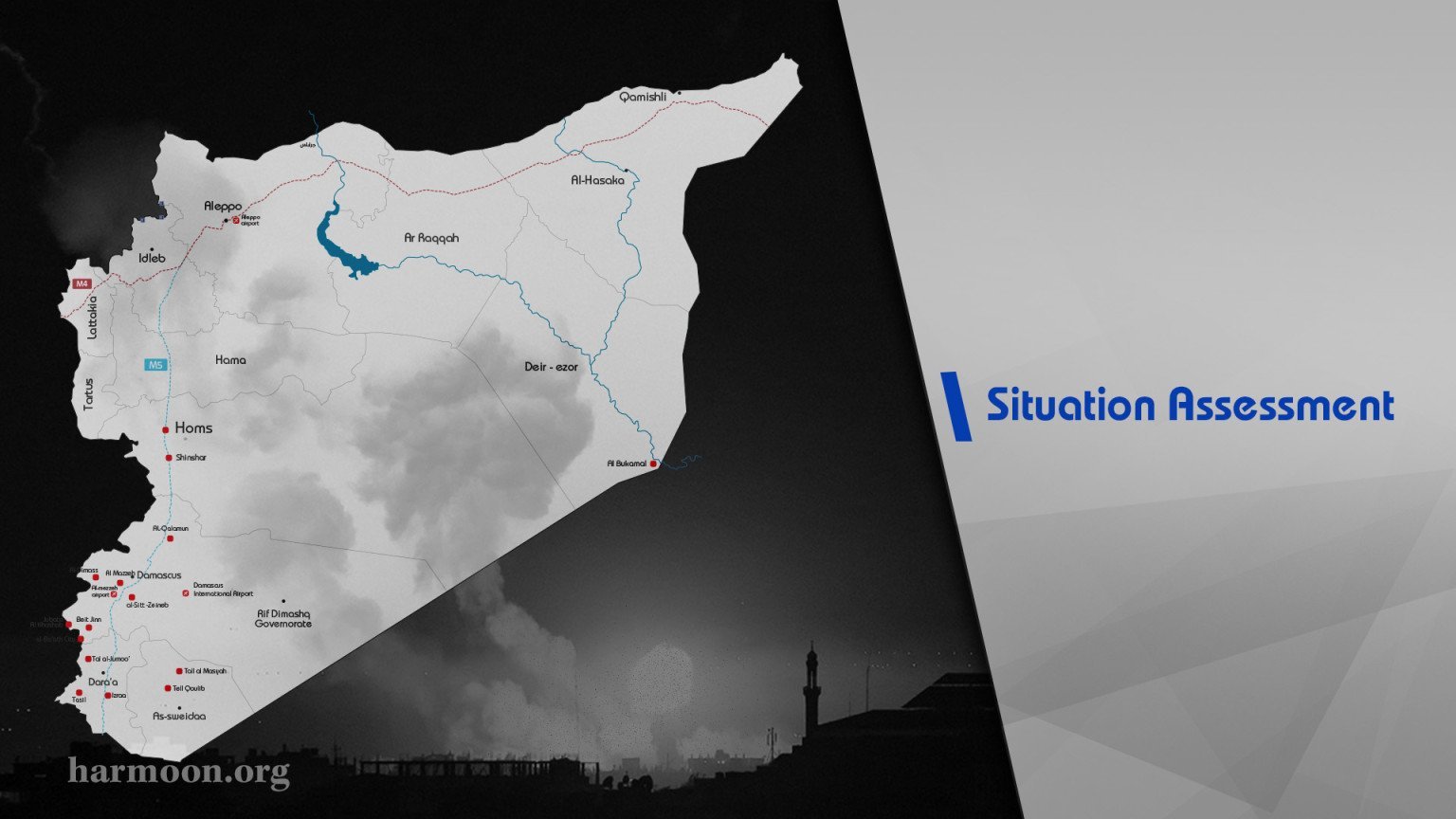
The recent surge in military operations in Syria involving the United States and Iran coincided with an escalation by Israel. Israel intensified its actions by targeting several sites controlled by Iranian militias in Syria. The frequency and intensity of these bombings escalated over time, culminating in the deliberate targeting of senior leaders within the echelons of Iranian militias in key urban centers of Syria.
This escalation prompts a series of questions: What are the strategic objectives behind Israel’s escalation? To what extent do the intersecting interests of various actors in Syria limit Iranian influence? What outcomes can be anticipated from this escalation? What scenarios are likely to unfold as a result?
Israel aims to undermine the neighboring Arab countries bordering Palestine, with a particular focus on preventing them from surpassing Israel in the realm of armaments. Additionally, Israel is actively working to sideline certain countries from the Arab-Israeli conflict by pursuing normalization of relations with select Arab countries.
Following the outbreak of the Syrian revolution in 2011, Israel refrained from direct intervention in the Syrian crisis. Instead, it adopted an indirect approach, aiming to uphold Bashar al-Assad’s regime. The rationale behind this strategy was rooted in the belief that Assad’s survival would perpetuate conflict, foster fragmentation, and exacerbate sectarian tensions within Syria. Israel expressed contentment with the Assad regime’s continued rule, given that it had maintained a ceasefire since 1974. There was apprehension regarding the potential influx of jihadist or moderate militias hostile to Israel into areas bordering its territory. The United States’ stance on the Syrian situation remained ambiguous. While it opposed the triumph of Assad and his allies, the U.S. did not actively support the opposition into victory, emphasizing its focus instead on managing the conflict and prolonging its duration.
However, Israel became concerned about a potential imbalance in military power in the region, particularly following the intervention of Lebanese Hezbollah and Iran in support of the Syrian regime against the opposition. In response, Israel initiated air strikes on January 30, 2013, targeting a military site with surface-to-air missiles near Damascus.[1] Since then, Israel has continued these strikes at an irregular frequency, conducting hundreds of air strikes specifically targeting Iranian militias in Syria.
Developments in the Israeli Raids after October 7, 2023:
Following Operation Al-Aqsa Flood on October 7, 2023, there was a notable escalation in the quantity and quality of Israeli strikes on various Syrian sites. This response was prompted by the threats posed by Hezbollah and Iranian militias, as well as the imperative to maintain Israeli superiority. This urgency became more pronounced given the recent expansion of Iran and its allies in southern Syria, posing a direct threat to the presence of American bases in northeastern Syria.
In the first nine months of 2023, Israel conducted approximately 48 strikes in Syria.[2] Following the events of October 7, the frequency of these strikes surged, totaling around 50 strikes by February 10, 2024,[3] representing a substantial increase in just four months.
Moreover, there is a noticeable shift in the rules of engagement between Iran and its affiliated militias in Syria on one hand and Israel on the other. Initially, Israeli airstrikes focused on intercepting shipments of weapons or missiles destined for pro-Iranian militias.[4] However, following the events of October 7, Israel increased the frequency of its targeting. This expanded scope included hitting strategic locations such as the Damascus and Aleppo international airports, both of which experienced disruptions in service multiple times within a month.[5] Additionally, military forces near the Syrian-Palestinian border, specifically in the western countryside of Daraa, were targeted.[6] By December 2023, the death toll of Iranian soldiers or their loyalists had reached 50,[7] with the strikes predominantly aimed at sites where Iranians or their allies were deployed, including military installations affiliated with the Syrian regime.
A significant shift occurred in Israeli raids, characterized by the targeting of various sites in residential areas within cities. One notable instance was the raid on a meeting of Iranian Revolutionary Guard leaders in the Mezzeh neighborhood of Damascus on January 20, 2024, resulting in the death of 5 Iranian advisors.[8] Another bombing targeted a building in the Hamra neighborhood in Homs, an upscale civilian area, on February 6, 2024. Leaders from Iran and Hezbollah, residing in one of the civilian structures, were killed in this particular strike.
Similarly, on December 25, 2023, an Israeli airstrike on the Sayyida Zeinab neighborhood, south of Damascus, specifically targeted Razi Mousavi, a leader of the Iranian Revolutionary Guard. Mousavi served as military advisor to the regime in its battles against the opposition. This incident highlights a shift in Israeli bombing strategy, emphasizing the precision targeting of high-value individuals. It also suggests a breakdown in Iranian efforts to keep the details of their meetings, movements, and locations confidential, revealing the extent of Israeli penetration into the regime’s security services.
In response to Israeli and American strikes, Iran announced that it would withdraw its leaders, and effectively began relying on allied factions to sustain its influence in Syria.[9] Operations targeting the Golan ceased in January 2024. Even though these attacks had been limited, focusing on open and uninhabited areas in the occupied Syrian Golan Heights,[10] they were brought to a halt at that time.


The Stance of Various Actors in Syria Regarding the Escalation
One of the key factors prolonging the Syrian crisis is the convergence and clash of interests among the states involved. A notable issue within this complex web of interests is the Iranian presence in Syria. Some actively involved states openly oppose it, with both Israel and the United States seeking to curtail it in the region, particularly in Syria—a strategically advantageous arena for containment. Meanwhile, the countries party to the Astana Agreements, such as Russia and Turkey, engage with the Iranian presence. There appears to be a shared interest among a majority of actors in Syria in limiting Iranian influence, aligning with the broader Arab stance advocating for such limitations.
Regarding the key positions in this escalation, concerning the Syrian regime, there are indications suggesting potential cooperation between some Syrian regime officers and the Israelis. This collaboration is evident in leaking the locations and whereabouts of leaders of the Iranian Revolutionary Guard, with public accusations from Iran pointing to information leaks within the Syrian regime to the Israeli side. This suggests disapproval among certain regime officers regarding the expanding Iranian influence in Syria, particularly as Iran asserts control in various sectors of the country. Conversely, despite its escalation, Israel is notably avoiding direct and substantial targeting of the Syrian regime forces. Exceptions include the targeting of specific military facilities in Sfeera, Misyaf, and airports. It appears that the regime will continue to issue threats in response to Israeli provocations, without actually delivering any tangible response.
Regarding Russia, the regime’s other ally, there was coordination between it and Israel during Israeli attacks. Israel would inform Russia of the dates and locations of the attacks beforehand, and in turn, the Russians would relay this information to the regime and the Iranians. This coordination helped minimize casualties resulting from these raids. However, it appears that this collaboration has diminished following the Ukrainian war, possibly due to Israel’s stance on the events in Ukraine. Despite this shift, it is not anticipated that there will be a conflict of interests between Russia and Israel in Syria. In early 2024, Russia announced the establishment of two military points in southern Syria in response to an increase in provocations along the demilitarized zone near the Golan Heights. This move seems aimed at de-escalating tensions in the region. Russia’s position emphasizes the need for calm, restraint, and the avoidance of any escalation. Russia aims to maintain positive relations with both Assad and Iran, on one hand, and Israel on the other. It is not in Russia’s interest to bolster Iran’s influence in Syria or to escalate Israeli airstrikes, as this could disrupt the delicate power balance within Syria.
Regarding the American stance, there is extensive coordination between the United States and Israel in their military actions and escalation in Syria. This collaboration intensified notably after three American soldiers fell victim to a bombing orchestrated by Iranian militias near Al-Tanf. Subsequently, an agreement was reached to conduct targeted strikes against those militias. Notably, the objective is to address the threat without getting entangled in a full-scale and direct war.
Concerning Iran, it has been actively expanding its influence across the entirety of the regime-controlled Syrian territory. Iran has various strategic objectives in the region, one of which is securing the road that extends from Iran to the Mediterranean. Despite these ambitions, Iran avoids direct confrontation with Israel and the United States. It is willing to sustain certain losses as long as they occur outside Iranian borders. Iran maintains a strategic focus in the region, and as long as the attacks remain beyond its territorial boundaries, they do not pose a significant challenge. Nevertheless, Iran aims to curtail the movements of its militias and enhance caution in response to the ongoing situation.
The airstrikes present a significant challenge to Iran and its militias. However, Iran acknowledges that its presence will persist and grow as long as Assad remains in power. Despite some countries offering incentives to encourage Assad to distance himself from Iran, it is not anticipated that these incentives will influence his policy in the foreseeable future.
Anticipated Scenarios
The future of Syria is, to some extent, interconnected with the outcomes of recent regional developments, particularly following the prospective conclusion of the Gaza conflict and its repercussions. Additionally, it hinges on the trajectory of the American presence in the region, with Israel expressing apprehension about a potential withdrawal of U.S. forces from Syria and Iraq. Amidst the ongoing stagnation in various paths toward a resolution in Syria, three scenarios regarding Israeli escalation in the region can be anticipated.
First Scenario:
The prospect of a U.S. withdrawal has been a topic of discussion, with numerous leaks suggesting such a move. However, the official American stance has denied this possibility, and it is not anticipated to occur in the near future. If a withdrawal were to happen, it could result in an amplification of Iranian influence in Syria, potentially raising concerns for Israel. This scenario might prompt an increased role for Russia in mediating between the parties involved, with the aim of de-escalation. Additionally, it could present an opportunity for Assad to assert control over oil fields in the region.
Second Scenario:
Iran’s withdrawal from Syria, whether complete or partial, could occur in response to Israeli and American airstrikes targeting Iranian assets. This shift might also be prompted by the Syrian regime’s response to Arab appeals urging a reduction of Iranian influence. If this scenario materializes, it would likely result in an increased sway of Russian influence over the Syrian regime, a diminished role for Iranian-backed militias, and the potential for negotiations advancing the path to a political solution in Syria. However, the likelihood of this scenario is also questionable. A careful analysis of Iranian regional policy suggests a deep-rooted influence in Syria across social, political, and military spheres. It indicates Iran’s intention to maintain a delicate balance in the rules of engagement, both with the United States and Israel.
Third Scenario:
This scenario appears to be the most probable, hinging on the ongoing escalation within the existing rules of engagement between the two parties. The situation is expected to avoid escalating into a state of direct and comprehensive war, unless there is a breach of the established rules of engagement by Iran and its allies. A significant development such as a bombing resulting in casualties in Israel would then compel Israel to elevate the level of escalation in response.
The outcome of the Gaza war and the potential scenarios and agreements to conclude it, along with the resulting regional arrangements, are eagerly awaited by all. The Netanyahu government appears to prefer a state of instability in the region. Concurrently, Iran aims to capitalize on the runup to the American elections, leveraging America’s reluctance to engage in direct warfare, particularly following the incident in which Iranian militias killed American soldiers in Al-Tanf and received a comparatively weak response from the United States.
Israel might achieve some success in mitigating the Iranian threat, but it does not harbor the intention of entirely eradicating Iranian influence in Syria. The reason for this lies in the shared interest of both Israeli and Iranian parties in the survival of the Assad regime. The continuity of the Assad regime serves as a common factor that aligns with their respective goals in Syria.
[1] “The Most Prominent Israeli Strikes in Syria since 2013,” Independent Arabia, February 6, 2020. Accessed July 7, 2023. https://bit.ly/49x3Tn6
[2] Syrian Observatory for Human Rights. Accessed February 12, 2024. https://2u.pw/Hemcx4g
[3] Monitoring Team, Harmoon Center for Contemporary Studies.
[4] “Damascus: Two Killed in Israeli Raids Targeting Hezbollah Sites.” Almodon, August 22, 2023. Accessed February 12, 2024. https://2u.pw/yrKr0yI
[5] “Israel Again Bombs Damascus and Aleppo Airports and Puts Them out of Service.” Al-Jazeera, October 22, 2023. Accessed February 12, 2024. https://2u.pw/7vJgIVt
[6] “Fighters Loyal to Hezbollah in the Daraa Countryside Launch Rockets towards the Golan.” Al Arabiya, October 24, 2023. Accessed February 12, 2024. https://2u.pw/zeBPaLd
[7] Syrian Observatory for Human Rights. Accessed February 12, 2024. https://2u.pw/Hemcx4g
[8] “5 Iranian Revolutionary Guard Advisors Killed in an Israeli Bombing of Damascus.” Al-Arabi Al-Jadeed, January 20, 2024. Accessed February 14, 2024. https://bit.ly/3uxWOnH
[9] “Reuters: Iran to Reduce the Number of Its Officers Deployed in Syria… No Intention to Withdraw.” Enab Baladi, February 1, 2024. Accessed February 12, 2024. https://2u.pw/GfPzMFW
[10] “Occupation Responds to the Sources of Fire… Two Shells Fired from Syria towards the Golan.” Al-Arabi TV, November 11, 2023. Accessed February 12, 2024. https://2u.pw/tg5RYUa