


Introduction
Since the fall of the Assad regime in December 2024 Israeli military operations in Syria have escalated significantly, reaching fresh intensity in early 2025. These operations have primarily targeted strategic military sites where groups linked to Iran and Hezbollah were present and active. This escalation took place in the security vacuum left by the fall of Bashar al-Assad’s regime, which Israel exploited to advance its objectives and reshape the balance of power in southern Syria.
Israel’s strategy has set out to achieve key security and military objectives; most notably strengthening its national security, preventing the re-emergence of groups linked to Iran or Hezbollah, and expanding its sphere of influence deeper into Syrian territory. To accomplish this, Israel has adopted a multifaceted military approach, making use of precision airstrikes, targeted raids, and building new infrastructure in the buffer zone to anchor its security operations.
This assessment examines the details of Israeli operations – both airstrikes and ground incursions – since the beginning of 2025. It analyses the extent of Israel’s ground expansion, and the strategic objectives behind these moves. The assessment also considers the potential repercussions at regional and international levels, including shifts in military balances in southern Syria and possible reactions from key actors in the Syrian conflict.
Aerial Campaign: Intensified Strikes on Strategic Targets
Israel intensified its military operations in early 2025, targeting strategic military sites and key figures associated with various armed groups. According to government sources and official Israeli media, these measures are part of Israel’s ongoing efforts to counter threats from Iran-backed militias and Hezbollah inside Syrian territory.[1]
Table 1: Israeli Raids in Syria: Targeted Locations and Details (January – 10 February 2025)

Israeli airstrikes have varied in intensity across targeted governorates, with Aleppo experiencing the highest concentration throughout Syria. Of the 11 recorded strikes, seven occurred in Aleppo, focussed on the defence factories area of As-Safira. These attacks targeted five warehouses, destroyed an entire building, and hit a radar site in the same vicinity.
Map 1: Israeli Strikes on Defense Factories in the City of As-Safira – January 2, 2025
In the Damascus suburbs, two strikes were recorded: one targeted a military base near Sa’saa, previously utilized by Iran during Assad’s rule; the other hit a warehouse in the Deir Ali area near al-Kiswah, which Israeli reports claimed contained weapons for Hamas.
In as-Suwayda, a single strike targeted a warehouse inside Khalkhala Air Base. Similarly, one strike was documented in the southern countryside of Quneitra.[2] Ground Expansion: Israeli Military Presence Beyond the Buffer Zone
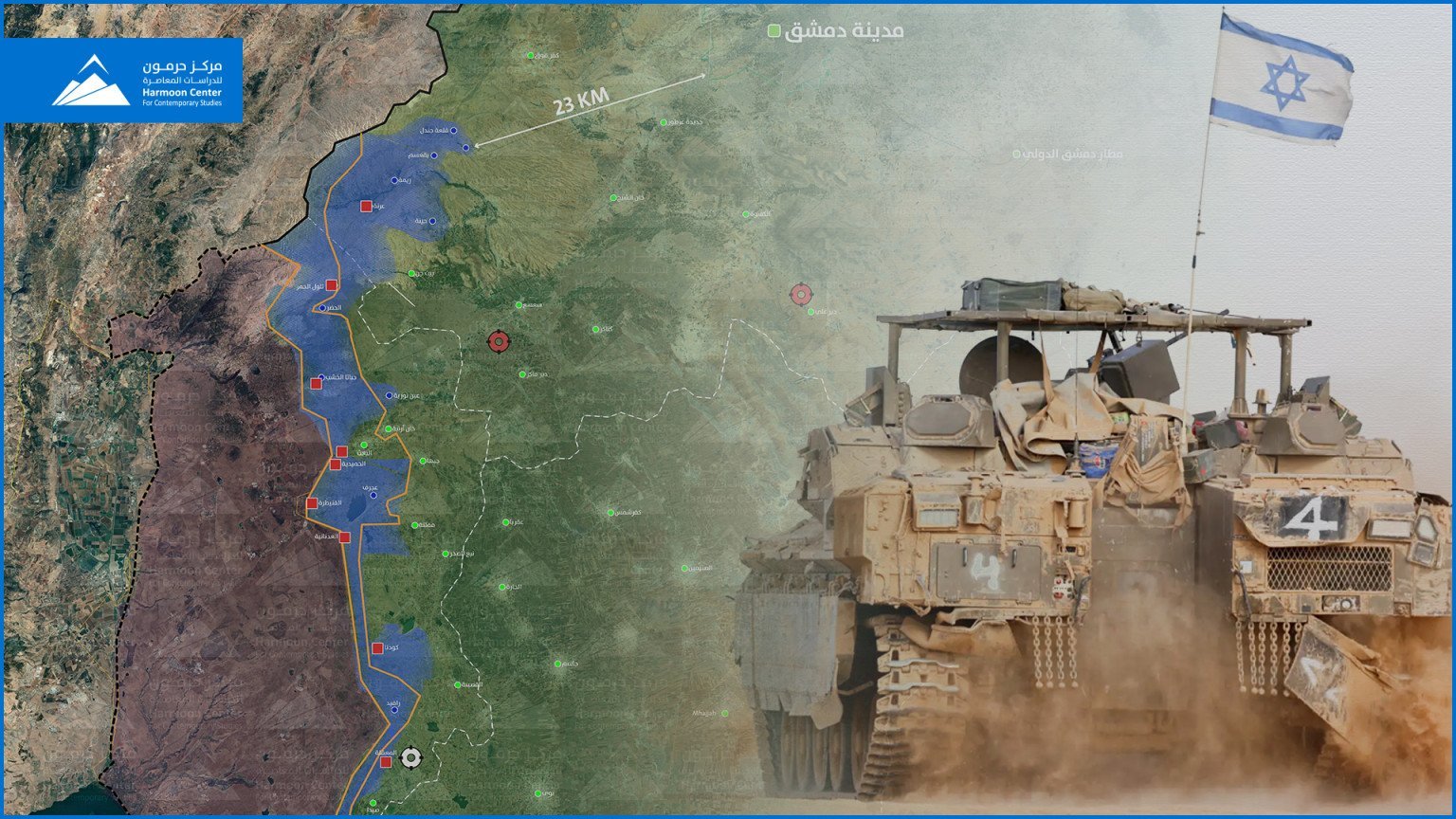
Israel took advantage of the security vacuum left by the fall of the Assad regime in southern Syria to strengthen its military presence, crossing the “Alpha Line” established in the 1974 disengagement agreement. During the first week of Israeli operations in the area, armed forces imposed control over a further 303 square kilometres inside Syria. As operations continued through January 2025, Israeli units withdrew from the Yarmouk Basin but expanded their deployment along the northern fronts, increasing the area under their control to 366 square kilometres by the end of January.
Subsequently, Israel reinforced its presence in the demilitarized zone (DMZ), establishing control either through direct troop deployment or by exerting curfews, which restrict civilian movement and prevent Syrian government security forces from operating inside the zone. As a result, the total area under direct Israeli control or influence then expanded to more than 460 square kilometers.
In parallel with its ground advances aimed at locating weapons left behind by formations previously aligned with Iran and Hezbollah, Israeli forces established new military posts within the buffer zone, an area originally designated as demilitarized. This move was justified as a necessary measure to protect Israeli national security and prevent the security vacuum left by the collapse of the Syrian regime from being exploited by Iran and Hezbollah-affiliated cells, which had been active in the region under Assad’s rule.
In southern Syria, Israeli forces advanced into the buffer zone in Quneitra, targeting strategic locations in order to dismantle Syrian military capabilities and secure a buffer along the border. One of the most notable targets was the Arnah summit in Mount Hermon, where Israeli forces established observation points and military barracks just days after their incursion[3].
In at-Talul al-Hamar, east of the town of Hader, Israeli forces capitalized on the withdrawal of Russian forces to strengthen their presence and established a military base, providing them with strategic oversight of the area. On the slopes of Mount Hermon in Disk al-Nafl, northwest of Hader, they opened and paved new roads, installed power lines for lighting, and reinforced their control over the border strip and the northern countryside of Quneitra.
In Jubata al-Khashab, near the Ziraa Tower within the nature reserve, Israeli forces established an integrated military post equipped with a helipad and prefabricated housing units for personnel, while also securing a road linking it to the border. Military units were also stationed north of Hamidiya after fully equipping and illuminating the site, transforming it into an alternative outpost to the evacuated government buildings. Israeli forces selected a high hill in Adnaniyah, near the Mantara Dam, for a new military position – which is currently under construction. Meanwhile in Quneitra city, near the Quneitra Tower, another strategic outpost is being prepared to enhance field control.
In the southern sector of Quneitra governorate, the Tal Ahmar al-Gharbi military site near the town of Kudna was reactivated after completing its infrastructure development. This location holds significant tactical value, offering extensive field oversight that extends into the southern countryside of Quneitra and large parts of the western countryside of Daraa. The site enhances intelligence capabilities and improves surveillance and operational control efficiency across the region.
Map 2: Control Areas in Southern Syria – February 13, 2025

Israeli Targets and Potential Repercussions
Strengthening Israeli National Security: Strategic Gains and Risks
Israel aims to establish a buffer zone in southern Syria to mitigate potential security threats – particularly from Iran, Hezbollah, and irregular armed groups. Although Iran’s direct military presence in the region has diminished, Israel remains concerned about the persistence of logistical support networks and intelligence infrastructure affiliated with these forces, considering them a long-term security threat.
However, these actions may well serve to heighten security tensions in southern Syria. The new Syrian government could easily perceive Israel’s military expansion as a violation of national sovereignty, prompting it to bolster its military presence or implement field measures to closely monitor Israeli movements. This situation could also lead to increased diplomatic pressure from the UN on Israel to reconsider its military activities.
Blocking Iran and Hezbollah: Preventing Resurgence and Impact on the Region
Israel fears that Iran-backed militias may exploit the security vacuum in southern Syria to reestablish their presence. Israeli military counter-initiatives, including the establishment of permanent bases, serve to prevent the redeployment of Iran-affiliated and Hezbollah-linked forces.
In response, Iran and Hezbollah may adapt their military tactics by increasing their reliance on clandestine networks and sleeper cells while intensifying intelligence operations in the region. This shift in strategy could escalate an undeclared intelligence conflict, leading to heightened tensions and potential covert confrontations between the involved parties.
Redefining Engagement Rules: The Effect of Israeli Military Deterrence
By strengthening its military presence in southern Syria, Israel is likely seeking to reshape the rules of engagement, granting itself greater operational flexibility by conducting preemptive strikes against military targets without resorting to large-scale ground operations. This approach aligns with Israel’s broader deterrence strategy, aimed at reducing long-term security risks to the state.
However, altering the rules of engagement could increase the risk of confrontation. The new Syrian forces are expected to enhance their defence capabilities, potentially deploying more advanced air defense systems and improving the readiness of military units in border areas. Additionally, Israel may face diplomatic pressure from the United States, as Washington seeks to prevent any escalation that could destabilize the region. Should Israeli military expansion in southern Syria continue, international calls for diplomatic intervention to regulate these activities are expected to intensify, pushing for diplomatic frameworks to prevent unnecessary escalation.
Controlling Key Corridors: Strategic Routes and Long-Term Consequences
Beyond its security objectives, Israel may also be working to establish long-term control over key strategic corridors leading to the Golan Heights and Damascus by building a permanent military infrastructure. This would provide Israel with a strategic advantage, enabling it to monitor Syrian military movements while limiting the ability of other actors to reorganise their forces in the region. The most critical of these corridors include:
- Damascus-Quneitra Road: A key route connecting the Syrian capital to the Golan Heights, serving as a vital military artery for troop movements and reinforcements.
- Khan Arnaba-Jubata al-Khashab – Golan Road: A crucial corridor for the movement of forces within Quneitra, functioning as a primary access route to the border areas.
- Mountain Passes in the Foothills of Mount Hermon: The rugged terrain provides natural routes for moving reinforcements and maneuvering troops in the region.
Israel’s control over these corridors could complicate future efforts to restore full Syrian sovereignty over the south of the country. The Israeli presence in these areas is likely to become a central point of contention in any future political negotiations regarding Syria’s territorial integrity. Moreover, the continued expansion of Israeli military infrastructure could obstruct the prospects of a comprehensive political settlement, as Israel’s withdrawal from these areas would likely require international and regional agreements to be resolved within broader security arrangements.
The Syrian Government Response – Diplomatic and Military Challenges:
Despite diplomatic efforts, including official complaints to the UN Security Council, the new Syrian government’s ability to mobilize effective international support remains limited. The lack of full international recognition weakens its capacity to exert pressure on Israel for a withdrawal from Syrian territory[4].
Israel, for its part, justifies its military presence in southern Syria as a necessary measure to safeguard its national security and prevent potential threats from Syrian territory. Israeli Defense Minister Yisrael Katz has affirmed that Israeli forces will remain in strategic locations, such as Mount Hermon, indefinitely signaling Israel’s clear intent to solidify its military foothold in the region[5]. Meanwhile, repeated Israeli military expansion has sparked growing concerns among the local population in southern Syria. Reports indicate increasing protests and demonstrations against the Israeli presence, as well as direct confrontations between Israeli forces and Syrian civilians. These rising tensions further complicate the security and humanitarian landscape, posing further challenges for the new Syrian government as it strives to restore full sovereignty over its territory and ensure the safety of its citizens[6].
Future Scenarios: Potential Outcomes of Israeli Operations
As Israeli military operations inside Syria persist following the fall of the Assad regime, several future scenarios for the region can be envisioned. These scenarios will depend on the interactions between regional and international powers, as well as the responses of key stakeholders.
1) Continued Military Escalation: Israel Expands Its Operations
Israel may broaden its military footprint in Syria, exploiting the security vacuum and internal instability. This scenario could:
- Increase tensions with the new Syrian army, which is attempting to reassert control over the south.
- Heighten regional pressure, particularly from Jordan, which remains deeply concerned about developments on its northern border.
- Spark wider regional frictions, especially as Israeli influence expands in southern Syria.
2) International Mediation and Regional Interventions (Most Likely Scenario)
The United States and the United Nations may step in to prevent further escalation, seeking diplomatic solutions such as:
- Pressuring Israel to curb its military expansion.
- Introducing new security arrangements, possibly involving international forces for border monitoring.
- Reinforcing peacekeeping mechanisms to stabilize the situation and prevent renewed conflict.
3) Political Settlement and Redrawing of Influence Zones
Under mounting regional and international pressure, the new Syrian government may negotiate a political settlement with Israel. This could include:
● Redefining zones of influence and military deployment in southern Syria.
● Establishing phased mechanisms for Israeli withdrawal from Syrian territory.
● Balancing Israeli security concerns with regional stability, ensuring a workable security arrangement.
Conclusion
Israel’s military operations in Syria in early 2025 signal a major strategic shift, leveraging the security and political vacuum left by the fall of the Syrian regime. Through intensive airstrikes and ground expansion in the buffer zone, Israel has sought to consolidate its control. While these actions are framed as necessary for national security and aimed at preventing the repositioning of Iran-backed militias, their implications extend beyond immediate tactical gains. The operations risk triggering broader military escalation, increasing tensions with regional powers, and reshaping the strategic balance in southern Syria.
Looking ahead, the future military landscape in Syria remains uncertain, largely depending on the actions of key stakeholders. Possible outcomes include:
- Continued Israeli expansion and military entrenchment.
- Potential Syrian countermeasures to regain control over border areas.
- Regional and international interventions aimed at de-escalation.
The evolving reality will ultimately be shaped by whether Israel succeeds in establishing a new security paradigm in southern Syria or faces countermeasures that redefine the regional balance of power.
[1] Why did Israel attack Syria at this time?, Al Jazeera, published December 11, 2024, accessed February 9, 2025, https://shorturl.at/E34i2
[2] Information regarding the Israeli strikes is from the private monitoring archive at the Harmoon Center
[3] Interviews conducted by the researcher with a private source in Quneitra on 12/13 February 2025
[4] What are the consequences of Israel’s declaration of permanent presence in Syria?, Alhurra, published February 12, 2025, accessed February 16, 2025, https://shorturl.at/Ph11B
[5] Israeli Defense Minister: Our forces will remain on Mount Hermon in Syria indefinitely, CNBC Arabia, published on January 29, 2025, accessed February 15, 2025, https://shorturl.at/ke7Da
[6] Israel Moves Across Southern Syria: Strengthening Occupation Meets with Local Resistance, The New Arab, Posted on January 3, 2025, accessed February 16, 2025, https://shorturl.at/Lseqz