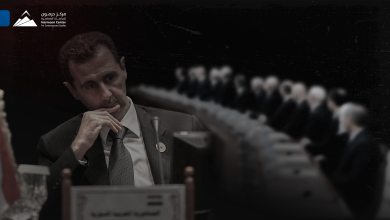



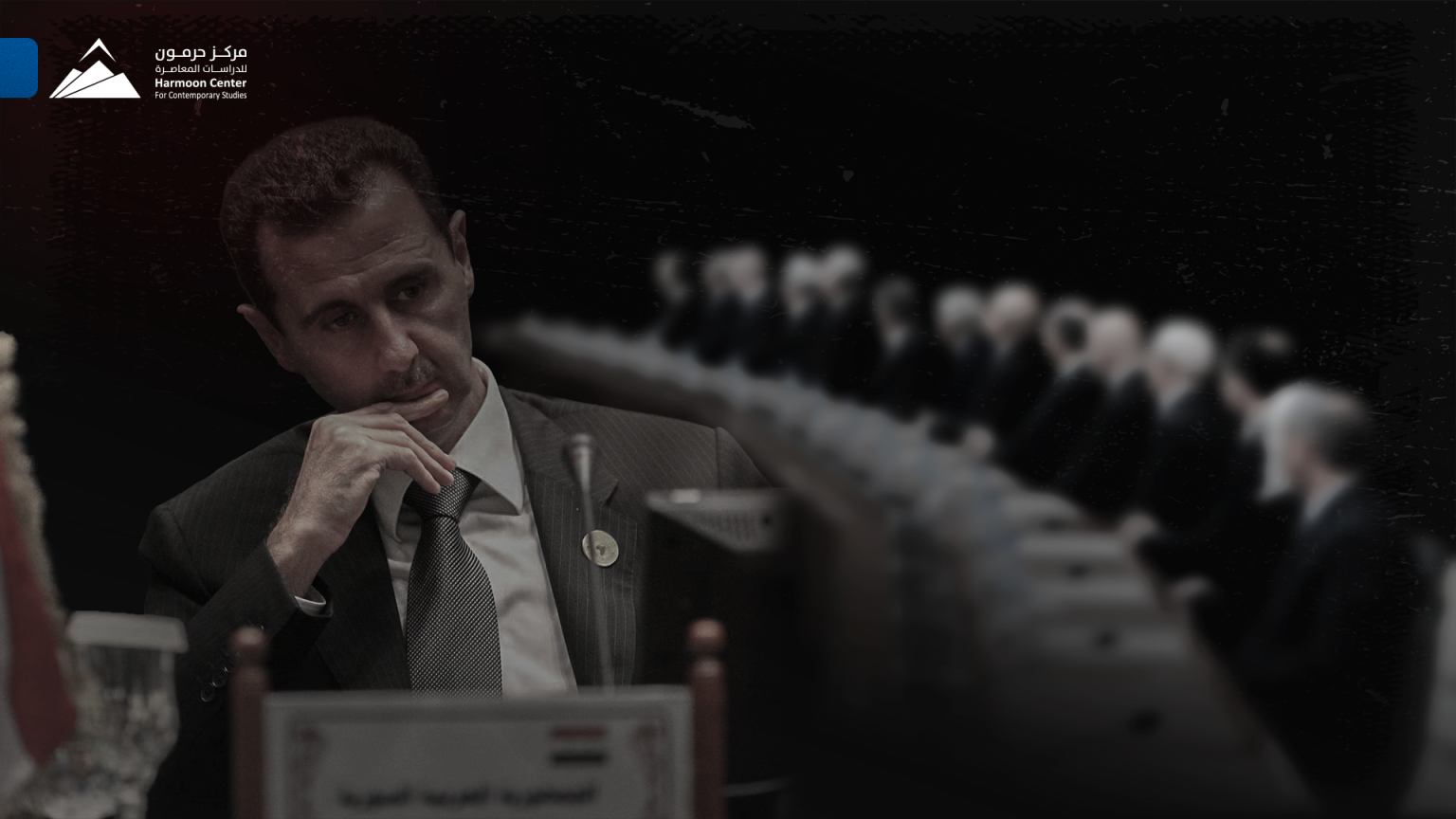
Bashar al-Assad now stands on quicksand, moving cautiously, glancing to the right and left, afraid of being swept away by the strong storms blowing across the Middle East. He is attempting to reassess his position but finding no clear solution.
Recently, Bashar al-Assad formed a new government in the same familiar style, with Ghazi al-Jalali as its head. The ministerial team remained largely unchanged, except for the foreign affairs and defense ministers. The former foreign minister, Faisal al-Miqdad, was replaced and appointed vice president, while Bassam Sabbagh assumed the role of foreign minister. A few weeks earlier, Assad oversaw elections for the Syrian People’s Assembly, which followed the same pattern, resulting in nearly the same makeup of members. Hammoud Sabbagh retained his position as Head of the Assembly, and Assad issued a general amnesty, similar to previous ones, covering criminal offenses but excluding opposition politicians, whom he continues to accuse of terrorism.
In his inaugural speech to the new cabinet on September 24, 2024, Assad appeared more like a professor lecturing his students. He spoke about the economy, investment, management, and administrative work, emphasizing the need not to have high expectations. He urged the government and ministers to avoid making promises, leaving many who had hoped for change disappointed. As usual, Assad did not address the deepening crisis in Syria, the worsening economy, or the harsh living conditions driving the emigration of young talent. He made no mention of the destruction in cities, the isolated state of the country, or the vast areas outside his control, particularly in northern Syria, where lawlessness prevails. Nor did he discuss the violence in the south, where Iranian militias, regime security forces, and local “peacemaking” factions are engaged in ongoing assassinations, or the deteriorating situation in Suweida and the Syrian desert, where remnants of ISIS continue to target his soldiers. He also ignored the plight of over 6 million Syrian refugees in neighboring countries like Turkey, Lebanon, Jordan, Egypt, and Iraq, and the challenges of their potential return. Assad’s speech lacked even a basic sense of presidential responsibility in a system where the president holds all power. It is clear he is aware of these issues but has no solutions to offer, choosing instead to focus on trivial matters that will not bring any real change. His speech created the illusion that Syria is not in crisis.
All of this shows that there has been no shift in the nature or behavior of the regime, nor in how it manages domestic politics. The 2011 earthquake and its aftermath have done nothing to alter the regime’s mindset or modus operandi. Its top priority remains clinging to power, no matter the cost.
After 13 years of war and widespread destruction in Syria, Assad faces immense challenges as an internationally recognized president. He lacks both financial resources and political support, while the threat of economic collapse looms large. Even among his supporters, hunger is spreading, and he fears that the protests in Suweida may spark unrest in other provinces due to worsening living conditions and the regime’s inability to provide solutions. In response, Assad has turned to manufacturing and exporting Captagon to generate revenue, rendering him the most hated pariah in the world.
True to his custom, inherited from his father, Assad avoided discussing foreign policy, regional tensions, or the issues of normalization with Arab countries and Turkey. He also ignored the Israeli war on Gaza, only making a brief, hurried reference to the conflict in southern Lebanon at the end of his speech. Since the days of Assad Senior, the cabinet has not engaged in discussions on foreign policy, military and security matters, or specific decisions related to general policies, whether domestic or international. These topics are handled exclusively by a small, inner circle around the president.
Israel continues to bomb deep inside Syrian territory, with Assad unable to respond. He maintains a quiet front in the Golan Heights and stays distant from Israel’s wars in Gaza and southern Lebanon, despite being part of the so-called “Resistance Front.” Assad is reluctant to provoke Israel, which played a crucial role in securing his hold on power, fearing that its displeasure could shift US policy against him. He is also concerned that the conflict in Lebanon could spill over into Syria.
At the last Arab Summit, Assad chose not to exercise his right to speak—in order to avoid addressing the war in Gaza, knowing that any comments he made could anger one of the warring parties. He also relinquished Syria’s right to host the next summit to Iraq, despite the diplomatic, media, and potential political benefits that holding it in Damascus could have provided in his efforts to restore his lost legitimacy.
Assad’s calculations involving Iran and Hezbollah are becoming increasingly complicated. Iran is his primary guarantor, providing substantial political, military, and material support, and it insists that he remain in power at any cost. However, his relationship with Iran adversely affects his ties with Arab countries, Turkey, Europe, the US , Israel, and even Russia. Iran’s presence in Syria provokes resentment among the Syrian population, as its militias have committed crimes against the people. Moreover, Iran seeks to position Assad as a follower rather than an equal partner, and its support undermines his authority within Syria.
Assad is closely monitoring Iran as it distances itself from Israel’s conflicts in Gaza and southern Lebanon. He is paying attention to statements from Iranian officials, including Supreme Leader Ali Khamenei, regarding potential dialogue with the “enemy” about the nuclear program and the notion of a “tactical retreat.” Recently, Hassan Nasrallah refused to meet with Hussam Luka, head of the General Intelligence Service, who was sent by Assad. Reports suggest that Nasrallah does not trust Assad, believing he is attempting to negotiate a deal with Arab countries and the West at the expense of his relationship with Hezbollah and Iran. Some Iranians even accuse Assad of leaking information to Israel. Assad may be concerned that a US-Israeli decision to curtail Iran’s influence in the region and limit Hezbollah’s capabilities is imminent. He could be factoring in the possibility of Trump’s success in the upcoming US elections, which might lead to efforts to undermine Iran and Hezbollah further. Additionally, there may be a chance of an American withdrawal from the east of the Euphrates, which could force the PYD to turn to him for support.
Russia and Iran both support Assad, but they also compete for influence over him. His army and security services are split in their loyalties between the two powers, and Assad himself is similarly divided. While each ally offers certain advantages, he aims to maintain as much independence from them as possible, despite his limited capabilities. Russia continues to play a role in keeping Assad in power, but it does not assist him in what comes next. It fails to provide the financial support he desperately needs to restore his legitimacy and is unable to help lift Western sanctions against him. In fact, his reliance on Russia only heightens the animosity of Western countries toward him.
Assad’s normalization with Arab countries and his return to the Arab League a year ago brought him some political gains, but these did not translate into significant material benefits as he had hoped, primarily due to Western sanctions—especially from the US—and his ongoing ties with Iran. He understands that Arab support is more generous and that Arab countries do not interfere in Syria’s internal affairs as Iran does, which undermines his authority on the ground. However, he is wary that they would support political change if it became possible, and this is a source of concern for him.
The United States has always been at the center of the issue, and Assad realized that it opposed both his overthrow and his victory. It did not view the Syrian opposition—neither its military nor political wings—as an acceptable alternative to his rule, and the countries comprising the “Friends of the Syrian People” failed to help the opposition create such an alternative. As a result, Assad remained in power out of necessity, with his continued leadership being the only available option. The US has attempted to pressure Assad and his regime in various ways, advocating for “changing the regime’s behavior,” a vague phrase that can be interpreted in multiple ways. However, Assad continues to refuse any change in the desired direction.
Assad’s calculations regarding Erdogan are the most complex. Although Erdogan appears eager to normalize relations with Assad—perhaps viewing a weakened and troubled Iran as an opportunity for rapprochement—Assad is wary of Erdogan and does not trust him or Turkey. He is well aware of Turkey’s stance on his regime over the years and recognizes its influence over Syrian society, which is more receptive to Turkey than to Iranian manipulation. Turkey holds several advantages that give it an edge over both Iran and Russia in the Syrian conflict. It has military forces present on Syrian soil, along with historical and popular ties, geographical proximity, and extensive borders. Moreover, Turkey is a strong regional player, a NATO member, and maintains close relationships with Russia, the US, and Israel. While Assad claims that normalizing relations with Turkey depends on the withdrawal of Turkish forces from northwestern Syria, he understands that this is unlikely to happen. Nonetheless, he is keen to achieve some gains if normalization occurs. For his part, Erdogan seeks both material and political benefits from this relationship. Without those gains, normalization would primarily benefit Assad politically. Erdogan is aware of Assad’s limited ability to fulfill commitments, particularly under Iranian pressure, which discourages Assad from strengthening ties with Turkey. The lack of mutual benefits poses a significant challenge to any potential meeting or normalization of relations between Erdogan and Assad.
Regarding potential gains, there is discussion about exchanging the opening of the M4 highway, which links Aleppo to Latakia, as a step in Assad’s favor, in return for opening the M5 highway that connects the Syrian border with Turkey to the Syrian border with Jordan. This would create a transit route for Turkish goods to the GCC countries, a significant development given Turkey’s current economic situation. Additionally, there may be an agreement on the return of Syrian refugees who wish to go back to their homes, rather than to northern Syria. Further arrangements could involve northern Syria and the development of the Adana Agreement between Syria and Turkey, or measures related to controlling the Kurdish PYD forces in the eastern Euphrates. Such developments could pave the way for a political solution, considering Turkey’s relationships with all parties involved in the Syrian conflict and its strong influence over the fragmented Syrian opposition. Turkey might also propose a joint initiative with Saudi Arabia for a political solution based on Resolution 2254, which would not necessitate Assad’s removal from power while allowing for opposition participation. However, two significant obstacles stand in the way of this solution: first, Saudi Arabia is reluctant to enhance Turkey’s influence in Syria; second, Assad fears the potential long-term impacts of such a solution on his grip on power.
Assad’s calculations regarding Turkey appear to be the most complex. While Turkey has the potential to open up several opportunities, Assad simultaneously fears its influence. Despite the challenges that may hinder progress, achieving a breakthrough is not impossible. The severe blow Israel is delivering to Hezbollah will significantly weaken, and possibly destroy, the group, a major supporter of Assad. Iran’s weakness, evident in its distancing from Israel’s wars on Gaza and Hezbollah, will also weaken Assad, as Iran is another key ally. As a result, Assad may become more inclined to draw closer to Ankara, presenting a potential opportunity for Turkey.