


Introduction
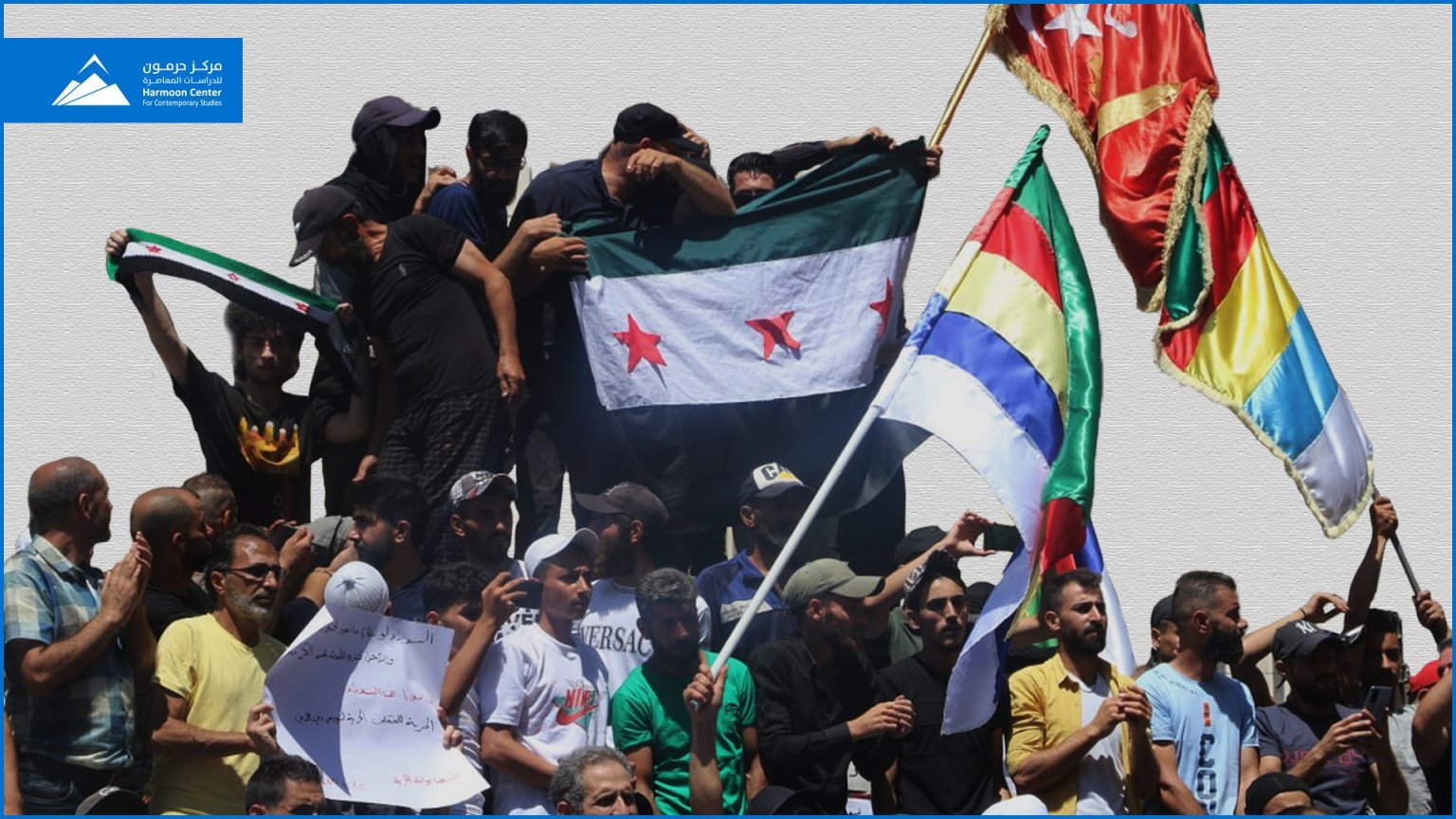
When the Assad regime fell on December 8, 2024, Al-Suwayda stood out as a Syrian city that had sustained the revolutionary momentum that had already begun in August 2023. This movement, driven by political demands, created the space for various political wings and factions. Many of them differed in their visions for the governorate’s administrative structure, and the role of local armed groups within a future Syrian army. The city’s military landscape was particularly complex, shaped by the diverse affiliations and allegiances. These ranged from militias engaged in destabilizing security and drug trafficking with foreign connections[1] to local factions aligned with various religious authorities and revolutionary civil society.
After the collapse of the Assad regime, along with its army and security apparatus, the role of Al-Suwayda ’s military factions experienced a major shift. After they focused on protecting demonstrations and maintaining security, these groups began positioning themselves within the emerging national army. Their roles reflected their differing demands for a relationship with the new government. And all the while, militias continued to pose a threat to the city’s stability.[2]
This paper examines the military situation in Al-Suwayda during Operation Deterrence of Aggression, as well as after the fall of the Assad regime. It explores the military alliances that formed in the city, mapping their demands and the background behind the rise of armed groups in the province. The paper also delves into the key political movements in the city, analysing their visions for their relationship with the authorities in Damascus, the governance structure of Al-Suwayda within the Syrian state, and potential future scenarios based on the nature of the relationship between armed groups and the Syrian government. The methodology combines cumulative monitoring conducted by the researcher from 2019 to 2025, an in-depth interview with the head of the political bureau of one particular political movement, and open-source materials.
- Al-Suwayda before the Fall of the Assad Regime
- Before Operation Deterrence of Aggression
The ISIS attack on the countryside of Al-Suwayda in mid-2018 marked a turning point in the city’s armed struggle. Following the campaign armed groups began to emerge, each with different goals, affiliations, and military capabilities. Prior to the ISIS attack, the factions in the city had been disorganized, and only undertook sporadic operations—either confronting regime forces, or urging the city’s youth not to join Assad’s army. The largest factions at the time were the Men of Dignity Movement, Ahrar Jabal al-Arab, and the Sheikh al-Karama Forces, which split from the Men of Dignity Movement.
Figure 1 below highlights the key security events in the city that shaped the formation of the armed groups.
Figure 1: Chronology of Security Events in Al-Suwayda Before the Fall of Assad

Before the fall of Assad, the city’s armed groups could be categorized into three main types based on their roles:
- Drug Trafficking and Smuggling Militias: Some of these groups operate under the direct influence of Hezbollah and Iran, while others were linked to the regime’s security apparatus.
- Assassination and Kidnapping Militias: These groups were often connected to military security or military intelligence in Damascus.
- Local Armed Groups: These factions maintained close ties with the local community and did not engage in activities that destabilise security.
Following the August 2023 uprising, civil society in Al-Suwayda became increasingly politically active. Several political bodies were formed to represent the demands of trade unions, professional groups, and street protesters. These included the Al-Suwayda Professional Gathering, the Freedom and Peace Movement, and the Jabal al-Rayyan Gathering Organization – alongside groups established after the 2011 revolution, such as the Syrian Federal Movement and the Syrian Brigade Party.
Despite differences, these political bodies shared a common stance on the necessity of a political transition in accordance with Resolution 2254. The primary point of contention was, however, Al-Suwayda ’s administrative structure. The Syrian Federal Movement and the Syrian Brigade Party both advocate for federalism in Syria, whereas the Political Youth Movement and the National Bloc oppose the idea.[3]
Military and political dynamics in Al-Suwayda are deeply interwoven, as seen in political movements like the Syrian Brigade Party, which previously established a “counter-terrorism” force to control the city’s security under the leadership of Samer al-Hakim (who was later killed by regime forces[4]). This overlap allows political parties to wield coercive tools to enforce their agendas on society, a dynamic that has become even more pronounced after the fall of the regime, exemplified by the dual role of the Military Council and the Syrian Federal Movement.
- During Operation Deterrence of Aggression
Before the launch of the operation to topple the regime, the Political Security and Military Security branches in Al-Suwayda along with the Police Command – served as key centers for Assad’s forces. Military Security also functioned as a coordination hub for armed militias engaged in drug trafficking, making it an early target when military action began in the governorate. The campaign, which started on November 27, 2024, escalated as armed groups in the city launched their first attacks against the Assad regime on November 30, targeting the Air Force Intelligence branch and the Police Command building. The military developments unfolded along four main vectors:
- Continued attacks on Assad regime and Ba’ath Party headquarters
- Defections within the ranks of the Assad army in the city
- Withdrawals of Assad forces from the city
- Military coordination among local groups through two operations rooms: the Joint Operations Room and the Decisive Operations Room
Figure 2: Military Developments in Al-Suwayda during Operation Deterrence of Aggression

On December 8, local factions took full control of Al-Suwayda province, assuming security authority as the regime fell. Some factions advanced into Damascus but did not engage in military operations beyond Al-Suwayda’s administrative boundaries.
II: Al-Suwayda after the Fall of the Assad Regime
- Military Groups
After the fall of the Assad regime, the influence of destabilising militias and drug trafficking in Al-Suwayda declined, hastened by efforts by local factions to target these groups. One such attack occurred on December 10, 2024, when the Sheikh al-Karama Forces targeted the home of Nasser al-Saadi, a militia leader in the town of Salkhad.[5] This action was in response to the confirmed deaths of three Sheikh al-Karama members in Seydnaya prison. Al-Saadi had been accused of handing them over to the Military Intelligence branch in 2020.[6]
As these groups became less visible, new military alliances within the governorate began to take clearer shape. According to Interactive Graphic 1 below, the largest alliances were the Military Council, the Joint Operations Room, and the Decisive Operations Room. The following graphic includes identification cards for each military group.
The military alliances’ positions on the government in Damascus can be clearly divided into three main approaches:
- Absolute Rejection of the Current Government: This stance is based on opposition to the current administrative structure of the governorate, with the goal of transforming Syria’s administrative system into a federation. This is the position of the Military Council, which was supported by the Syrian Democratic Forces (SDF) immediately after the council’s formation was announced.[7]
- Conditional Acceptance of the Current Government: Certain groups support the government on the condition that security and military affairs fall under the control of the Ministries of Defence and Interior, with personnel in Al-Suwayda coming from the region itself. This view is held by the Men of Dignity and Ahrar Jabal al-Arab.
- Conditional Acceptance with Reservations: This stance accepts the government but demands that weapons remain under local control until the structure of the Ministry of Defence is clarified and foreign personnel are excluded from the ministry. The Jabal Brigade shares this position.[8]
These were not the only demands that the military alliances were waiting for Damascus to respond to. Tensions also escalated within the city. The establishment of the Military Council initially faced resistance from other local factions who felt it did not represent the views of the people of Al-Suwayda. This opposition stemmed from the fact that the council’s leader, Tariq al-Shoufi, is the head of the Syrian Federal Movement, which advocates for the federalization of Al-Suwayda. Additionally, Brigadier General Samer al-Shaarani, a member of Assad’s army, appeared in the video announcing the council’s formation. Al-Shaarani had previously commanded the Qutayfah area in the Damascus countryside and retained his position until the fall of the Assad regime. This raised concerns about the involvement of Assad’s officers in the new military formation.
Later, an agreement was reached between the Joint Operations Room in the governorate and the Damascus government, stipulating that the sons of Suwayda would take on the task of joining the Internal Security Forces to maintain security in the governorate, on the condition that none of them had been convicted of criminal offenses, on March 6, 2025, the Ministry of Interior sent nine police vehicles from Damascus to Al-Suwayda . However, the Military Council factions prevented the vehicles from entering.[9] This coincided with demonstrations organized by the Syrian Federal Movement, which called for the overthrow of the current regime and expressed support for Sheikh Hikmat al-Hajri and Sheikh Muwaffaq Tarif.
- Political Activism
Political activism in Al-Suwayda began with the onset of the Syrian revolution, but over time, its influence waned under the weight of exhaustive military campaigns. This decline continued until the uprisings of 2022 and 2023, when political activity in Al-Suwayda surged once again. New and former groups played a key role in organizing the nascent local movement, reflecting their demands and emphasizing an alignment with the broader Syrian revolution. All political parties and movements involved in the Al-Suwayda uprising agreed on the necessity of a political transition in Syria in line with Resolution 2254. Fresh political action was centered around organizing and voicing civic demands, even though the Assad regime continued to provide basic services in the city and manage key institutions, such as water and electricity services and the Education Directorate – albeit with a reduced staff.
The main point of contention among the political movements was the administrative status of the governorate within the broader Syrian framework. This dispute persisted even after the fall of Assad but became more pronounced as the scope for political action expanded to include service-related issues. This shift occurred amid the security and military vacuum created by ongoing negotiations between the Ministry of Defense in the new Syrian government and the city’s factions, whose demands often clashed with those of the government.
After the fall of the regime, the political committee in Al-Suwayda attempted to appoint members to the governorate’s executive office, but this effort was met with resistance from other political factions. As tensions escalated, the Syrian government appointed Mustafa Bakkour as governor of Al-Suwayda. Following December 8, 2025, political factions in Al-Suwayda were unable to establish an effective coalition in the city due to ongoing security and military concerns in the governorate. This was largely due to disputes among factions, with some, such as the Syrian Federal Current, having military forces tied to the Military Council.
Several movements and factions refrained from meeting with the government due to prior demands from the state. However, periodic meetings were held between government representatives and figures from the Joint Operations Room and the Decisive Operations Room. One such meeting took place on February 24, 2025, between President Ahmed al-Sharaa, Suleiman Abdul Baqi, leader of the Ahrar Jabal al-Arab Movement, Laith al-Balous, leader of the Sheikhs of al-Karama Movement, and other figures from the governorate.[10] Table 1 below shows the positions of the most prominent political movements on the issues of federalism and foreign intervention:
Table 1: Positions of the Most Prominent Political Movements on the Issues of Federalism and Foreign Intervention
| Name of Movement | Position on Federalism | Foreign Intervention | Year Established |
| Youth Political Movement | Against | Against | 2022 |
| National Bloc | Against | Against | 2023 |
| Syrian Secular Movement | With | Undecided | 2025 |
| Syrian Brigade Party | With | With | 2021 |
| Syrian Federal Movement | With | With | 2023 |
| Social Authority for National Action | Against | Against | 2012 |
| Political Committee | Against | Against | 2024 |
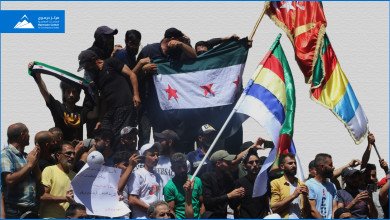
It is worth noting that while there was no change in the positions of these movements regarding the administrative structure of the governorate,[11] there was a shift in the approach of those supporting the idea of federalism and how they promoted their agendas. On March 6, 2025, demonstrations were organized by the Syrian Brigade Party, the Syrian Federal Movement, and the Military Council. Protesters chanted against the Damascus government, while the Syrian flag was removed from both the governorate building and the Police Command building. In contrast, the demonstrations on March 7, 2025, focused on emphasizing national unity and rejecting any separatist projects, whether political or military. These demonstrations did not involve military intervention by the city’s factions.
On March 12, 2025, talks between the government and Sheikh Hikmat al-Hajri led to progress on security and service issues in the governorate.[12] Representatives from Al-Suwayda met at a dialogue conference with Al-Suwayda Governor Mustafa al-Bakkour, where preliminary agreements were reached on the following matters:
- Security and Defence: This included the reactivation of police and security operations in the governorate and the reinstatement of defected officers and personnel within the Ministry of Defence.
- Service Institutions: Agreements were made to prioritise the reemployment of employees who had been arbitrarily dismissed under the Assad regime, review the cases of those dismissed after December 8, 2024, expedite the appointment of members to the interim executive office, establish a university campus in the former Baath Party building, and release overdue salaries to employees.
- Religious Authorities
The positions of the three religious authorities in Al-Suwayda —Hikmat al-Hajri, Hammoud al-Hinnawi, and Youssef al-Jarbou—differed regarding the Assad regime after 2022. Al-Hajri adopted a more confrontational stance toward Assad and offered stronger support for the revolutionary movement in the city, especially after the August 2023 uprising. This marked a shift from his earlier support for the regime before 2020, when he encouraged the province’s residents to join the Assad army for compulsory service after 2013.[13] Sheikh Hammoud al-Hinnawi also supported the movement, particularly its economic demands, while Sheikh Youssef al-Jarbou’s position remained closer to the regime’s narrative. He continued to serve as the representative of the Druze community at official Assad regime events until the regime’s fall.
After the fall of Assad, alliances within the city shifted between religious authorities and political movements. A notable alliance emerged between the Syrian Brigade Party and Sheikh Hikmat al-Hajri, made public in the party’s statements. The party announced a general mobilization and expressed full coordination with Sheikh Hikmat in their “joint rejection of Ahmed al-Sharaa’s policies.”[14] This shift in alliances occurred amid a clear dispute between Sheikh Hikmat al-Hajri and Yahya al-Hajjar, the leader of the Men of Dignity Movement, over their positions on the Damascus government’s military and security policies. The Men of Dignity Movement ultimately reached an agreement with the Damascus government, stipulating that the internal security forces in the city would consist of residents from the governorate.
Sheikh Hikmat al-Hajri was the most politically active religious authority following Assad’s fall, issuing statements that closely followed unfolding events. He maintained that the dissolution of factions and the surrender of their weapons should be contingent upon the establishment of a unified Syrian army.[15] Additionally, he argued that international intervention was necessary to ensure the political process led to a civil state.[16] In contrast, both Sheikh Youssef al-Jarbou and Sheikh Hammoud al-Hinnawi focused on rejecting any separatist movements in the governorate. Sheikh al-Hinnawi, in particular, voiced strong opposition to all military and political groups advocating for Al-Suwayda ’s secession.[17]
- Israeli Statements
After Assad’s fall, Israel launched attacks on Syrian army positions and facilities while advancing militarily in Quneitra and the Daraa countryside, ultimately seizing control of the Mount Hermon heights. By early February, Israel shifted its approach to align with internal Syrian developments and articulate its political agenda toward the emerging Syrian government. During a graduation ceremony in Tel Aviv on February 23, 2025, Israeli Prime Minister Benjamin Netanyahu stated his intention to demilitarize the southern region of Damascus and asserted that he would not tolerate any threats to the Druze community in southern Syria.[18]
Israeli Defence Minister “Israel Katz” echoed this stance on February 24, 2025, amid rising tensions in the town of Jaramana, warning that Israel might intervene militarily if the Druze faced any threat from the Damascus government. Despite these statements, Al-Suwayda ’s revolutionary movement and religious authorities maintained a firm stance against foreign intervention. The city’s three religious leaders publicly rejected any Israeli involvement, reaffirming Syria’s unity— a position also upheld by Suleiman Abdul Baqi, leader of the Ahrar Jabal al-Arab Movement.[19]
III: Possible Scenarios: Settlement vs. Continued Unrest
- Full Agreement between Armed Groups and the State
This scenario envisions an agreement unfolding on two levels: first, among the city’s factions regarding local demands, and second, between these factions and the state. If realized, this would be the most effective path toward maintaining internal civil peace within the governorate. The agreement could stipulate that security, police personnel, and public security forces be composed of individuals from within the governorate. However, significant obstacles posed by drug-trafficking militias remain, as they may seek to derail such an understanding to maintain their justification for bearing arms. As a result, the next logical step following such an agreement could be a concerted effort to dismantle these militias.
It is essential that the state adhere to the commitments previously made with the Men of Dignity Movement, particularly the requirement that only individuals with clean criminal records be allowed to join security or military forces. Failure to enforce this condition could create an opportunity for destabilising militias to operate under the state’s cover. This scenario gained traction following the initial agreement reached at the Spiritual Council of the Wise Elders on March 12, 2025, between Al-Suwayda ’s representatives at the National Dialogue Conference and Governor Mustafa Bakkour.
- Partial Agreement between Some Factions and the State
This scenario envisions a continuation of the current situation, with some local factions aligning with the government while others remain opposed. As a result, armed groups become divided into two camps: those supporting the government and those opposing it. In this context, religious authorities—particularly Sheikh Hikmat al-Hajri—could play a crucial role. They may either mediate to unify the armed groups under a shared agreement or become entangled in disputes that threaten civil peace in the governorate. Direct confrontations could escalate, with drug-trafficking militias playing a prominent role against local factions aligned with the government.
Two key factors contribute to this dynamic. First, these militias have a history of conflict with local factions. Groups such as the Men of Dignity Movement have previously launched campaigns against them, most notably dismantling Raji Falhout’s militia, which was once the largest in Al-Suwayda. Second, the ongoing instability provides an opportunity for the resurgence of the drug trade, particularly along the Jordanian border, as traffickers exploit the deteriorating security situation.
- No Agreement between Armed Groups and the State
In this scenario, local armed groups prioritize tribal and communal ties over national identity and their existing divisions, much as they did during the ISIS attack on the governorate under the banner of “land and honor.” This outcome would have severe consequences for Syria’s national cohesion, potentially leading to international intervention in support of Al-Suwayda . Such intervention could come from Israel, aligning with Prime Minister Benjamin Netanyahu’s statements about protecting the Druze community.[20] This would further entrench the fragmentation of Syria, stabilizing the situation in northeastern Syria while potentially triggering rebellions along the coast. Ultimately, this could lead to the country’s division into multiple regions with external affiliations, leaving Syria as a fragmented state with little control over its full territory.
Conclusion
Local dynamics in Al-Suwayda play a crucial role in shaping its future after the fall of the Assad regime. As the city’s traditional power structure disintegrates, new forces are emerging, each vying to redefine their place in the political and military landscape. This has given rise to instability driven by conflicting visions among local factions and political movements— particularly regarding their relationship with the new government in Damascus. Al-Suwayda now faces significant challenges. While some forces advocate for negotiation and settlement as a means of maintaining local security and securing political representation, others firmly reject any association with the government, risking internal divisions that could lead to prolonged unrest.
Given these complexities, multiple scenarios emerge for Al-Suwayda ’s future. A consensus between local factions and the Syrian government could pave the way for gradual stability, as long as the province’s political and administrative unique characteristics are respected, and no unpopular settlements are imposed. However, if political and factional divisions persist, Al-Suwayda could descend into ongoing security tensions, especially as some parties attempt to exploit the situation for personal gain. This could manifest through the imposition of political agendas that contradict demands from civil society or through destabilising security activities, such as drug smuggling and assassinations.
The next phase will be critical in determining Al-Suwayda ’s future—whether it can overcome its challenges through consensual political solutions or become a battleground for open conflict between factions, leading to new risks and potentially reproducing chaos rather than fostering reconstruction.
References
Al-Zein, R. (2022) ‘Syrian Regime Forces Enter the “Counter-Terrorism” Stronghold in Al-Suwayda’, Asharq Al-Awsat, 9 June.
Zabad, Y. (2024) ‘Al-Suwayda Movement… Security Challenges and Ongoing Demonstrations’, Omran Center for Strategic Studies.
Zabad, Y. (2024) ‘The Armed Group in Al-Suwayda: The Security-Drug Duality’, Omran Center for Strategic Studies.
Zabad, Y. (2023) ‘The Al-Suwayda Uprising in August 2023: Security Challenges and Open Scenarios’, Omran Center for Strategic Studies.
[1] The Armed Group in Al-Suwayda: The Security-Drug Duality, Yaman Zabad, Omran Center for Strategic Studies, November 2024, accessed March 10, 2025: https://bit.ly/4hfyGIB
[2] By “militias,” we refer to armed groups engaged in ongoing security destabilization and drug trafficking, previously affiliated with security branches, Russia, or Iran. By “factions,” we mean armed groups operating within the governorate, independent of external affiliations.
[3]Al-Suwayda Movement… Security Challenges and Ongoing Demonstrations, Yaman Zabad, Omran Center for Strategic Studies, May 8, 2024, accessed March 3, 2025: https://bit.ly/3FhGZX1
[4] Syrian Regime Forces Enter the ‘Counter-Terrorism’ Stronghold in As-suwaida, Riyad al-Zein, Asharq Al-Awsat, June 9, 2022, accessed March 3, 2025: https://bit.ly/3VRdSAo
[5] Nasser al-Saadi leads a drug-trafficking militia in the Salkhad area. In December 2023, Jordanian forces attempted to assassinate him by targeting his home.
[6] “The Town of Salkhad Experiencing Security Tensions Following an Attack by the Sheikh al-Karama Forces on the Home of Nasser al-Saadi’s Family on December 10, 2024,” As-suwaida 24, accessed March 6, 2025: https://bit.ly/4ksakyc
[7] A New Military Council Formed in As-suwaida, February 23, 2025, accessed March 6, 2025: https://archive.md/ByK9e
[8] TV Interview with Najib Abu Fakhr, Spokesman for al-Jabal Brigade, February 2, 2025, accessed March 7, 2025: https://bit.ly/4ivJ0xa
[9] Interview conducted on March 8, 2025, with the head of the political bureau of one of the political movements, who was one of the organizers of the August 2023 movement.
[10] Al-Balous Reveals to al-Hurra the Latest Developments in the Relationship with Damascus and the Position on Israel, Dhiaa Odeh, al-Hurra February 26, 2025, accessed March 12, 2025: https://bit.ly/3XLPjEV
[11] As-suwaida Movement… Security Challenges and Ongoing Demonstrations, Yaman Zabad loc. cit.
[12] Qanawat House Hosts an MOU with the New Syrian Administration, Al-Suwayda Media Center, March 12, 2025, accessed March 12, 2025: https://bit.ly/3XJ5V02
[13] The Al-Suwayda Uprising in August 2023: Security Challenges and Open Scenarios, Omran Center for Strategic Studies, August 31, 2023, accessed March 10, 2025: https://bit.ly/3Ufnwub
[14] Official page of the Syrian Brigade Party on Facebook, March 9, 2025, accessed March 10, 2025: https://bit.ly/3XF8ccy
[15] Al-Hajri to Syria TV: The Surrender of Weapons and the Dissolution of the Factions Are Linked to the Establishment of a Syrian Army, Syria TV website, January 4, 2025, accessed March 10, 2025: https://bit.ly/3DhGs79
[16] Sheikh Hikmat al-Hajri Calls for International Intervention to Ensure a Civil State and Separation of Powers, Syria TV website, February 25, 2025, accessed March 10, 2025: https://bit.ly/4kD02LJ
[17] Interview with Sheikh Hammoud al-Hinnawi, Noon Post, February 28, 2025, accessed March 10, 2025: https://bit.ly/3XE5Avs
[18] Hidden Israeli Intentions: The ‘Druze Canton’ Scenario Returns to the Forefront, Al-Arabiya TV, March 5, 2025, accessed March 12, 2024: https://bit.ly/41KR7iE
[19] Southern Syria… The Shock of Netanyahu’s Dictates, Dhiaa Sahnawy, Al-Araby Al-Jadeed, February 25, 2025, accessed March 12, 2025: https://bit.ly /3XJ4iiW
[20] “$1 billion from Israel to Turn Syria’s Druze against Damascus,” Asharq Al-Awsat, March 5, 2025, accessed March 10, 2025: https://bit.ly/3XC4VL2