


Abstract
This paper examines the ideological, strategic, and governance transformation of Abu Mohammad al-Jolani, the former leader of Jabhat al-Nusra, into Ahmed al-Sharaa, the transitional president of Syria following the fall of Bashar al-Assad’s regime on December 8, 2024. As the leader of Hay’at Tahrir al-Sham (HTS), al-Jolani initially commanded a militant group with jihadist origins but gradually repositioned HTS as a localized Syrian movement. By integrating political pragmatism with governance, he successfully transitioned from insurgency to state leadership. this study assesses the factors contributing to al-Jolani’s exit from violence and his emergence as a political figure. It explores HTS’s organizational restructuring, shifts in ideological discourse, and governance strategies that facilitated its legitimacy within Syria’s transitional framework. The research is based on an empirical analysis of al-Sharaa’s speeches, policy decisions, and geopolitical positioning, highlighting the interplay between internal power dynamics and external diplomatic pressures. It further examines the sustainability of Syria’s new governance model, the potential challenges of integrating former insurgent leaders into state structures, and the broader implications for conflict resolution and post-war stabilization in Syria.
Keywords: Syria, Hay’at Tahrir al-Sham, Abu Mohammad al-Jolani, Ahmed al-Sharaa, rebel governance, deradicalization, political transformation, post-conflict transition
Following the fall of Bashar al-Assad’s regime on December 8, 2024, Syria has been governed by a transitional government led by Prime Minister Mohammed al-Bashir, the former head of the Syrian Salvation Government in Idlib province. The de facto leader of Syria during this transitional period is Ahmed al-Sharaa, who assumed this role upon the formation of the transitional government.
However, on January 29, 2025, he was formally chosen as the transitional president of the “New Syria” (MEM, 2025). The transitional government and the presidency are currently controlled by former Hay’at Tahrir al-Sham (HTS) officials. HTS evolved from Jabhat al-Nusra, a former branch of al-Qaeda (Usher, 2024). HTS has engaged in conflicts against both the Syrian regime and other rebel factions for territorial control.
A pivotal moment in HTS’s transformation came in 2016, when it officially severed ties with [1]al-Qaeda. This decision marked a significant ideological and strategic shift, allowing HTS to reposition itself as an independent localised Syrian movement rather than a transnational jihadist group (ibid).
This paper examines HTS and its leadership both as a rebel group and as a governing authority. More specifically, it explores the deradicalisation process of Abu Mohammad al-Jolani, the former leader of Jabhat al-Nusra, and his transition into a political figure under the name Ahmed al-Sharaa. This study analyses the ideological, discursive, and strategic transformations that shaped al-Jolani’s evolution based no different theoretical frameworks. Omar Ashour’s (2009) theoretical framework on deradicalisation, Stathis Kalivas (2006) on control and legitimacy in civil wars, Zachariah Mampilly’s rebel rulers (2011). The research is based on empirical analysis of his speeches, political actions, and geopolitical positioning.
Ashour comprehensive deradicalisation occurs in three main dimensions: ideological, behavioral and organizational deradicalization. Which means the abandonment of fundamentalist principles in favor of a more moderate political framework, The rejection of violence and commitment to peaceful political processes. And organizational deradicalization and the internal structural transformation of the group to align with political and institutional frameworks. Kalyvas’s work emphasises the localised and contingent nature of violence in civil wars. His analysis highlights how rebel governance is often constrained by the dynamics of conflict, requiring adaptation and compromises to maintain control. Mampilly’s work often considers the impact of state formation and weakening on the emergence and consolidation of rebel movements. He highlights the ways rebel groups might gain de facto control of territory and resources, establishing parallel governance structures.
The exit from violence or the transformation of the conflict behaviour of HTS is a crucial issue in understanding the evolution of armed Islamist movements and their political legitimacy (Hamid, 2014). Al-Jolani’s case raises several questions: what factors contributed to his exit from violence? Is his transformation strategic, aimed at political survival, or does it reflect a genuine ideological shift? How has this shift affected HTS’s governance, international legitimacy, and the local political landscape?
This study adopts a meso-level approach, focusing on internal and external factors that influenced HTS’s conflict behaviour and its leader’s transformation. It primarily examines internal decision-making processes while also considering the geopolitical context, though this study does not cover international relations in depth. It is divided on four main parts, emphasising the ideological adaptation, the behaviour and governance and the strategic transformation. The last part evokes the sustainability of the new government and the true reform.
Ideological adaptation: evolution of Al-Jolani’s Discourse
Islamist groups, when participating in formal politics, often face dilemmas between ideological purity and political pragmatism (Hamid, 2014). Similarly, HTS under al-Joulani has shown ideological flexibility, distancing itself from global jihadist agendas to gain local support and legitimacy.
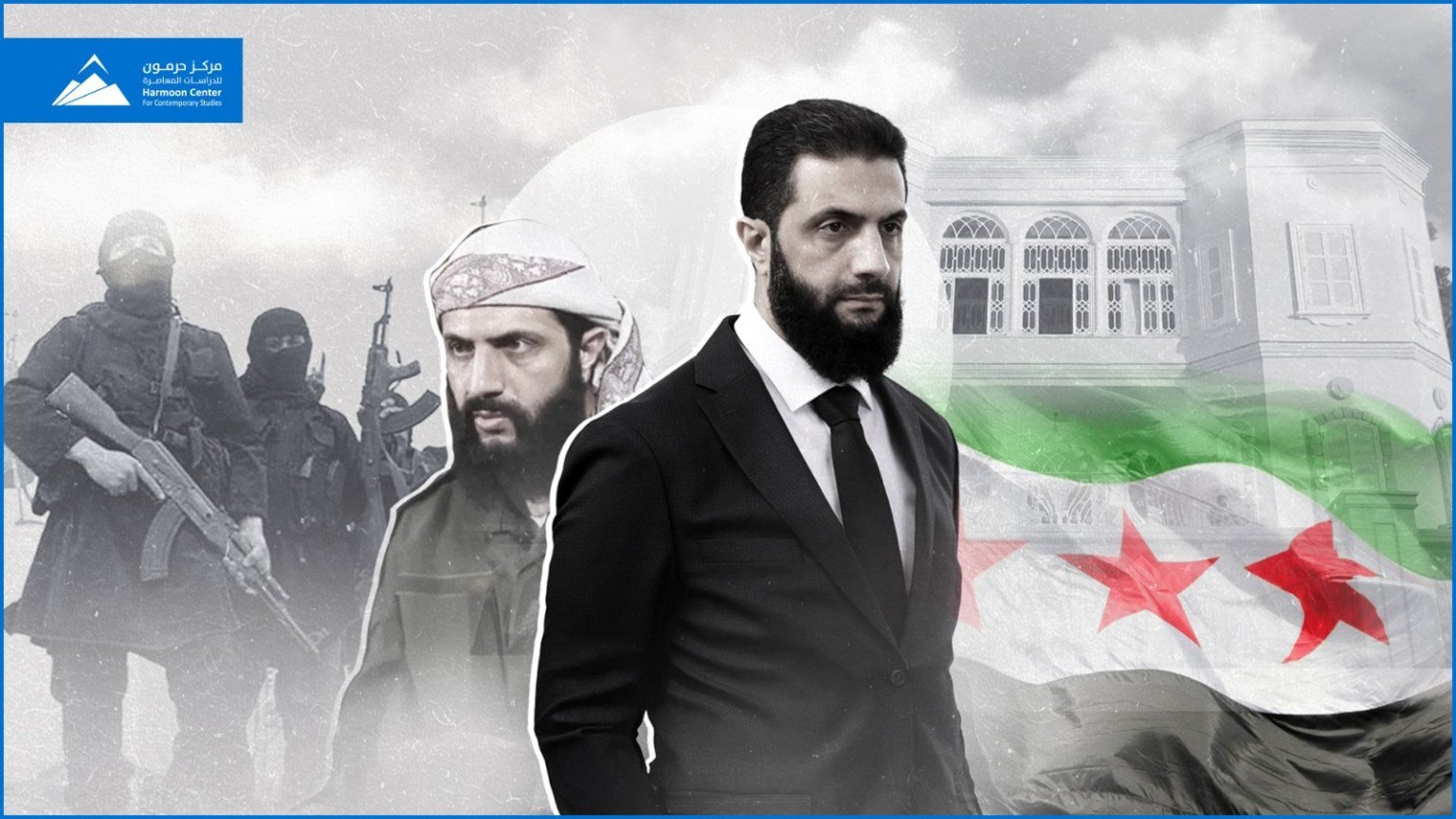
Al-Jolani’s transformation has been carefully crafted over the years, as evidenced not only by his public statements but also by his changing appearance. In his early years, he dressed in traditional jihadist attire, symbolising his role as a militant leader. As a military commander during the “Deterrence of aggression” operation, he was often seen in military suit. Today, Ahmed al-Sharaa presents himself in Western-style suits with a well-groomed beard, he projects the image of a modern statesman (Da Silva, 2024).
Over the past decade, al-Jolani’s rhetoric has undergone a significant transformation. Initially, he advocated for an Islamic state governed by Sharia law. While his speech, delivered on December 8, 2024, at the Umayyad Mosque, represents a strategic effort to reposition HTS as a moderate political actor, willing to participate in the reconstruction of post-Assad Syria (AlJazeera, 2024). It emphasised the importance of Syrian national unity, calling for the country’s reconstruction and reconciliation among different factions.
Additionally, al-Sharaa articulated his vision for Syria, advocating a pragmatic, even technocratic, form of Islamism within a national framework. This shift suggests a desire to modernise and stabilise Syria, moving away from the political Islamist practices of the past.
The speech was widely perceived as a positive signal by Arab powers and international actors, who saw al-Sharaa as a potential interlocutor for Syria’s reconstruction and stabilisation. However, skepticism remains regarding HTS’s ability to fulfil these commitments and fully integrate into Syria’s political system.
On January 29, 2025, Ahmad al-Sharaa was officially designated as the interim president of the Syrian Arab Republic. He delivered a speech marking the victory of the Syrian revolution. This address, given at a dedicated conference, highlighted several key aspects for the country’s future.
Al-Sharaa called for national dialogue, announcing a “National Dialogue Conference” and emphasising the importance of inclusive participation from all segments of Syrian society. The interim president reaffirmed his commitment to end internal hostilities and create a secure environment for all citizens, regardless of their ethnic or religious affiliations (Harmoon Center, 2025). He stated: “In transitional phases, you need a harmonious work team. At this stage, we do not want to distribute institutions and ministries as gifts to ethnicities, sects, and parties.”
Addressing the issue of Syrian refugees, al-Sharaa expressed his conviction that the majority of the 14 million displaced Syrians would return within the next two years (TRTWorld, 2025). He acknowledged the challenges linked to the reconstruction of infrastructure and housing, while emphasising the resilience of the Syrian people (Harmoon Center, 2025). In a gesture of national unity, the president highlighted Syria’s historical diversity, mentioning the coexistence of Muslims, Christians, Kurds, Alawites, and Druze.
In his rhetoric and political discourse, al-Sharaa emphasises his commitment to certain democratic values. He uses terms such as “pluralism” and “equality”, advocates for the protection of human rights and freedoms, and acknowledges the importance of democracy, stating (Bunzel, 2025).
Behaviour and governance: From War to Politics
Given Syria’s religious, sectarian, and ethnic diversity, al-Sharaa reassessed his beliefs and modified his behaviour based on interactions with political and military partners. This shift underscores a deliberate effort to move beyond jihadist governance and integrate HTS into Syria’s post-war political landscape. Al-Sharaa has demonstrated a pragmatic approach, shifting from rigid ideological positions to more flexible, politically oriented strategies. This adaptability reflects his acknowledgment of the complex realities of both Syrian society and the international community.
Historically, Abu Mohammad al-Jolani led an organisation engaged in military offensives and summary executions. However, since 2020, several key decisions indicate a break from this approach, demonstrating a gradual shift from violence to political governance. In the past, HTS has gradually consolidated control over Idlib and surrounding areas, using both violent suppression of rivals (e.g., Ahrar al-Sham, Hurras al-Din) and strategic governance (Kalyvas, 2006) to maintain legitimacy. HTS suppresses dissent but also integrated local elites and Islamic scholars to sustain governance.
HTS provides security, dispute resolution, and some public services, following Kalyvas’s idea (2006) that legitimacy in civil wars is not just ideological but also tied to governance and order. HTS has targeted defectors and dissenters selectively, using coercion while also claiming to protect civilians, in line with Kalyvas’ argument that rebels use violence strategically to secure compliance. In this sense, Hamid’s (2014) work emphasises that Islamist movements derive legitimacy not only from religious narratives but also from effective governance.
Since 2018, following public outrage and protests from other Islamist factions, HTS reoriented its role within the jihadist movement, shifting toward greater openness to mainstream revolutionary factions and closer alignment with Turkish and Western interests (ACLED, 2023). This transformation is particularly evident in the reduction of armed confrontations with Syrian government forces, and the consolidation of civil order in territories under HTS control.
Through his charismatic leadership and military gains, al-Sharaa has achieved a high degree of structural cohesion within HTS, leading to its evolution in governance and leadership. As a result, he became the first post-Assad Syrian president.
Al-Sharaa entered the political arena through his governance in Idlib, initiating a process aimed at conquering Damascus. This transformation is based on a rational choice calculations, cost-benefit analyses, and perceptual and psychological factors that shaped his decision-making. The HTS leadership altered its worldview following the territorial gains, the overthrow of Bashar al-Assad, and the socialisation and interaction with “the other”, leading to ideological adjustments.
Strategic transformation: The Restructuring of HTS
The transformation of HTS under the leadership of Abu Mohammad al-Jolani serves as a key indicator of his deradicalisation. Over the past decade, HTS has gradually moved away from its jihadist origins, shifting from a purely militant group to an organisation with governing ambitions (Carenzi, 2020). The break from al-Qaeda was not merely symbolic but also tactical, enabling HTS to seek broader legitimacy among Syrian opposition factions and engage with regional powers such as Turkey and Qatar (Edelbi, 2021). This separation also led to internal divisions, with hardline jihadist elements defecting to groups such as Hurras al-Din, which remains loyal to al-Qaeda (Bunzel, 2023).
Following its break from al-Qaeda, HTS adopted a more structured approach to institutionalised governance (Mampilly, 2011), establishing: ministries overseeing various sectors, including education, healthcare, and justice. A police force tasked with enforcing laws and maintaining security in Idlib and surrounding areas. A civil administration responsible for public services, infrastructure, and economic management (Hoffman, Makovsky, 2021).
However, these governance efforts remain controversial. Different human rights reports argue that HTS continues to exercise authoritarian control, suppressing dissent and silencing opposition voices. In a political adaptation process, HTS moved from a jihadist insurgency to a governing authority, enforcing political centralisation while claiming local legitimacy.
To strengthen its legitimacy, Al-Joulani has sought recognition from Turkey and even softened rhetoric appeal to external powers while maintaining firm internal control. He has actively collaborated with humanitarian organisations and engaged in the development of local institutions. It has also worked with local councils to develop municipal services and establish legal courts that blend Islamic and civil law principles (Mauvais, 2021).
Sustainability of the new governance and global powers
The leadership of Ahmad al-Sharaa presents a paradox. Is he an opportunistic pragmatist who shifts positions solely for power, or a genuine reformer adapting for long-term governance? Pragmatism and reform are not necessarily contradictory. His transformation from a hardline jihadist to a governance-focused leader reflects the complex nature of political survival in warzones.
As an opportunistic pragmatist, Al-Joulani’s career is marked by tactical flexibility rather than unwavering ideological commitment. His history of shifting alliances, ideological adaptation, and strategic transformation suggests that his primary concern is political survival rather than consistent reform. To sum up, he broke with al-Qaeda for Political Gain, he suppressed rivals and opposed Dissent
Alternatively, al-Joulani’s evolution can be seen as a sincere attempt to transition from jihadist militancy to a legitimate governance model. He pivoted away from global jihadist networks could indicate a genuine ideological shift toward a localised governance model. He built institution sin Idlib and HTS’s governance efforts, though imperfect, resemble previous rebel groups that transitioned into legitimate political entities.
The most likely scenario is that al-Joulani embodies both opportunism and reform. These characteristics are not contradictory; rather, they are complementary strategies for survival in unstable environments. Based on the authoritarian resilience and the adaptation as Survival, Andrew Nathan (2003) argues that authoritarian regimes adapt pragmatically to remain in power, sometimes enacting reforms not out of conviction, but out of necessity. Al-Sharaa’s shift could therefore be seen as an authoritarian survival mechanism, incorporating just enough reform to sustain legitimacy while maintaining coercive control.
Conclusion
Al-Sharaa has adapted rebel governance strategies, controlled violence strategically, built economic networks, and engaged in political pragmatism to sustain power. His transformation reflects a shift from jihadist militancy to a hybrid authoritarian-rebel governance model, making HTS a unique case in modern insurgency politics. However, questions remain about its long-term governance model and its ability to foster pluralism and democracy, and the willingness of the international community to engage with HTS as a legitimate political entity. While HTS has made notable progress in its restructuring, its legitimacy on the international stage remains a subject of ongoing debate as a terrorist listed organisation. However, this restructuring could involve disbanding the organisation and giving it a different name.
According to Cronin (2011), the decline and demise of non-state armed groups can occur through success, meaning the achievement of their original objectives. In this context, if HTS successfully transitions into a political entity, it could signal a long-term shift away from militancy toward institutionalised governance.
Ultimately, fostering inclusive political spaces and structuring governance frameworks will be essential for ensuring that Ahmad al-Sharaa commits to democratic norms, rather than reverting to violence or authoritarian rule.
At the end, the new democratic governance should start with:
- Strengthening institutions to introduce democratic structures, such as parliaments, municipal councils, independent commissions.
- Establishing clear legal frameworks to promote transparency, fair governance and accountability.
- Overcoming stigma and political sabotage.
Finally, if al-Sharaa continues to engage in pragmatic governance reforms, seeking international legitimacy, he may transition into a stable political actor, an If his adaptations are merely tactical, he may revert to hardline policies when convenient.
Ahmad al-Sharaa may not need to choose between pragmatism and reform—he can embody both. Whether his governance in Idlib becomes a durable political transformation or a temporary tactical shift remains uncertain. As past examples of insurgent leaders show, pragmatism does not preclude genuine reform, and time will be the ultimate test of his trajectory.
References
ACLED (2023). HTS and the Evolution of Syria’s Rebel Governance.
Al-Tamimi, Aymen Jawad (2017). From Jabhat al-Nusra to Hay’at Tahrir al-Sham: Evolution, Approach and Future. Konrad Adenauer Stiftung. 6 december. Link.
Ashour, Omar (2009). The De-Radicalization of Jihadists: Transforming Armed Islamist Movements. New York: Taylor & Francis.
Bunzel, Cole (2025). “From Jihadi to Islamist: Ahmad al-Sharaa and His Critics”. Jihadica. 3 January. Link.
Carenzi, Silvia (2020). Perspectives on Terrorism, December 2020, vol.14, No6, special issue: Restraint in Terrorist groups and radical milieu, pp. 91-105. Terrorism Research Initiative.
Cronin, Audrey Kurth (2011). How Terrorism Ends: Understanding the Decline and Demise of Terrorist Campaigns. Princeton: Princeton University Press.
Da Silva, Chantal (2024). He toppled a dictator and traded fatigues for a suit — Syria’s new leader tries to reassure the U.S. NBC News. 20 December. Link.
Edelbi, Omar (2021). Hayat Tahrir al-Sham as a de facto authority. Haramoun Center for contemporary Studies. February 7. https://www.harmoon.org/researches/هيئة-تحرير-الشام-كسلطة-أمر-واقع/
Hamid, Shadi (2014). Temptations of Power: Islamists and Illiberal Democracy in a New Middle East. Oxford University Press.
Hoffman, Max, Alan Makovsky (2021). Northern Syria Security Dynamics and the refugee crisis. Ceter for American Progress. May.
Kalyvas, Sathis (2006). The logic of violence in civil war. Cambridge University Press.
Mampilly, Zachariah Cherian (2011). Rebel Rulers: Insurgent Governance and Civilian Life during War. Cornell University Press. http://www.jstor.org/stable/10.7591/j.ctt7zfvj.
Mauvais, Lyse (2021). HTS seeks greater engagement with the West, but the impact on humanitarian access is uncertain. Syria Direct. 3 may. Link.
MEM (2025). Syria’s Sharaa declared president for transition. 30 January. Link.
Nathan, Andrew (2003). Authoritarian Resilience. Journal of Democracy, 14(1), 6–17. Project Muse.
Usher, Sebastien (2024). Who are the rebels in Syria?. BBC. 8 December. Link.
[1] Al-Sharaa President declared on early February the dissolution of all the armed groups and the creation of one united Syrian army. https://www.rfi.fr/fr/moyen-orient/20250209-syrie-l-armée-nationale-syrienne-dissoute-et-intégrée-à-la-nouvelle-armée-régulière.