



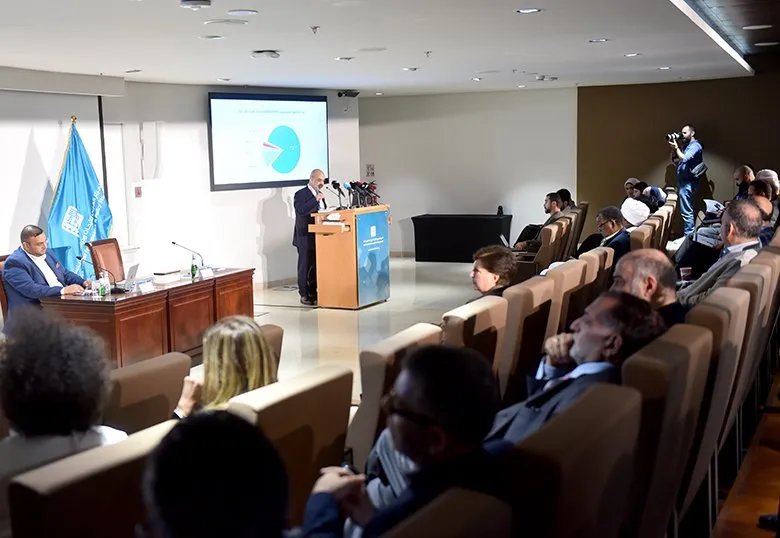
The Arab Center for Research and Policy Studies issued a report on Wednesday, January 10, 2024, documenting Arab public opinion about the Israeli war on Gaza. The report includes the key findings of a survey conducted on a sample of 8,000 respondents in 16 Arab countries.
The survey questions were selected to determine the opinions of citizens in the Arab region on important topics related to the Israeli war on Gaza.
The survey outcomes highlighted the following:
– Arab citizens perceive this war as directly affecting them, with 97% of respondents expressing psychological stress (to varying degrees) as a result of the war on Gaza. Moreover, 84% stated that they feel significant psychological pressure.
– Around 80% of respondents affirmed their regular engagement with war news, with 7% stating non-following, further emphasizing the localized perception of the Arab public towards this conflict. Regarding news sources, 54% relied on television, while 43% turned to the internet.
– The results highlight that Arab public opinion is unconvinced that the military operation carried out by Hamas on October 7, 2023, was driven by a foreign agenda. Notably, 35% of respondents considered the continued Israeli occupation of Palestinian territories as the most significant reason for the operation. Moreover, 24% primarily attributed it to defending against Israel’s targeting of Al-Aqsa Mosque, with 8% viewing it as a consequence of the ongoing siege of the Gaza Strip.
– Regarding the discussion on the legitimacy of that operation, 67% of the Arab public opinion agreed that the operation is a “legitimate resistance operation,” while 19% reported that it was a somewhat flawed but legitimate resistance operation, and 5% considered it “illegitimate.”
– The results showed that there is an Arab consensus of 92% expressing solidarity with the citizens of the Arab region with the Palestinian people in Gaza. While 69% of respondents expressed their solidarity with Palestinians and support for Hamas, 23% expressed solidarity with Palestinians despite opposing Hamas, and 1% expressed a lack of solidarity with the Palestinians.
– Within the context of discussions among Israeli politicians and some American officials comparing Hamas to ISIS, two-thirds of Arab public opinion believe that it differs entirely from ISIS. Only 3% stated that it does not differ from ISIS at all.
– Concerning the evaluation of Arab public opinion regarding the policies of regional and international powers toward the war on Gaza, the results reflected that the Arab public opposes the United States’ policy. 94% of respondents rated its stance as “bad” and “very bad,” with 82% stating it is “very bad.”
– In the same context, 79%, 78%, and 75% respectively agree that the positions of France, Britain, and Germany are negative. Meanwhile, Arab public opinion is divided on the stances of Iran, Turkey, Russia, and China; with 48%, 47%, 41%, and 40% respectively considering them positive, while 37%, 40%, 42%, and 38% respectively regard them as negative.
– In the same context, 76% of respondents reported that their position toward the United States following the Israeli war on Gaza had become more negative, indicating that the Arab public has lost confidence in the US. Furthermore, respondents demonstrated a near consensus (81%) in their belief that the US government is not serious about working to establish a Palestinian state in the 1967 occupied territories (The West Bank, Jerusalem, and Gaza).
– About 77% of respondents named the United States and Israel as the biggest threat to the security and stability of the region. While 51% saw the United States as the most threatening, 26% considered the biggest threat to be Israel. While 82% of respondents reported that US media coverage of the war was biased towards Israel, only 7% saw it as neutral.
– Arab public opinion considers the Palestinian Cause as “the cause of all Arabs and not just the Palestinians,” with a rate of 92%. It is worth noting that this percentage is the highest recorded when compared to previous years, rising from 76% at the end of 2022 to 92% this year. Some countries recorded significant increases. In Morocco, it rose from 59% in 2022 to 95%, in Egypt from 75% to 94%, in Sudan from 68% to 91%, and in Saudi Arabia from 69% to 95%, a statistically significant increase that represents a fundamental shift in the opinions of the citizens of these countries.
– Arab public opinion is almost unanimous in rejecting recognition of Israel, with 89% opposing their countries’ acknowledgment, up from 84% in the 2022 survey.
– The percentage of those opposing recognition of Israel in the Saudi public opinion increased from 38% in 2022 to 68%. Similarly, in Sudan, it rose from 72% in 2022 to 81%, and in Morocco, it increased from 67% in 2022 to 78%, representing a statistically significant increase.
– When asked about their opinions on what measures Arab governments should take to stop the war in Gaza, 36% of respondents stated that Arab governments should suspend all relations or normalization processes with Israel, while 14% of them stated that aid and support should be brought into Gaza without Israeli approval. Additionally, 11% said that Arab governments should use oil as a weapon to assert pressure on Israel and its supporters. Moreover, 9% emphasized the necessity of forming a global alliance to boycott Israel.
– There is a near consensus among Palestinian respondents from the West Bank (including Jerusalem), around 95%, that safety and freedom of movement between the governorates and cities of the West Bank and their sense of security and personal safety have been affected negatively since 7 October 2023.
– A further 60% of Palestinian respondents in the West Bank said that they had been subjected to or were witnesses to raids by the occupation army forces, while 44% said that they were subjected to arrest or interrogation by the Israeli army, and 22% reported that they were subjected to harassment by settlers.
It is worth mentioning that this survey is the first of its kind to gauge public opinion on the topic across the Arab region. It was conducted in the field from December 12, 2023, to January 5, 2024, in 16 Arab countries.
To read the full report, please click on the download icon below: