


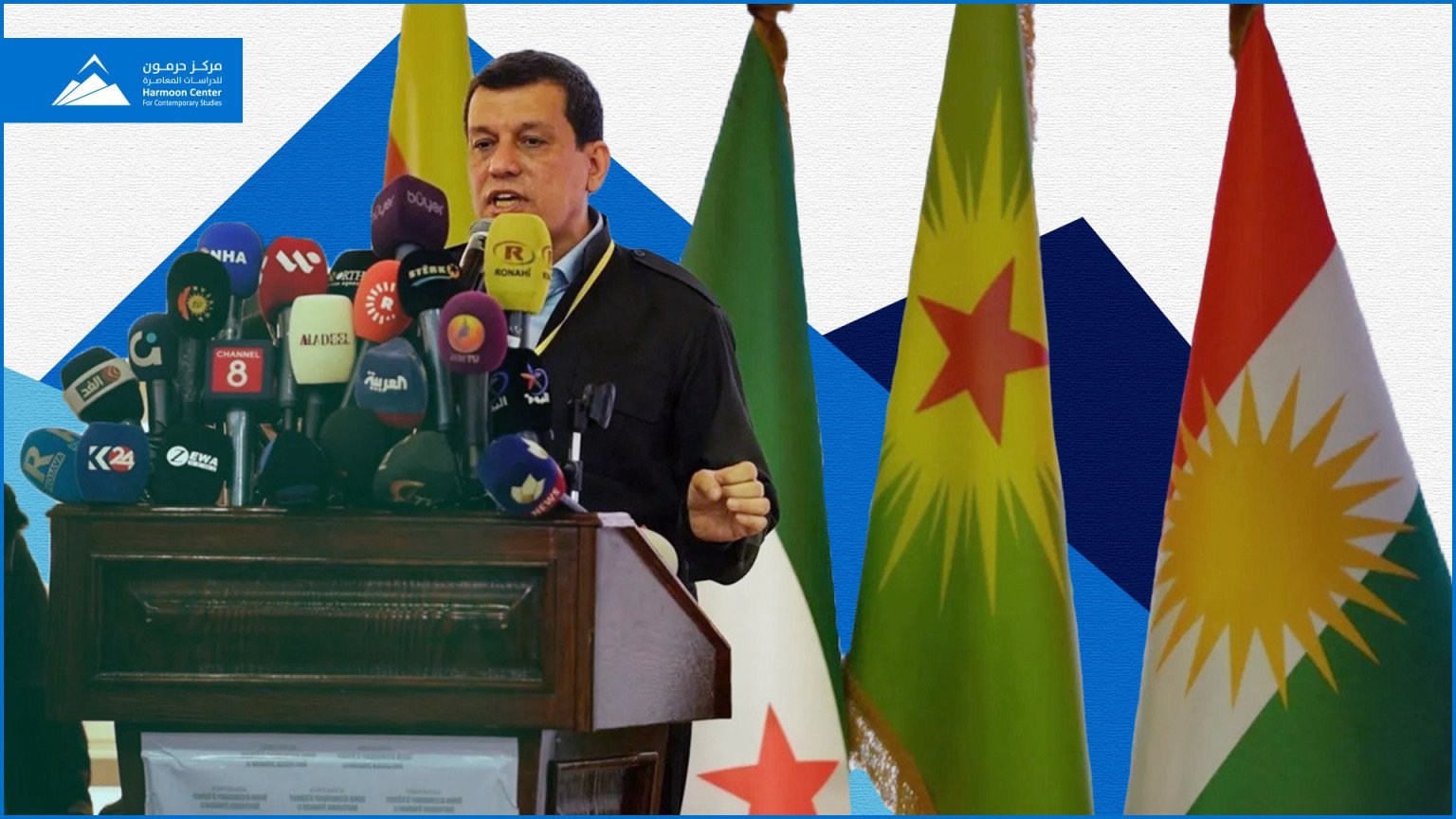
In the shadow of the redeployment of US and international coalition forces in the north and east of Syria, amid the stagnation of Washington’s stance toward the Syrian transitional administration, and Turkey’s close monitoring of affairs on their southern border, key Kurdish political actors held a conference entitled “The Unity of Kurdish Ranks and Positions in Rojava Kurdistan” in Qamishli on April 26. The conference and its outcomes posed yet further questions and challenges to Syrian Kurds: most centrally, how to keep their cause distinct from other regional Kurdish conflicts amongst delicate and complex regional and international dynamics. This meeting of minds followed several earlier efforts—all sponsored by President Masoud Barzani—to broker agreements between Kurdish factions, none of which bore fruit.
More than 400 people participated in the conference, including leaders from the Kurdish National Council and the Kurdish National Unity parties, as well as representatives from other Kurdish parties, independent figures, and members of the Kurdistan Workers’ Party (PKK). Representatives from Kurdish parties from Iraq’s Kurdistan Region also attended, alongside observers from Turkish Kurdish parties including the Equality Party and the Peoples’ Democratic Party, US envoy Scott Boles, and military commanders from the international coalition forces.
Preparations lasted around five months and centred on developing a unified Kurdish vision to guide Kurdish participation in Syria’s future. Participants adopted a joint political document calling for the establishment of a democratic, decentralised Syrian state whose constitution guarantees the rights of the “Kurdish people”. This final document asserted these demands despite repeated declarations by the transitional Syrian government that it is committed to safeguarding the rights of Kurds—and all other components of the Syrian population—within the framework of a unified state.
Moreover, On March 10, 2025, Syrian transitional president Ahmad al-Sharaa and SDF commander Mazloum Abdi signed an agreement recognising the Kurds as an integral part of the Syrian state. The agreement guaranteed their full constitutional rights, and provided for the integration of the autonomous administration’s civilian and military institutions into those of the Syrian state. Despite this agreement, the SDF criticised the constitutional declaration, claiming it granted the transitional president excessive powers incompatible with the stated goals of the transitional phase. The SDF also objected to the composition of the new government, arguing that it failed to reflect Syria’s true diversity—despite including two Kurdish ministers. Furthermore, the SDF continues to resist the integration of its forces into the Syrian Ministry of Defence and has delayed transferring control of certain areas, such as the Tishreen Dam region, to the transitional government.
Conference Outcomes:
- Foundational Political Document
The conference released a political text outlining a set of general principles that enjoyed broad support among Syrians across the country. These included promoting women’s participation in political and public life, protecting children’s rights, affirming Syria’s territorial integrity, embracing a comprehensive national identity that reflects the country’s ethnic and religious diversity, and upholding international conventions and treaties. However, the document also addressed several controversial issues that lack national consensus, most notably:
- A bicameral parliamentary system. The document calls for the adoption of a parliamentary system with two houses; however, this proposal has garnered precious little support among Syrians, especially in light of such negative experiences with similar systems in Lebanon and Iraq. The current absence of active political parties in Syria further undermines the feasibility of such a model. As a result, a semi-presidential or presidential system is more likely to be considered in future discussions. Ultimately, these issues will be decided in the permanent constitution.
- Changing the state’s flag, name, official languages, and national holidays. These are all sensitive matters of sovereignty typically decided during the final stages of the constitutional process, through a popular referendum, rather than through partial or unilateral initiatives.
- Forming a constituent assembly under international auspices. The proposal to establish a constituent assembly with international sponsorship is likely to face broad pushback, as many view it as a violation of national sovereignty that could expose Syrian decision-making to external meddling.
- Halting demographic shifts and minimising their impacts. While this demand generally receives support in principle, it may provoke controversy due to differing views over what constitutes demographic change.
- Recognising the Yazidi religion as an official religion. While the document affirms the state’s neutrality toward religions, this proposal may raise concerns, especially since the number of Yazidi followers in Syria now stands in the low hundreds.
- Making the Kurdish regions an integrated political and administrative unit within a federal Syria. This proposal presents significant challenges, particularly due to the lack of a clear definition of what constitutes “the Kurdish regions”—and how to create a cohesive political unit given the geographical distance between these areas. While the document does not explicitly mention the word “federal,” its overall intent suggests a federal structure.
- Ensuring Kurdish representation in state institutions. While the document stresses equality among citizens, it also recommends the allocation of quotas or seats to a specific group—which undermines the principle of full citizenship and equality before the law. This approach creates a quota system, potentially leading other groups to make similar demands, which could result in the fragmentation of Syria.
- Referring to the “Arab Belt” issue. The document makes mention of the “Arab Belt,” a term that is sensitive due to its association with the former regime’s policies in Hasakeh province, particularly referring to the resettlement of people affected by the Euphrates Dam on state-owned agricultural land. While this is an old issue whose actual effects have ceased to impact daily life, reopening its legacy could stir social and regional tensions.
- Demanding infrastructure development in Kurdish regions. This request is significant, considering that many areas of Syria, such as Deir ez-Zor, Raqqa, the Aleppo countryside, as-Sweidaa, and others across the country, have also been marginalised.
- Forming a unified negotiating delegation
In a notable development, the conference participants agreed to form a single Kurdish delegation to negotiate unilaterally with the Syrian transitional government. The final statement called for a shared political vision as the foundation for any future national dialogue between Kurdish forces and the transitional administration in Damascus. It also emphasised the need to coordinate with various stakeholders to translate this vision into concrete actions.
The view of Syrians and other Kurdish forces toward the Qamishli conference:
Reactions within the Syrian Kurdish community to the outcomes of the meeting in Qamishli were mixed. Several Kurdish forces and figures opposed edicts of the conference, arguing that they did not represent all Syrian Kurds and that many Kurdish regions were excluded. Among the most prominent objections came from:
- “The statement from the Kurdish political, tribal, and civil blocs,” which explicitly rejected the conference document.
- “The Association of Independent Syrian Kurds” also stated that the conference and its outcomes “do not concern them.”
In contrast, some Kurdish forces welcomed the conference, seeing the possibility for the beginning of a new phase in the pursuit of “national rights” for Kurds within the framework of the Syrian state.
Many Arabs and Syriacs from other communities expressed concerns that the conference outcomes would lead to their political marginalisation. The Jazira Sons Gathering (TAJ) issued a statement rejecting the conference document and criticising ongoing violations by SDF forces in the region.
The response of the Syrian transitional government:
The day after the conference, the Syrian presidency issued an official statement firmly rejecting any attempts to impose divisions or establish separate entities under the guise of federalism or self-administration without national consensus. The statement emphasised that Syria’s unity—both through its land and people—is a red line that cannot be crossed. It also pointed out that the actions and statements of the SDF contradict the agreement signed between Interim President Ahmed al-Sharaa and Mazloum Abdi on March 10, which was seen as a “positive step toward calm and openness to a comprehensive national solution.” The statement further argued that calls for federalism and the creation of separatist entities threaten the country’s unity and expressed grave concern over practices that suggest leaning toward demographic change in certain areas, which could destabilise Syria’s delicate social fabric.
The Syrian presidency warned against disrupting state institutions in areas controlled by the SDF, restricting citizens’ access to essential services, and monopolising national resources outside the state’s framework. It emphasized that Kurdish rights are already protected within the context of a unified Syrian state, based on full citizenship and equality before the law, without the need for external interference or foreign oversight. Despite its strong rhetorical stance, the transitional government left room for future negotiations, expressing its willingness to discuss formal settlements under the umbrella of Syrian unity. The government indicated its intention to focus on some of the more sensitive issues during this period before fully addressing questions circling the SDF.
Regional and International Stances
By involving its special envoy, Washington also signalled political support for the Syrian Kurds. However, it was cautious not to go too far—mindful of its relationship with Ankara, a NATO ally. As a result, any firm US policy toward the Syrian Kurds remains ambiguous, shaped by tactical considerations. This inconsistency creates a precarious situation for the SDF, which cannot strategically depend on Washington at this time, nor can it establish a sustainable institutional partnership, and thereby weakening its negotiating position with Damascus.
While Turkey has not issued an official statement, media leaks have revealed strong opposition to the conference, particularly on account of the participation of figures associated with the Kurdistan Workers’ Party (PKK), which Ankara regards as a direct threat to its national security.
The Kurdistan Region of Iraq strongly supported the conference, driven by nationalist and strategic considerations aimed at strengthening the region’s role in the regional and international landscape. This support reflects the region’s desire to bolster Syrian Kurdish influence within a broader Kurdish framework. However, this position comes into contention with Turkey’s concerns about any Syrian Kurdish group aligning with the Kurdistan Workers’ Party (PKK). While the strong ties between Erbil and Ankara position the neighbouring region as a potential mediator if an international consensus on a settlement emerges, it cannot fully back the SDF without risking Turkey’s anger.
Potential Future Scenarios
- Political Settlement
This scenario is seen as the most balanced, offering potential benefits for all parties. If the unified Kurdish delegation succeeds in negotiating with the Syrian transitional administration, with regional and international support—especially if the US withdraws from the region—it could pave the way for a decentralised formula that ensures Syria’s unity while protecting the rights of all Syrian communities and regions.
If achieved, Kurdish unity would provide significant negotiating power to the bloc, especially if carried by a moderate and balanced political vision with both local and international acceptance. While this scenario seems the most rational, its realisation faces several challenges, including:
- Lack of mutual trust between the SDF and Damascus;
- Significant differences in perceptions regarding the political system’s structure;
- A regional veto, particularly from Turkey, would likely oppose any project that grants the Kurds institutional legitimacy in northern Syria.
This scenario is feasible in the medium term but requires concessions from both sides and clear international guarantees.
- Escalation and Confrontation
If dialogue fails, and the SDF persists with its hardline rhetoric, Damascus holds fast in its rejection of any federal formula outside a national consensus, the United States refuses to withdraw and Turkey remains intransigent, Syria could find itself in a complete political deadlock, potentially escalating into renewed military conflict. Several factors support the likelihood of this scenario:
- Regional incentives, particularly from Turkey, to push Damascus toward direct or indirect confrontation;
- Concerns that the recent conference could serve as a gateway for imposing a political fait accompli on the ground;
- The contradiction between the moderate rhetoric of some Kurdish leaders and the participation of figures linked to the Kurdistan Workers’ Party (PKK), undermining international credibility for the bloc.
This scenario is less likely than the possibility of a stalemate but remains on the table—especially if tensions continue to rise without serious negotiations. The likelihood of conflict is closely tied to developments in the regional and international spheres, particularly the US position.
- Political Stalemate (the most likely present scenario)
In the near term, the SDF is likely to maintain its de facto control over the areas it currently governs in lieu of a final and sustainable political settlement. The security situation remains fragile and shaped by intermittent negotiations among local and international actors. Immediate developments continue to be framed by the uncertainty over US relations with the new powers in Damascus and the potential withdrawal from the Syrian Jazira region. As a result, the SDF will continue to operate without official recognition, limiting the presence and authority of Syrian state institutions in these areas. Meanwhile, international stakeholders remain focused on their own strategic interests, with little momentum toward a comprehensive resolution.
This situation is unsustainable in the long term and sets the stage for either a realistic settlement or a sudden escalation, particularly if international dynamics shift. A decline in US support or a change in Washington’s position on the SDF—both of which are highly likely in the short term—could significantly alter the balance on the ground.
Conclusion
The Kurdish Unity Conference in Qamishli marked a significant attempt to reorganise the Syrian Kurdish political landscape and present a united front. It was undoubtedly a pivotal moment in the trajectory of the Kurdish role in a future Syria. However, its success will depend on the Kurdish leadership’s ability to develop an inclusive national discourse that reassures other Syrian and regional actors, the Syrian transitional government’s responsiveness to Kurdish demands, and the level of international support and willingness to facilitate a viable solution.
The political document issued by the conference sparked heated debate across the country, as it appeared to escalate demands and use the conference as a pressure lever on Damascus to secure political gains. This raised concerns that the SDF might be attempting to weaponise previous agreements to position itself as the sole representative of the Kurds, pushing for conditional settlements that could ultimately prioritize secession over national partnership.
Although the agreement between President Ahmed al-Sharaa and Mazloum Abdi calls for the integration of Kurdish institutions into Syrian state institutions, the SDF continues to look for support to shore up its power base. It depends on US and international political support to avoid confrontation with Damascus, and is actively working to establish itself as an indispensable party in the political process. However, field data suggests that this is a risky approach, given the shifting international stance in favour of the Syrian state and the growing popular discontent within the areas under the autonomous administration, principally due to the SDF’s practices and its monopolisation of decision-making.
Comparative experience shows that unilateral solutions undermine the prospects for long-term stability. Therefore, the future of the Kurdish issue in Syria depends on active participation in a comprehensive national process, grounded in balanced partnership and mutual recognition. This process should aim for a unified, democratic state that respects ethnic and cultural diversity, while guaranteeing full equality for all its citizens.
The crisis in the Syrian Jazira is at a critical crossroads, with the potential for both a national settlement and the risks of escalation or stagnation. Scenarios suggest that a political settlement, based on a decentralized formula within a unified Syrian state, is the optimal solution, but it requires complex mutual concessions and flexibility from all parties. On the other hand, escalation remains a distinct possibility if political dialogue fails and the contradiction between the SDF’s political discourse and its regional affiliations continues. Meanwhile, political stagnation appears to be the most likely short-term scenario, remaining fragile and potentially explosive as regional and international dynamics shift.
Building a genuine national partnership is the only way to ensure lasting stability. Shifting the Jazira region from the cycle of open conflict to a comprehensive political solution would undoubtedly help strengthen the legitimacy of state institutions nationwide and foster social harmony throughout Syria.