


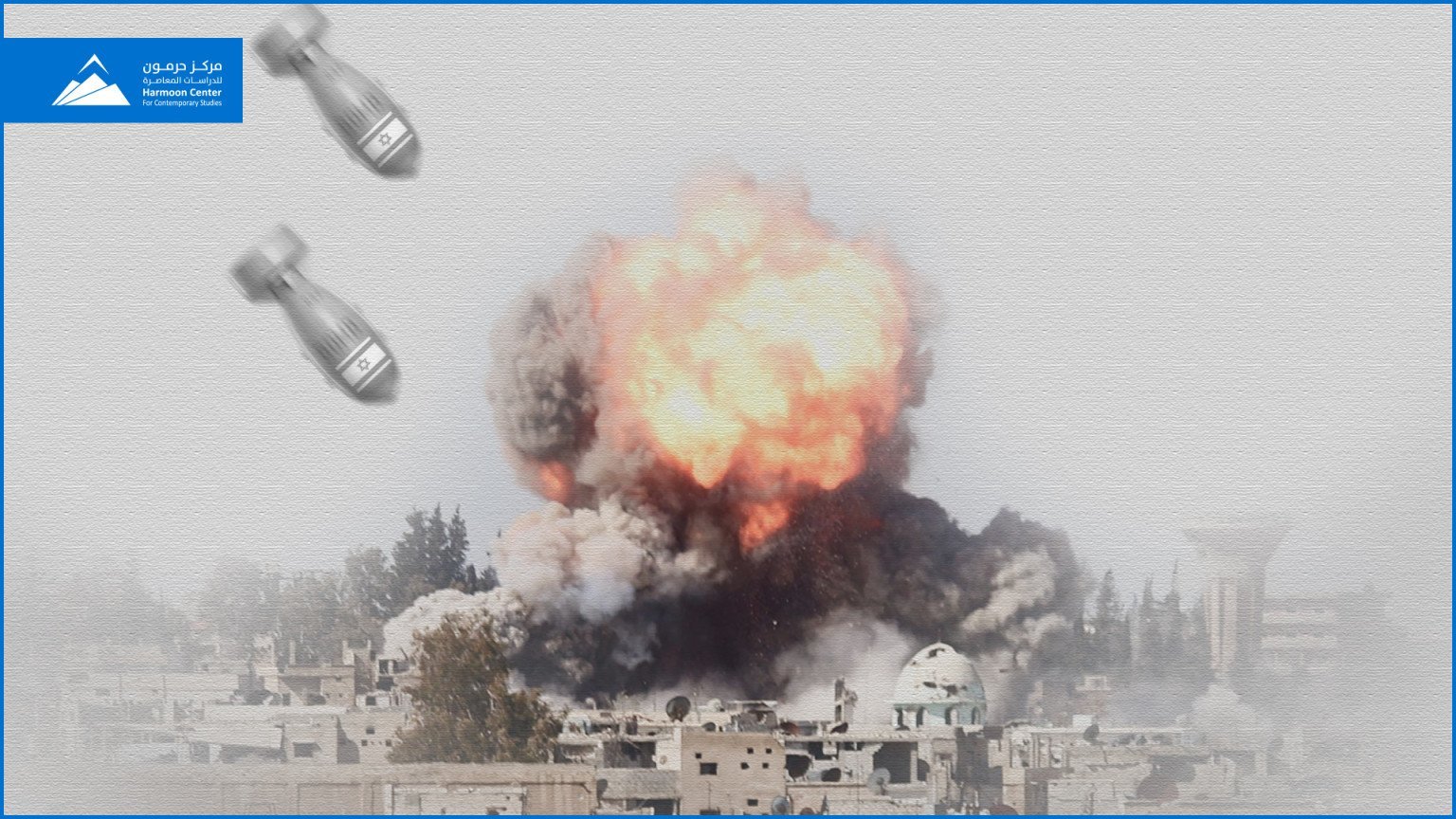
In the aftermath of the Assad regime’s fall, live conflict between Israel and Syria has reached a critical juncture in the history of relations between the two countries. The Assad dynasty presided over significant transformations in Damascus’s power structure and regional political alliances for over two-thirds of Israel’s entire existence. In recent years, new actors have emerged across the region, prompting Israel to ramp up its aggressive military stance in Syria. Since the regime fell, Israel has carried out hundreds of air and missile strikes and has occupied additional territory in southern Syria following the withdrawal of UN separation forces.
This paper explores the factors driving Israel to expand its occupation of Syrian territory and tear up international agreements in the process. It seeks to analyse Israel’s evolving policies toward Syria and assess the options available to Syria’s new government as they respond to Israeli escalation.
- Contexts of the Syrian-Israeli Conflict
Syria’s stance towards Israel has deep historic roots, predating the establishment of the Israeli state. As early as 1920, the Syrian Kingdom rejected the project of so-called “Zionist immigration.” The Syrian national movement went on to support the cause of Palestinian statehood, with Syria taking part in the 1948 Arab-Israeli war. During the conflict, the Syrian army briefly gained control of parts of northern Palestine before the Nakba and the defeat of the Arab armies. Since then, Syria has maintained a consistently hostile position toward the establishment of the State of Israel, viewing the Palestinian issue as integral to its national security.
The 1967 war marked a turning point, culminating in Syria’s loss of the Golan Heights. However, many Syrians continue to question the official narrative of the war – particularly in light of numerous eyewitness testimonies suggesting that the Syrian army’s withdrawal from Quneitra was carried out under direct orders from the leadership in Damascus.[1]
The Hafez al-Assad regime sought to reclaim Syrian territory occupied by Israel during the 1973 October War. A year later, Syria signed a disengagement agreement under UN auspices, which established a demilitarized zone between the two sides in 1974. This was not a peace agreement, but rather a ceasefire arrangement.

Negotiations within the framework of the stalled peace process between Syria and Israel then began in 1991 in Madrid, but they did not result in any agreement. In 2008, Turkey also attempted to mediate and revive talks through indirect diplomacy between the two sides. However, no agreement was reached due to several factors; namely Israel’s outright refusal to withdraw from the Golan Heights, the Gaza War, a lack of clear guarantees within the confidence-building process, and the Assad regime’s growing alignment with Iran.
Following the outbreak of the Syrian revolution, Iran’s increasing influence over the regime of Bashar al-Assad led Israel to adopt a cautious, neutral stance toward Assad – albeit one that did not support the Syrian revolution. However, this stance shifted as Israeli airstrikes and bombing operations within Syrian territory became more frequent, driven by the growing Iranian presence. These violations were coordinated directly with Russia, which then intervened in 2015 to support the Assad regime and shaped the regional dynamics for years to come.
Operation Al-Aqsa Flood in October 2023 dramatically shifted the region’s power relations. Israel launched a major offensive against forces aligned with the Iranian axis, targeting the Houthis in Yemen, Hezbollah in Lebanon and Syria, and – within Syrian territory – Iran and the remnants of the Assad regime’s military arsenal. This campaign established Israel as the dominant power in the region, significantly weakening its array of opponents. However, the fall of Assad marked the most profound change, raising crucial geo-security and geostrategic questions for the future of the region.
At a pivotal moment when both international and regional attention was focused on military confrontation, Israel crossed the long-established lines of contact and military engagement, advancing into southern Syria to expand the Syrian territory it already occupies. At the same time, the Military Operations Command forces were heavily focused on taking control of Damascus and overthrowing the Assad regime. This Israeli move served as a preemptive[3] [4] step, signalling[5] [6] a paradigmatic shift in Israel’s policies toward Syria – marking a stark departure from the circumspect approach that prevailed during the Assad era.
The first signal did not come through political rhetoric or official statements; Israel actually entered Syrian territory, a move unprecedented since 1974. This coincided with Israeli Prime Minister Benjamin Netanyahu’s announcement of the complete collapse of the Syrian-Israeli Disengagement Agreement, deeming it obsolete in the context of the new Syrian reality and Israel’s geo-security interests.[2]
During the initial period of security instability, Syria’s new president Ahmad al-Sharaa and his team aimed to manage tensions with Israel by issuing statements leaning more toward appeasement than conflict. They sought to balance condemning Israel’s incursion into Syrian territory with the possible future of their relationship, especially in light of Syria’s new regional approach of “no war and national reconstruction.” The Syrian president’s statements emphasised Syria’s reluctance to engage in any new war, while focusing on internal development, sending clear signals to regional countries, particularly Israel, that Syria would not pose a threat or serve as a launchpad for attacks against Israel. At the same time, he called for Israel’s withdrawal from the buffer zone it had occupied, an area of approximately 450 square kilometres[7] [8] .[3]
However, these statements were clearly insufficient to prompt Israel to reconsider its policies following Assad’s downfall. On the contrary, military involvement and threats against Syrian territory escalated, and Israel continued to target strategic Syrian military sites, to dismantle what remained of the country’s military arsenal. This was compounded by a military incursion that reached the administrative borders of Daraa Governorate, resulting in the establishment of over eight new military sites, along with launch surveillance capabilities now just 23 kilometres[9] [10] from the Syrian capital Damascus. The Israeli government declared that it would not allow Syrian government forces to deploy anywhere in southern Syria, and demanded that the entire region be demilitarized.[4]
As indications grew that Israel was shifting from threats and temporary incursions to a longstanding military occupation aimed at altering Syria’s territorial landscape, the Syrian administration began to reconsider its political actions and public discourse. The final statement of the National Conference in Damascus, under the second clause, explicitly condemned the occupation and rejected any ceding of Syrian territory. This stance followed the realization that Israeli ambitions clearly extend beyond addressing the power vacuum and seek to exploit Assad’s fall to expand its territorial control, using threats to national security as a practical justification for bypassing international and UN agreements.
International and regional reactions provided further motivation for the new Syrian government to strengthen its rhetoric, shifting from flexible diplomacy to a stance of “coercive diplomacy.” A key turning point came during President al-Sharaa’s visit to Turkey, where he met with Turkish President Recep Tayyip Erdoğan. The meeting occurred amid growing Israeli concerns about the potential start of coordination between the two countries, possibly leading to a joint defence agreement.[5]

The Syrian government has seen regional and international support, along with the activation of fresh diplomatic channels, as a crucial opportunity to deter Israeli aggression against Syria. Israel, on the other hand, is exploiting divisions within the international community over the new authorities in Damascus to strengthen its influence within Syria.
The overall regional and international landscape has, however, strengthened the Syrian government’s position, as countries have differentiated between their stances on the new Syrian government and their reactions to Israeli bombings and violations of Syrian sovereignty. International and regional engagement has proven effective, leading to some general opprobrium of the Israeli position. Positions have varied, with some countries issuing explicit condemnations of Israel, while others have condemned the actions without specifying the actor, as seen in statements from the United States, Germany, and Europe. Notably, traditional positions on Syria have remained unchanged, with some countries still hesitant or opposed to the new Syrian government, particularly those that were previously aligned with the Assad regime. These countries, including Iraq, Iran, and Russia, have all condemned Israel’s actions against Syria.
Ongoing objections to the Netanyahu government within Israel are limiting its domestic ability to sustain its escalation in Syria, restricting it to a specific time frame. Israel’s military engagements are taking place alongside the resurgence of protests within Israel, fueled by Netanyahu’s domestic policies, which are increasing popular discontent.[6] There is growing concern that these policies could undermine the so-called “Abraham Peace Accords,” shifting the focus from peace to war, or potentially jeopardizing the opportunity for regional stability – especially following the weakening of Iran. This concern is further amplified by increasing US discussions about a potential opportunity for peace with Syria and Lebanon, as highlighted by American envoy Steven Witkoff.[7]
- Israeli Ambitions, Fears, and Policies
The Syrian people’s overthrow of the Assad regime has resulted in a major shift in the regional rules of engagement. The Syrian issue has long been defined by its international and regional implications. Its strategic importance has made it a priority for the countries involved, and has, at times, led to conflict over territorial gains.[8] The new reality, marked by changes in the balance and positioning of forces, suggests that relations with the new Syria will increasingly polarize Israel and Turkey, rather than Russia, Iran, and Turkey. For the first time since World War I, the new Syrian reality has positioned Israel and Turkey in direct strategic opposition to one other.
The emergence of the new Syrian government has served to significantly reshape the unconventional alliance system that Israel had grown accustomed to. This shift presents an unusual threat and concern for Israel, particularly given Turkey’s expanding role. What was once a limited Turkish presence in northern Syria has evolved into a strategic alliance with the Syrian government. This has been a key motivation for Israel’s actions in southern Syria, often at the expense of Turkish forces in the north. The growing influence of Turkey makes Israel wary of Syria being supported by a NATO member and ally. Despite numerous security and political factors that could pose a threat to Israel, fear remains the primary driver of uncertainty and confusion.[9]

The new Syrian government’s intention to sign a joint defence agreement with Ankara has intensified Israeli concerns, confirming Tel Aviv’s growing conviction that a uniquely close relationship is emerging between Damascus and Ankara. These fears are further fueled by Turkey’s recent regional positioning and the deterioration of Israeli-Turkish relations following the Gaza War. Israel’s primary concern centres on the possibility of a new Syrian state aligning its interests closely with Turkey – prioritising shared Syrian-Turkish objectives over broader regional agendas or Israel’s strategic vision for the region.[10]
This shift in Damascus’ alliances has prompted Israel to deploy all available tools to regain the initiative and steer developments in a direction that serves its strategic interests. Central to this approach is the promotion of orchestrated instability—or what can be described as “calculated chaos”—through the creation of security challenges in southern Syria and efforts to prevent the new Syrian army from establishing control in the area, as part of a broader Israeli push for a “weapon-free” zone.
Tel Aviv has also escalated its tactics by attempting to play the sectarian card, particularly in Jaramana and as-Sweidaa governorate, where it has sought to incite public opinion against Damascus. Such interventionist rhetoric was largely absent during the Assad regime. Notably, Prime Minister Netanyahu declared Israel’s readiness to intervene if the Druze community in Syria were harmed, capitalizing on internal divisions within the Druze over their relationship with the new government. This trend culminated in an unprecedented visit by a delegation of Syrian Druze to the Golan Heights—the first in decades—highlighting the depth of polarization and shifting allegiances in the region.[11]
This indicates that Israel is attempting to fragment and exploit Syria’s minority communities by employing a policy of sectarian co-optation to legitimize its influence. However, the rise of nationalist movements in as-Sweidaa that support reconciliation with the Syrian government has posed a challenge to these ambitions, limiting the effectiveness of the so-called “minority card.” At the same time, the continued absence of a comprehensive Syrian social contract and the presence of multiple competing factions within minority groups still leave room for Israel—and other actors—to manipulate internal divisions while they remain fragile.
What is perhaps even more dangerous in this context is the growing sense among Syrian communities that they are constantly expected to justify and re-calculate their positions, largely due to ongoing Israeli pressure and narrative framing. Israel has used the minority card to legitimize military actions under the pretext of “protecting Syrian minorities” – a justification that complements its broader security rationale. This approach serves to reinforce Syria’s fragmentation, weakness, and disunity, especially so long as the Syrian government’s alliances diverge from Israel’s strategic vision for the region.
One option Israel appears to be pursuing is the restoration of Russia’s role in Syria as a guarantor of balance within the Syrian landscape. This would serve to reduce perceived threats to the Israeli government and, in turn, lower the risk of direct confrontation with Turkey and the new Syrian government. Israel believes that renewed Russian involvement could curb Turkey’s growing influence in Syria. However, a potential Turkish-Israeli clash is seen as a highly dangerous scenario—one both sides are eager to avoid. Indeed, Israel has made consistent efforts in recent years to avoid provoking Ankara.
Israel’s objectives in Syria appear to focus on the following:
- Weakening the Syrian state by ensuring its continued operational fragility, dismantling the remaining arsenal of the Syrian army, and obstructing any path toward stability that might enable the emergence of a strong, unified Syrian state.
- Establishing a security buffer in southern Syria by keeping the Syrian army – now composed of factions aligned with Syrian nationalist ideology and no longer subservient to Iran or Russia – at arm’s length from the Israeli border.
- Positioning itself as the protector of Syrian minorities in place of the Assad regime, particularly by exploiting tensions in as-Sweidaa Governorate. This strategy seeks to fragment Syria by promoting ethnic and sectarian divisions, encouraging loyalties to sub-national identities over a unified national identity.
- Preserving its dominance as the central regional power, capable of projecting control across the region. This involves limiting the influence of rivals like Turkey and Saudi Arabia, and tightening pressure on neighbouring Arab countries such as Jordan, Iraq, and Lebanon.
- Advancing its strategic vision of territorial control, especially in Syria, where the ongoing security vacuum presents a valuable opportunity that aligns with Israel’s broader regional ambitions.
Israel is clearly playing a destabilizing role in Syria, targeting not only Damascus but applying a broader strategy to maintain its dominance over the region. This approach is rooted in longstanding agreements and power dynamics that serve Israeli interests alone. The intensification of this strategy threatens not just Syria and Turkey, but also places Lebanon and Jordan in increasingly difficult positions. Should Israel succeed in asserting control over southern Syria, it would effectively encircle Jordan geopolitically, heightening regional pressure and increasing the likelihood of both political and military confrontations.[12]
- Syrian Options for Confrontation and Control
The new Syrian government faces numerous security challenges, both in restoring national sovereignty and addressing regional threats – and chief among them is Israel. Historically, Israel has always preferred a weak, authoritarian Syrian regime over a stable state that reflects the will of its people. It views the reemergence[11] [12] of a Syrian state that balances freedom and security as a long-term strategic threat. Nevertheless, the Syrian government has several options for responding to Israeli threats:
– Leveraging diplomatic capacity to use the principle of international mediation:
The Syrian government must work to rebuild its relationship with the United States by making tangible progress on a democratic and gradually moving toward the establishment of a national, locally rooted Syrian state. This includes addressing perceived threats, offering reassurances that Syria will not pose a threat to its neighbours, and removing any justifications for refusing to recognize the new government.
The United States is closely monitoring Syria’s actions, with the State Department indicating a possibly imminent reassessment of its stance on Damascus. Rebuilding trust with Washington could, hypothetically, enable Syria to leverage American mediation in restraining Israeli aggression against its territory and sovereignty. This would also help create conditions for long-term stability—particularly relevant given President Donald Trump’s emphasis on ending conflicts in the Middle East and promoting regional stability. Continued Israeli escalation undermines that vision, contributing instead to further chaos and insecurity.[13]
– Signing Joint Defence[13] [14] Agreements with Ankara as a Form of Coercive Diplomacy:
Cooperation with Turkey significantly strengthens the Syrian government’s ability to achieve regional balance. As a central regional power with a significant military presence in Iraq, Syria, and Nagorno-Karabakh, Turkey’s influence – both regionally and within NATO – can serve as a crucial deterrent to Israeli threats. A joint Syrian-Turkish defence agreement would represent a major shift, especially if carefully framed within a non-provocative context, unless Israeli actions morph into a full-blown invasion. Turkey’s role could extend beyond political support to include mediation, coordination, and strategic pressure on Tel Aviv, capitalising on its regional presence and international channels. Militarily, Turkey could support the Syrian army’s development, enhancing its capabilities and rebuilding it into an effective deterrent force.
The existence of land supply lines along the Syrian-Turkish border further increases the viability of this alliance, reducing the likelihood and effectiveness of a Gaza-style Israeli operation in southern Syria and diminishing Israeli willingness to escalate. Syrian-Turkish cooperation is grounded in the “win-win” principle of international relations, offering mutual benefits and strategic returns. This partnership is not merely tactical; it carries a long-term strategic dimension, providing Syria with a protective regional framework during its recovery. Over time, this alliance opens multiple options under a policy of “strategic patience.”

Building a Common Regional Path and Resolving Contradictions: Syria can transform the Israeli threat to its sovereignty into an opportunity by framing it as a broader regional danger and by forging strategic bilateral and regional ties with Saudi Arabia. These relations could help rebuild trust between the two countries, grounded in their shared opposition to Iran and Syria’s interest in restoring ties with Washington and engaging with the evolving regional order. As one of the most influential Arab states, Saudi Arabia could play a key role in shaping US policy – particularly if it acts as a mediator to halt violations of Syrian sovereignty. This could be facilitated by leveraging the growing role of regional mediation, as demonstrated in the agreement to demarcate the Syrian-Lebanese border following recent security tensions.
Strengthening trust and overcoming obstacles in Syria’s relationship with Egypt will also bolster Syria’s capacity to confront Israeli threats. This can be achieved by reframing these threats as regional concerns with collective implications, countering Israel’s efforts to isolate them through dual pretexts and its strategic alignment with Iran. The threats extend to Syria’s neighbours, particularly Jordan, which stands to suffer most from any Israeli incursion into Syrian territory. Israel’s withdrawal from the disengagement agreement also jeopardizes the long-standing legal framework governing the Syrian border. This breach of international commitments risks triggering widespread escalation, threatening regional stability—an outcome opposed by the current US administration as well as by Saudi Arabia and Qatar.
The primary danger of an Israeli incursion lies in the increased encirclement of Jordan and the collapse of prospects for renewed trade with Syria, directly endangering Jordan’s national security. As a result, the pursuit of regional stability is no longer a concern for Damascus alone but one that aligns with the interests of Syria’s neighbours. This gives Syria the opportunity to frame the stability of a new disengagement agreement not merely as a matter of sovereignty, but as a regional imperative affecting collective security. In doing so, Syria can facilitate regional cooperation against Israeli threats and increase regional pressure on Tel Aviv. Leveraging this approach may also help to build a regional front in support of Syria.
Leveraging the Principles of Sovereignty and Autonomy within International Institutions: Syria’s restoration of sovereignty and legitimacy—along with its re-engagement in the international system—signals the return of its full political status as a sovereign state and the reactivation of all diplomatic tools at its disposal. These tools can be used to shape international public opinion against Israel’s violations of Syrian sovereignty. Reintegrating into the international system offers Syria the opportunity to rely on international and UN institutions, such as the General Assembly and the Security Council, to address these violations and internationalise the issue. The more Damascus succeeds in balancing its relationships with both Western-aligned and opposing powers, the greater its chances of pursuing a policy of positive neutrality, attracting global support, and reframing international positions on Syrian sovereignty. This is especially true if diplomatic relations with key allies including Russia and China are restored. However, caution is key to prevent any perception of foreign interference in Syria’s internal affairs. A carefully managed foreign policy can provide Syria with a broader international umbrella and greater leverage to confront or mitigate risks. It may also open the door to negotiated settlements through the creation of regional frameworks involving key players such as Syria, Turkey, Jordan, Russia, and Israel.

Using Technology to Protect National Security: Technology has become a key tool for deterrence. During the revolution, the Syrian opposition effectively leveraged technology to support its security and military operations, gaining a temporary edge over the Assad regime. Notably, Shaheen drones were introduced during the formation of the 2024 Military Operations Room, despite the challenging circumstances the opposition faced. These technological capabilities enabled the revolutionary forces to gather critical intelligence on the movements of Assad’s regular army. As these forces evolve into state-level actors, their capacity to develop advanced security and military systems—particularly those utilising artificial intelligence and drone technology—has grown significantly. This progress strengthens their ability to secure borders, build robust defence[15] [16] systems, implement comprehensive surveillance networks, and deploy early warning technologies – which will be particularly relevant on Syria’s southern border with Israel.
Deterring Sectarianism While Addressing Internal Challenges: Israel continues to exploit the fissures in Syria’s social fabric, while the Syrian government requires time and support to confront and overcome the deep cultural and social legacy of mistrust left by the Assad regime. The government’s ability to address internal factionalism hinges on more than simple integration – it requires the full assimilation of figures like Ahmed al-Awda and the factions in Daraa into the Syrian army’s structural and operational framework. Another key challenge is the absence of a secure military corridor between Damascus and the southern region.
Accelerating efforts to bridge this gap could reduce security risks and help reach a settlement with as-Sweidaa’s Wise Elders regarding the governorate’s future. Enhanced coordination, sustained dialogue, and active national diplomacy – particularly in collaboration with pro-government forces – can significantly reduce the exploitation of sectarian divisions. These efforts would also throw sand in the gears of Israel’s attempts to manipulate Syria’s internal dynamics and support the gradual rollout of a roadmap for social reconstruction, rooted in transitional justice and national consensus.
Managing the Syrian National Project: Israel seeks to exploit vulnerabilities within Syria’s national discourse, particularly in the southern region, which suffers from severe deficiencies in public and economic services – a reality mirrored across much of the country. These gaps provide Israel with an opportunity to win over local populations in occupied areas by offering promises of improved living conditions, including better healthcare, education, and municipal services, especially in the Quneitra region. In addition to economic incentives, Israel is leveraging security fractures to deepen its influence among Syrians, particularly amid the Syrian government’s inconsistent stance toward Israeli aggression – vacillating between diplomatic restraint and threats of escalation. This ambiguity, coupled with widespread political frustration and the perception of unequal power dynamics, weakens the promise of national cohesion. To counter this, Syria must urgently develop comprehensive governance strategies that address economic, service-related, and security needs. A robust and integrated policy response would not only help fill existing gaps but also undermine Israel’s attempts to manipulate local grievances for its own strategic benefit.
Conclusion
Israel’s behaviour has been led by a deep sense of strategic threat posed by the emergence of a new Syrian state, even as Syria requires time to fully reclaim its status as a functioning sovereign entity. This perceived threat may be one of the key drivers as Israel appears to tamper with Syria’s fragile national security landscape. However, their southern neighbour seems unwilling to accept the evolving regional dynamic of asymmetric warfare – particularly in the Syrian context – suggesting a broader reluctance to adapt to the shifting balance of power.
Israel’s infringement on Syrian sovereignty marks a shift from traditional military violations – framed as preemptive[17] [18] actions against potential threats – to a broader effort to disrupt Syria’s political and national reconstruction during its transitional phase. This reflects a strategic risk management approach, rooted in the belief that Syria, if successful in rebuilding its state institutions, could emerge as a long-term threat in the coming decades.
Israel is attempting to undermine the emerging Syrian project before it can fully take shape, and at the very least, create tactical obstacles to slow its progress. Clearly, Israel is exploiting every available tool, including the internal sectarian divides, to fragment Syrian society, deepen divisions, and keep Syria weak, disunited, and trapped in a conflict of sub-national identities – far from fostering a unified national sense of self. The Syrian government must counter this by neutralising these divisive tactics, addressing internal issues, and continuing the national-regional struggle, much like the revolutionary forces did during the Syrian revolution. It is crucial to view this phase as one of self-development, national growth, and defence[19] [20] of national security, while implementing policies that will strengthen Syria’s position in coercive diplomacy.
References
Arab Center for Research and Policy Studies (2025) Israeli policy towards Syria after the fall of Bashar al-Assad’s regime. 9 March. Available at: https://cutt.ly/bro1elOZ (Accessed: 18 April 2025).
Fraser, S. and Hazboun, I. (2025) Turkey and Israel face mounting tensions over future of post-Assad Syria. 15 March. Available at: https://cutt.ly/5ro1sP20 (Accessed: 18 April 2025).
Harmoon Center for Contemporary Studies (2025) Israeli escalation in Syria in early 2025: Raids, targets, and implications. 18 February. Available at: https://cutt.ly/prpsPaDW (Accessed: 18 April 2025).
Harmoon Center for Studies (2025) Southern Syria: Israeli moves and regional balances. 4 March. Available at: https://cutt.ly/3roM0NRq (Accessed: 18 April 2025).
Le Monde with AFP (2025) In Israel, opposition calls for general strike over security chief dismissal. 22 March. Available at: https://cutt.ly/droM7pdZ (Accessed: 18 April 2025).
Kurtzer-Ellenbogen, L. (2024) What Assad’s fall means for Israel and its regional relations. 19 December. Available at: https://cutt.ly/dro1s84c (Accessed: 18 April 2025).
The New Arab (2025) Lebanon, Syria could ‘normalise ties with Israel’, US Middle East envoy Witkoff claims. 27 February. Available at: https://cutt.ly/CroM5nxk (Accessed: 18 April 2025).
Mort, J. (2025) Can Trump make a deal for Middle East peace? The Guardian, 23 January. Available at: https://cutt.ly/Wro1tHBH (Accessed: 18 April 2025).
Middle East Monitor (2025) Netanyahu says Israel will stay in southern Syria ‘for foreseeable future’. 25 February. Available at: https://cutt.ly/OroM4wx1 (Accessed: 18 April 2025).
Ravid, B. (2024) Scoop: Israel and Jordan held secret talks on Syria. 14 December. Available at: https://cutt.ly/Lro1djEU (Accessed: 18 April 2025).
Svetlova, K. (2025) Following Assad’s fall, do Syria’s Druze want Israel to come to their aid? Haaretz, 3 March. Available at: https://cutt.ly/2ro1woSv (Accessed: 18 April 2025).
Valensi, C. (2025) A new era in Syria: Winners, losers, and implications for Israel. 12 January. Available at: https://cutt.ly/Kro1de7x (Accessed: 18 April 2025).
[1] See Khalil Mustafa, The Fall of the Golan Heights, pp. 30-90.
[2] “Netanyahu says Israel will stay in southern Syria ‘for foreseeable future’,” Middle East Monitor, February 25, 2025: https://cutt.ly/OroM4wx1.
[3] Harmoon Center for Contemporary Studies, “Israeli Escalation in Syria in Early 2025: Raids, Targets, and Implications,” February 18, 2025: https://cutt.ly/prpsPaDW
[4] Harmoon Center for Contemporary Studies, “Southern Syria: Israeli Moves and Regional Balances,” March 4, 2025: https://cutt.ly/3roM0NRq
[5] Suzan Fraser and Ibrahim Hazboun, “Turkey and Israel Face Mounting Tensions Over Future of Post-Assad Syria,” March 15, 2025: https://cutt.ly/5ro1sP20.
[6] “In Israel, opposition calls for general strike over security chief dismissal,” Le Monde with AFP, 22 Mach 2025: https://cutt.ly/droM7pdZ.
[7] “Lebanon, Syria could ‘normalise ties with Israel’, US Middle East envoy Witkoff claims,” The New Arab, 27 February 2025: https://cutt.ly/CroM5nxk
[8] Fadel Khanji, “Evoking the Shock of October 7th When Thinking About Syria’s Future,” Omran Center for Strategic Studies, May 16, 2024: https://cutt.ly/Uro1iqgG
[9] Lucy Kurtzer-Ellenbogen, “What Assad’s Fall Means for Israel and Its Regional Relations,” Thursday, December 19, 2024: https://cutt.ly/dro1s84c
[10] Carmit Valensi, “A New Era in Syria: Winners, Losers, and Implications for Israel,” January 12, 2025:https://cutt.ly/Kro1de7x
[11] Ksenia Svetlova, “Following Assad’s Fall, Do Syria’s Druze Want Israel to Come to Their Aid?,” Haaretz, March 3, 2025: https://cutt.ly/2ro1woSv
[12] Arab Center for Research and Policy Studies, “Israel’s Policy Towards Syria After the Fall of Bashar al-Assad’s Regime,” March 9, 2025: https://cutt.ly/bro1elOZ
[13] Jo-Ann Mort, “Can Trump make a deal for Middle East peace?,” The Guardian, 23 Jun 2025: https://cutt.ly/Wro1tHBH