


Introduction
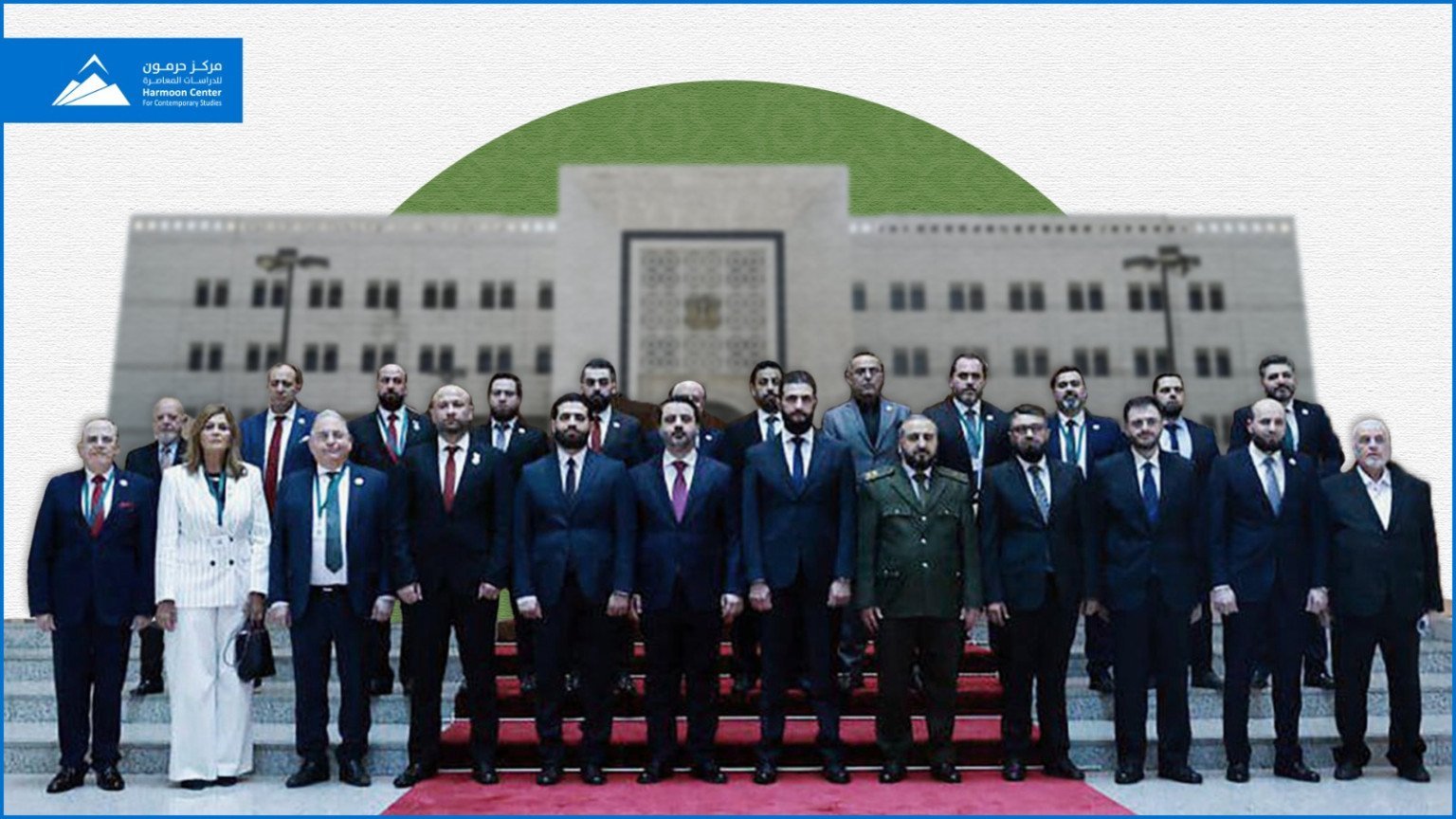
The Syrian Transitional Government has been established as the second pillar of the country’s new governance structure. Following the Constitutional Declaration for the Transitional Period, Syria’s new leaders announced the government’s formation on Saturday March 29, 2025, during a televised ceremony at the Presidential Palace. As the “executive authority,” the transitional government forms one of three branches of power in post-Assad Syria. A temporary legislative council is expected to begin drafting legislation, while the Supreme Judicial Council will serve as the judiciary.
At the ceremony, President Ahmed al-Sharaa opened the meeting with a speech outlining his administration’s objectives for the next phase of Syria’s transition. Each minister then delivered a speech detailing their ministry’s specific goals, which were remarkably ambitious. The government does not include a Prime Minister, as the American-style presidential system, which Syria has adopted under the Constitutional Declaration, grants the President direct oversight of the ministers. However, a Vice President is still needed to manage the Council of Ministers in the President’s absence.
The formation of the government was met with intense anticipation, particularly the cabinet – which al-Sharaa had pledged would be inclusive, representative, and based on merit. The ceremony attracted significant domestic, regional, and international attention, in the shadow of Syria’s ongoing territorial fragmentation. The SDF continues to control the northeast, imposing its own rule on the ground despite a framework agreement between President al-Sharaa and Mazloum Abdi.
In as-Sweidaa, local forces still reject Damascus’s authority and maintain their own control of sovereign Syrian territory. Meanwhile, Israel remains active in southern Syria, conducting periodic airstrikes and making strategic advances, further fracturing Syria’s unity. Tensions also persist in the coastal region and the city of Homs. The security situation on the coast has drawn widespread international criticism, tarnishing the transitional authority’s reputation. Additionally, growing societal friction between extremist factions and local communities has heightened fears among large swathes of the population.
Amid these challenges, the announcement of the new cabinet significantly shaped the political climate and influenced the course of events, both positively and negatively.
To the credit of the new government, it was announced in an unprecedented manner. A public session, attended by approximately 300 guests—including a small number of women—was held and broadcast live. During the session, each minister outlined their initial vision and programme, many of which were highly ambitious. Given Syria’s ongoing internal and external challenges – especially its complex political and geographical divisions – these pledges to the Syrian people will be difficult to fulfill. The government’s approach appeared to convey two key messages: domestically, a commitment to openness and transparency, and internationally, a willingness to enter a new, more accountable phase. Notably, however, the term “transitional government” was in fact absent from the session’s discourse.
The Structure of the Cabinet
The new cabinet comprised 23 ministries, six fewer than the previous regime. Some ministries were merged, while the Ministry of Water and the Ministry of Internal Trade and Consumer Protection were abolished. Two new ministries were introduced; the Ministry of Youth and Sports, and the Ministry of Emergencies and Disasters. The reduction from 29 to 23 ministries reflects an organizational restructuring and, crucially, a pragmatic response to resource scarcity and financial constraints. With a meagre general budget and limited prospects for external support—especially if sanctions remain in place—cutting government expenditure has become a necessity.
While departmental mergers may help streamline operations and reduce costs, they also pose challenges for ministers now overseeing multiple portfolios, particularly given the constraints of a limited administrative staff and a complex bureaucracy. Notably, the Ministry of Emergencies and Disasters might have been more effective as an independent body rather than as a full ministry. Additionally, clarity is needed regarding the responsibilities of the abolished ministries, particularly Irrigation and Internal Trade, and which ministries will assume their functions.
The new government features a strong cohort of young ministers, with birth years ranging from 1956 to 1992. It is largely composed of graduates of Western universities, with most ministers having academic or technical professional backgrounds, including doctors, engineers, and economists. Geographically, representation is concentrated in Damascus and its countryside with five ministers, followed by Idlib with four, Aleppo and Deir ez-Zor represented by three each, Hama have two. The cabinet also has one minister from each of Quneitra, Tartous, Latakia, Homs, and Hasakah. Notably, there are no ministers from Daraa or Raqqa. The government is predominantly Sunni Arab, with two Kurdish ministers and one representative each from the Druze, Christian, and Alawite communities. There is marked lack of representation of Turkmen or Ismailis.
A significant portion of the ministers, nine out of the 23, are affiliated with Islamist movements – particularly Hay’at Tahrir al-Sham and the Salvation Government – and they hold key ministries of state. The Ministries of Oil, Electricity, and Water have been merged into a single Ministry of Energy, led by Muhammad al-Basheer. Seventeen ministers are known opposition figures, while six have no clear political affiliations. Two previously held ministerial positions in the pre-revolution government, and several others served in the Salvation Government (SG) in Idlib or the Caretaker Government (CG) that succeeded the former regime, with some retaining their previous posts. Women’s participation remains minimal, with only one female minister—a step widely seen as insufficient given increasing demands for greater political inclusion.
Domestic Reaction
A wave of optimism swept through the Syrian public with the appointment of new and younger faces to the cabinet. However, disappointment has remained over the lack of broader participation, particularly the marginalization of women. While the government includes figures from diverse ethnic and religious backgrounds, it cannot be considered truly representative of all Syrians. Symbolic diversity alone cannot replace genuine representation, which can only be ensured through democratic elections—an impossibility under current conditions. A more inclusive approach, such as community or elite consultations to influence the cabinet’s formation, could have strengthened its legitimacy and mitigated the discontent expressed by various figures and groups. However, this step was not taken, and has raised questions about the selection process. The absence of traditional opposition figures from the Syrian Coalition, the Interim Government, and the Negotiating Commission suggests an effort to break from past models. And yet, this shift has not been accompanied by greater openness to emerging civil or societal forces.
The SDF issued a strong statement rejecting the new government, describing it as “exclusionary and unilateral.” SDF emphasized that they would not recognize any decisions made by the government, viewing its formation as a “return to monopolization and hegemony.” The same sentiment was shared by the key forces in as-Sweidaa and the as-Sweidaa Military Council. This rejection risks deepening national divisions and undermines efforts to establish a comprehensive national partnership. The ongoing geographic and political divisions, most crucially the unresolved issues in the SDF-controlled areas and as-Sweidaa, remain the most significant challenges for the government in its pursuit of rebuilding the country’s unity.
The International Response
The announcement of the new transitional government was welcomed by many countries, including Qatar, Turkey, Saudi Arabia, the United Arab Emirates, the United Kingdom, Germany, Norway, Jordan, Kuwait, France, Italy, and others.
The United States announced that it will continue to monitor the actions of the interim authorities and determine future steps based on their assessments, particularly in relation to sanctions. Any shift in US policy will depend on a sequence of actions, including the full renunciation and suppression of terrorism, the exclusion of foreign fighters from official positions, and preventing Iran and its proxies from exploiting Syrian territory. The US demands that the new Syrian regime takes verifiable steps to dismantle Assad’s chemical weapons, assisting in the recovery of US citizens and others who have disappeared in Syria, and ensuring the security and freedoms of religious and ethnic minorities.
The European Union, on the other hand, expressed its willingness to support the new government. Unlike previous statements, the EU’s announcement did not include any conditions, signaling that EU countries are ready to cooperate with the new Syrian government regardless of US policy.
The Objective Challenges Facing the Government
The new government faces significant challenges, from reconstruction and securing the return of refugees to the most difficult task of all; rebuilding national unity in a fractured and weary society. Achieving this will require more than just day-to-day management; it will demand a project to restore the country’s unity and bridge political and societal divisions, with the ultimate aim of rebuilding national trust.
• Transitional Justice and Community Peace: Transitional justice remains absent from the government’s agenda, despite its potentially crucial role in rebuilding societal trust after years of division. Additionally, efforts to foster civil and community peace have not been adequately pursued, leaving tensions unresolved among various groups. This represents the greatest challenge for the new Syrian government, as it encompasses key national agreements on the nature of the political system, the new social contract, power sharing, public freedoms, decentralized administration, and addressing the growing desire for revenge among certain groups in recent months.
• Multiple Areas of Control: Several regions remain under the control of armed factions. The SDF, controlling the area east of the Euphrates, has signed a framework agreement with Damascus – but many details of this agreement remain contentious. Similarly, as-Sweidaa remains outside government control, rejecting Damascus’s authority and demanding specific changes in governance. Israel continues to openly declare its efforts to prevent Damascus from extending its control over the sovereign lands of southern Syria, carrying out periodic raids and airstrikes. Additionally, in Daraa Governorate, factions – particularly those led by Ahmad al-Awda – have yet to reach an agreement with Damascus.
• Security Breakdown: The population suffers under widespread chaos and mismanagement of security on the streets, which directly hampers the government’s ability to enforce the law and uphold the authority of its institutions. The lack of a professional and unified security apparatus continues to complicate efforts to restore stability. This disorder is evident in ongoing unrest in coastal areas and Homs, as well as in the abuses of power against citizens by security forces. Many individuals are arrested without legal grounds, specific charges, or a court order. Detainees are often imprisoned without trial, and their families are left unable to determine their whereabouts. Meanwhile, incidents of violence, assault, and theft have increased, driven by severe financial hardship and insufficient police presence on the ground.
• Destruction and Collapsed Infrastructure: The government faces a monumental challenge to repair Syria’s widespread destruction of infrastructure. Without a comprehensive reconstruction plan, basic services will remain limited, undermining the government’s legitimacy in the eyes of its citizens.
• Refugees and Displaced Persons: The number of Syrian refugees and displaced persons is estimated at around 12 million, including over 5 million internally displaced individuals and more than 6 million refugees – primarily in Turkey, Lebanon, Jordan, and Europe. They represent a significant burden for the new government, requiring comprehensive programmes and extensive regional and international cooperation. Given the current conditions, many refugees are not enthusiastic about returning home.
• External Recognition: Despite the regional and international welcome for the government’s announcement, full political recognition remains absent. Most countries view the government as a “functional” entity rather than a legitimate, recognized alternative. This hesitation in the international stance limits the government’s ability to secure the financial and political support needed for its stability.
• External Threats: The government faces ongoing threats from hostile regional powers that are disinclined or unwilling to accept political change in Syria. C continued foreign military presence – both regular and irregular – also undermines the government’s ability to assert control over national sovereignty.
• Syria’s Geopolitical Location: Syria occupies strategic territory where regional and international influences intersect, making any government vulnerable to conflicting and competing pressures. The new government must craft a balanced foreign policy that preserves the country’s identity, avoids entanglement in regional alliances, and remains open to international powers that support the restoration of stability.
• Challenges of Scarce Resources
The significant challenges facing the transitional government demand substantial financial and human resources, yet the government itself is grappling with a severe shortage of both.
• Scarcity of Material Resources: The government faces a near-total lack of material resources due to international sanctions and a lack of external funding. Ministers will be confronted with a reality that contrasts sharply with the aspirations outlined during the ceremony. In its early years, Syria will require external aid, in addition to fostering domestic investment and revitalizing the local economy. However, these two sources – both internal and external – are dependent on the lifting of sanctions imposed on Syria since 2011. These sanctions, including those from Arab, European, American, and UN entities, place heavy restrictions on the country, preventing aid and hindering investment. As a result, the government’s success will depend on its ability to develop domestic resources, activate alternative financing mechanisms, and secure external aid. This will require political flexibility and a pragmatic approach to both domestic and external realities.
• Human Resources Shortage: The Caretaker Government has, thus far, relied more on political loyalty than meritocracy, resulting in the dismissal of thousands of key personnel who once managed state institutions and their replacement with young, inexperienced individuals. This has negatively impacted the performance of various state institutions. The government must restore the credibility of these institutions, recruit qualified personnel, and end loyalty-based appointments – a challenging task that will require genuine political will.
• Powers: The greatest challenge lies not in capabilities but in the limitations of the government’s authority. The key questions remain: Does the new government have the power to make decisions on the ground? Can it control the armed factions that still hold territory? Does it have the final say on sovereign decisions? If these issues remain unresolved, achieving stability will remain rhetorical for the new government.
• Diversity within the Government: While the government’s diversity may be a strength, it also presents a challenge due to the ministers’ differing ideological and professional backgrounds. It is unclear whether the government will be able to function cohesively as a team, and to what extent President al-Sharaa can control the direction of the government as a unified national body.
Due to these myriad challenges, the government must urgently issue a statement outlining its programme for the transitional period, which, according to the Constitutional Declaration, will span five years. The statement should lay out the key aspects of the political, economic, and social systems involved, and spell out the social contract it aims to establish. It should also include timelines for implementation, alongside monitoring mechanisms and criteria for measuring progress. Crafting this statement is no mean feat, as each ministry’s programme reflects a particular vision and specific interests.
Conclusion
Despite all the reservations laid out above, it is too early to make a final judgment on the new government. The experiment is still in its early stages, and while cautious, there remains hope that the government can achieve tangible results, particularly in improving public services and living conditions. Syrians are likely to give the government an unspoken but decisive deadline—perhaps up to six months—before the public demands greater accountability. During this period, performance across each ministry will be closely monitored, along with the implementation of the programmes announced during the inauguration.
Despite all the disappointments, Syrians remain vigilant, watching with open eyes and alert minds, searching for any glimmer of hope that might free them from the reality of division and deprivation. They understand that this is no longer a time for experimentation or empty slogans. Success is not a luxury; it is a national necessity that cannot be delayed.
Appendix 1: Formation of the Syrian Transitional Government