


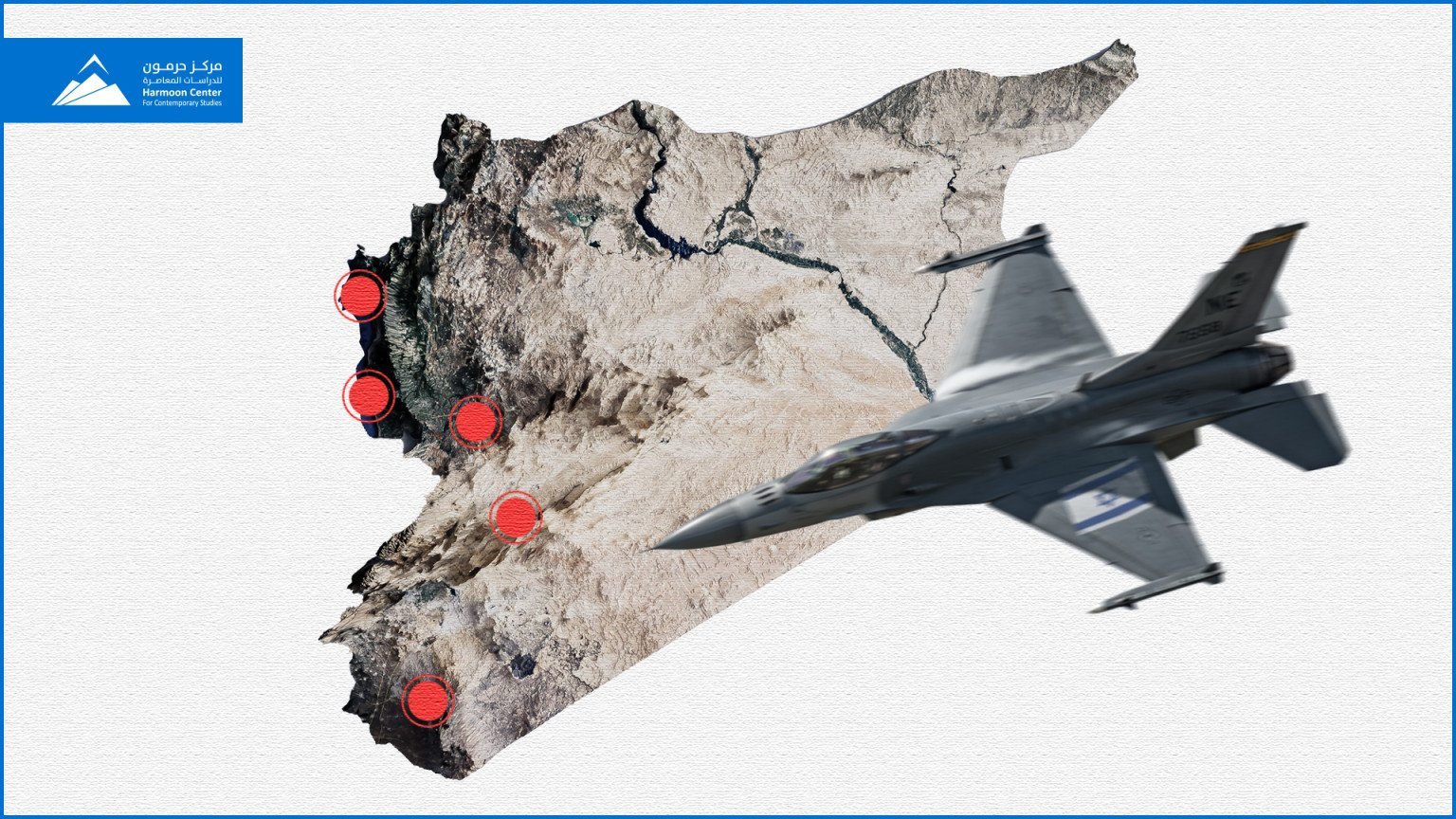
A total number of 80 Israeli strikes on Syria were recorded throughout March 2025, targeting diverse military sites across five key Syrian provinces. The trend marks a notable escalation in the intensity of strikes during the month, with several concentrated strikes carried out on the same day, particularly in Homs and Rural Damascus. These concentrated and repeated barrages point to an Israeli strategy of undermining Syrian military capabilities and preventing the repositioning of forces in strategic locations.

The figures indicate that Homs province was the primary target, accounting for more than two-thirds of the strikes (68.5%), especially focused on T4 (Tiyas) and Palmyra airbases. This demonstrates a clear intention to disrupt the airforce infrastructure and logistical support to the military deep within Syria. Rural Damascus came in second place with (13.75%), which is a significant figure considering the presence of numerous brigades and military divisions there, such as the 68th and 90th Brigades. Daraa accounted for (11.25%) of the strikes, while strikes in Latakia and Tartus were limited and mainly targeted defence facilities and warehouses. Below is a comprehensive table of all strike targets in March:
| Governorate | City/Town | Target | Number of Strikes | Date of Strike |
| Tartus | Tartus | Air defence site | 2 | 03.03.2025 |
| Latakia | Qardaha | Qardaha Stadium (military warehouses) | 1 | 03.03.2025 |
| Daraa | Izraa | 12th Armored Brigade | 1 | 10.03.2025 |
| Rural Damascus | Khan al-Sheih | 68th Brigade | 2 | 10.03.2025 |
| Rural Damascus | Kom | 90th Brigade | 1 | 10.03.2025 |
| Rural Damascus | Al-Kiswah | Military brigade base | 1 | 10.03.2025 |
| Daraa | Izraa | Army radar area | 1 | 10.03.2025 |
| Rural Damascus | Zakiyah | 137th Artillery Regiment | 1 | 10.03.2025 |
| Daraa | Izraa | 12th Armored Brigade | 1 | 10.03.2025 |
| Rural Damascus | Kom | 90th Brigade | 1 | 10.03.2025 |
| Daraa | Jabab | 89th Brigade | 3 | 10.03.2025 |
| Rural Damascus | Al-Kiswah | Military brigade base | 1 | 10.03.2025 |
| Rural Damascus | Damascus International Airport | Army radar area | 1 | 10.03.2025 |
| Rural Damascus | Khan al-Sheih | 68th Brigade | 1 | 10.03.2025 |
| Rural Damascus | Al-Hayjanah | Air defence base | 1 | 10.03.2025 |
| Rural Damascus | Dummar al-Balad | Islamic Jihad headquarters | 1 | 13.03.2025 |
| Daraa | Izraa | 12th Armored Brigade | 1 | 17.03.2025 |
| Daraa | Daraa City | 132nd Brigade | 2 | 17.03.2025 |
| Homs | Khirbat al-Tayyas | T4 / Tiyas Airbase | 16 | 21.03.2025 |
| Homs | Palmyra | Palmyra Airbase | 13 | 21.03.2025 |
| Homs | Khirbat al-Tayyas | T4 / Tiyas Airbase | 11 | 24.03.2025 |
| Homs | Palmyra | Palmyra Airbase | 15 | 24.03.2025 |
| Latakia | Latakia City | 110th Brigade | 2 | 26.03.2025 |

Air bases were the primary targets of Israeli strikes during March 2025, receiving 55 strikes representing 73% of the total. This clearly reflects a coordinated strategy by Israel to paralyse aerial infrastructure and prevent any attempt to rebuild the Syrian Air Force. Among the most prominently targeted sites were T4 (Tiyas) and Palmyra airbases, each of which was struck twice in under four days, indicating a “double strike” strategy aimed at ensuring complete destruction.
Map (1): Locations of Israeli strikes on Palmyra Airbase during March 2025

To view the map in high resolution, click on the link.
Map (2): Locations of Israeli strikes on T4 (Tiyas) Airbase during March 2025

To view the map in high resolution, click on the link.
Secondary targets were the headquarters of ground brigades and regiments, with 18 strikes – 24% of the total. These were spread across Rural Damascus and Daraa, targeting key military groups such as the 68th Brigade near Khan al-Sheih, the 90th Brigade in Kom, the 132nd Brigade in Daraa City, and the 12th Armored Brigade in Izraa. This shows that Israel’s objective was not only to disrupt air defences but also to hinder the reconstruction of coherent and efficient ground units for the Syrian army.
Air defence sites and radar systems were hit by 5 strikes (6.6%) across Syria, including sites in Tartus, around Damascus Airport, Zakiyah, and al-Hayjanah. In contrast, only one strike (1.3%) was recorded on military warehouses in Qardaha, reflecting a shift in Israel’s focus, now moving toward the sovereign military structure of the Syrian army.
Additionally, a single strike targeted the headquarters of the Palestinian Islamic Jihad in Dummar al-Balad, rural Damascus. This has been classified as an attempted assassination, which may have been a preemptive Israeli message directed at Palestinian factions previously aligned with Iran. We can see clearly from the data that most strikes, 73% in total, were aimed at disabling air capabilities. Ground units and air defences have become secondary targets, and strikes on warehouses and assassinations have significantly declined.
- Kuwaya Incident in Western Daraa and Civilian Casualties in Southern Syria
The town of Kuwaya in western rural Daraa witnessed one of the deadliest and most escalatory attacks in March 2025, following an attempted ground incursion by Israeli special forces into the border town. This prompted a spontaneous grassroots reaction, as locals confronted the incursion using personal firearms. The confrontation escalated into Israeli aerial and artillery strikes, which forced hundreds of families to flee the area. The operation ended with the Israeli forces withdrawing, and it was followed by a wave of intense local and regional outrage, especially as residents strongly refute the Israeli claim that ISIS cells were present in the town. The townspeople of Kuwaya suffered the most human losses, with at least 6–7 civilians killed, and dozens wounded – including women and children. Additionally, 3 deaths and 22 injuries were recorded in Daraa City and Izraa on March 17, making Daraa Governorate the area with the highest number of casualties compared to other provinces.
In contrast, no fatalities were recorded in the Homs and Latakia strikes due to the isolated nature of the targets. Meanwhile, one person was killed in a strike on the Palestinian Islamic Jihad headquarters in Rural Damascus.
- Conclusions
The geographic distribution of Israeli strikes during March 2025 reveals that Homs Governorate was a central focus, particularly due to the intensive targeting of T4 and Palmyra airbases. There is a clear intention to disable these critical sites and paralyse any operational or logistical capabilities therein.
In Rural Damascus, the strikes were markedly diverse, targeting major military brigade headquarters as well as radar and air defence sites, indicating a systematic attempt to exhaust military capacities in and around the capital, breaking down early warning systems and the organizational structure of the new army. In Daraa, the pattern of strikes remained consistent with past trends, focusing on ground brigades and radar positions, signaling Israel’s ongoing concerns at the prospect of stability of southern Syria.
Although the coastal region witnessed limited targeting, the strikes on Qardaha and Tartus appeared symbolic and preemptive, delivering deterrent messages aimed at preserving Israeli air dominance along the coastal strip and preventing any unexpected military activity in this sensitive area.