


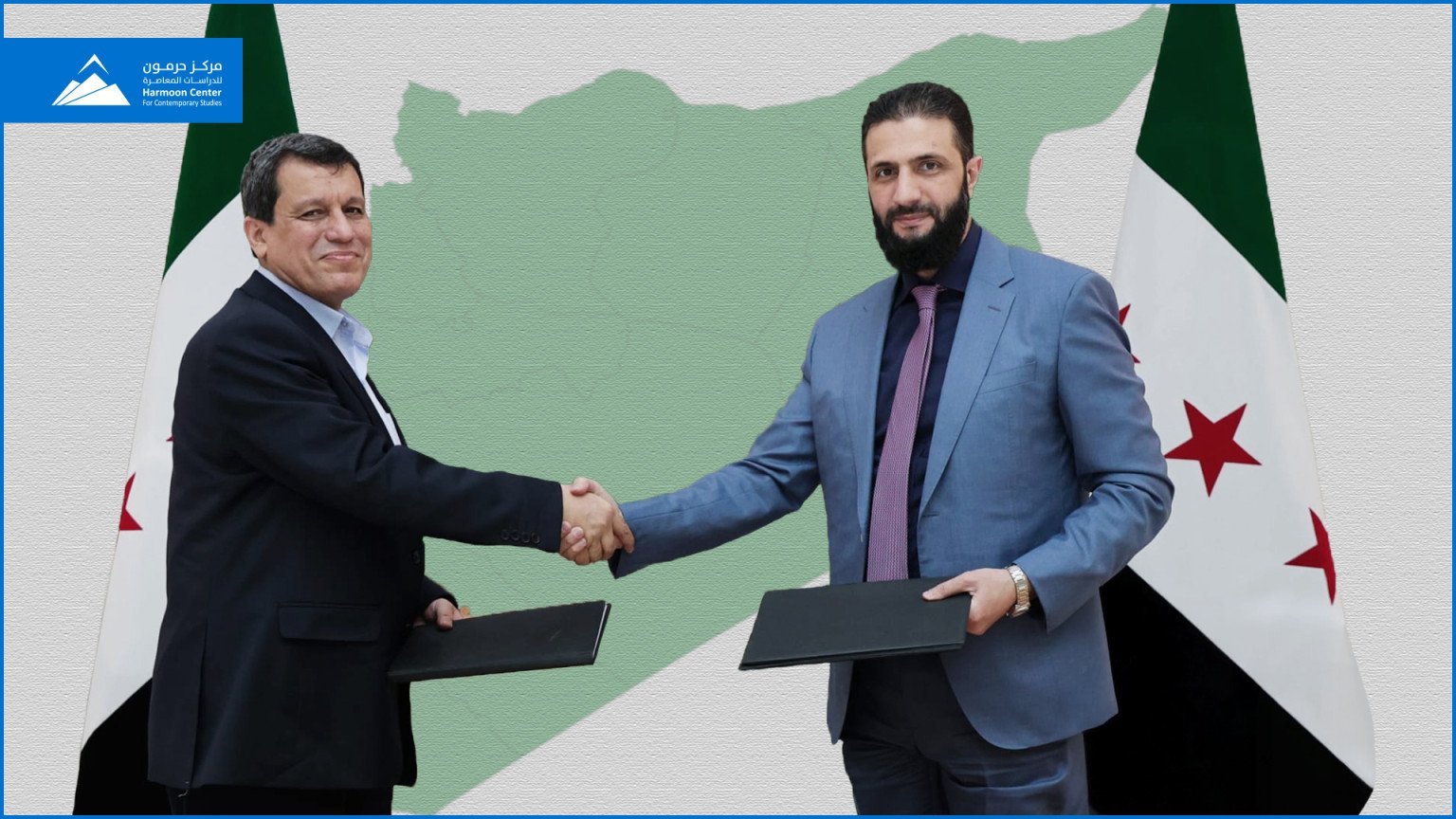
Political and military agreements between local actors play a crucial role in shaping the future of countries as they emerge from protracted crises. In the case of Syria, the new accord between the government and the Syrian Democratic Forces (SDF) marks a pivotal shift that could redefine the country’s political and security landscape. Following the meeting between President Ahmed al-Sharaa and SDF Commander-in-Chief Mazloum Abdi on March 10, an agreement was reached that has been called historic. It carries significant prospects for Syria’s politics, security, and economy, and marks a shift in the relationship between the new Syrian government and the SDF.
This situation assessment examines the agreement’s terms from those three perspectives, evaluates its repercussions within Syria and its impact on key actors, and explores the challenges it may face. Additionally, it outlines potential future scenarios.
I. Analysis of the Agreement Between the Syrian Government and the SDF
Before any analysis of the agreement’s published text, it is crucial to understand each party’s objectives in the negotiations. The new Syrian government seeks to consolidate control over the entire country, assert sovereignty over border crossings, oil fields, and state institutions in the Syrian Jazira (i.e., east of the Euphrates). The SDF, meanwhile, aims to safeguard gains it has made over the last decade, and integrate into the Syrian state while securing its rights, and ensure its recognition as the representative of the Kurds with political and constitutional representation. Additionally, it seeks to avoid military confrontation with Türkiye and mitigate the risks of a potential US withdrawal of support.
Several developments paved the way for this agreement, including Kurdistan Workers’ Party (PKK) leader Abdullah Öcalan’s announcement of an agreement with Türkiye. US statements signaling a desire to withdraw from Syria have also dialled up the pressure, as well as the SDF’s own concerns about the consequences of such a withdrawal if no deal was reached. Türkiye has also sharpened its focus on the SDF, while events along the Syrian coast, and international scrutiny of the new Syrian government have compelled it to adopt a more flexible approach. The agreement emerged as a timely response to the developments on the Syrian coast and their broader implications. The agreement can be examined through the following key dimensions:
- Ensuring fair representation in the political process
The first clause guarantees all Syrians the right to participate in politics and state institutions without religious or ethnic discrimination. This commitment underscores the new Syrian government’s aim to establish a more representative system. It also seeks to reassure the SDF of their active and continued role in the country’s political landscape.
- Recognizing the Kurdish role in Syria
The second clause affirms that the Kurdish community is an essential part of the Syrian state and guarantees its full citizenship rights. This provision addresses a longstanding legal and political issue. By acknowledging these rights, the state embraces a new approach that recognises ethnic pluralism while maintaining equality without special privileges. This recognition aligns with the new national principles of a unified state.
- Rejecting partition and hate speech
Article three emphatically rejects both partition and hate speech, sending a clear message to internal and external actors who seek to exploit ethnic and sectarian divisions to prolong the conflict. It reaffirms Syria’s unity and explicitly denounces any fragmentation into entities defined by ethnic or sectarian identities.
- A Ceasefire across all Syrian territory
A comprehensive ceasefire is a crucial provision, ending active combat and paving the way for more stable political solutions. It also increases the likelihood of forming a unified national army free from factional loyalties, allowing the state to focus on both internal and external security challenges.
- Integrating the SDF’s military and civilian institutions into the Syrian state
This clause, one of the most sensitive provisions, calls to integrate all civilian and military institutions in northeastern Syria into the Syrian state administration – including border crossings, airports, and oil and gas fields.
- Supporting the government’s campaign against remnants of the Assad regime
This clause marks a shift in the SDF’s stance, committing it to supporting the Syrian government in combating remnants of the former regime and addressing other security threats.
- Ensuring the return of displaced Syrians to their towns and villages
One of the most complex crises of the war, this clause pledges to facilitate the return of refugees, internally displaced persons, and those forcibly displaced. It seeks to reassure and guarantee their safe return home without fear of reprisals or persecution.
- Forming executive committees to implement the agreement by the end of 2025
The agreement mandates executive committees to fully implement its commitments by the end of the year, requiring all parties to take immediate and concrete steps.
If implemented, the government will regain control of nearly a third of Syrian territory, bolstering its position both domestically and internationally. While the agreement strengthens the new government’s influence, the SDF will relinquish its status as a de facto authority and integrate into the state. In return, it will gain political influence in the transitional process and future political developments in Syria.
II. Regional and International Reactions to the Agreement
Türkiye welcomed the agreement, seeing a victory in curtailing the influence of the Kurdistan Workers’ Party (PKK) in Syria and allowing new government forces to be stationed in those areas. Having previously threatened military action to neutralise what it views as a national security threat, Türkiye sees the agreement as a means of addressing its security concerns, particularly if fully implemented.
US reaction has been positive, given its role as one of the mediators between the two parties. The agreement would not have been possible without Washington’s blessing, as it ensures regional stability, sustains the fight against ISIS, and addresses the management of prisons in SDF territory. Additionally, it safeguards America’s Kurdish allies and provides a dignified exit strategy should the US choose to withdraw from Syria. President Trump seeks stability in Syria and to reduce the scope of Iranian influence in the region.
Russia is taking a pragmatic approach to the Syrian issue, prioritizing its strategic interests, particularly the preservation of its military bases on the Syrian coast. While it is unlikely to oppose the agreement, it will closely monitor its implementation to safeguard its interests. Internationally, there is broad support for any agreement that ensures a ceasefire and prevents a new refugee crisis.
Most Arab countries welcomed the agreement – particularly Saudi Arabia, which may have played a facilitating role through its ties with both parties. The agreement is seen by most as a step toward stability, aligning with broader Arab aspirations for a stable Syria.
Iran is the biggest loser in this agreement, which appears to have been reached through a US-Turkish understanding aimed primarily at curbing Iranian influence in Syria and strengthening the new Syrian government. The agreement restricts Iran’s ability to operate in northeastern Syria, and the new government will not permit armed groups loyal to Tehran on its territory. A strict campaign has already been launched against Alawite militias loyal to Assad on the coast, severing one of Iran’s key military footholds in Syria.
Israel has not officially commented on the agreement but is monitoring it cautiously. It may take a tentatively positive stance, with its regional adversary Iran set to lose out. However, Israel remains wary of any measures that could strengthen the new Syrian government, preferring a weakened and fragmented Syria to prevent future military threats. As a result, Israel is likely to keep a close watch on the agreement’s developments and may attempt to shape its outcomes indirectly through its relationships with key actors on the ground.
III. Repercussions of the Agreement on the Syrian Situation
The SDF leadership initially sought to join the new Syrian army as a unified bloc or a special corps with some degree of autonomy. However, if the agreement is implemented, it appears to have ultimately accepted individual integration under the command of the Syrian Ministry of Defense, as indicated by the agreement’s text. Non-Syrian fighters deemed unsuitable to remain for security or political reasons—particularly those accused of ties to the Kurdistan Workers’ Party (PKK)—may be given the option to leave Syria or retire from military service.
Those who are accepted will be integrated into the military, with some assigned to security duties in the eastern governorates under central command. All sensitive military sites – from headquarters, bases, and airports previously controlled by the SDF, will be transferred to the Syrian army’s administration. Joint executive committees will oversee the integration process, resolving the status of fighters while determining their ranks and roles. It is likely that some prominent SDF leaders will secure positions within the Syrian military or security apparatus to maintain coordination and reassure former fighters. Mazloum Abdi may join the Defense Council or take on an advisory role.
If the agreement is implemented, the responsibility to effectively combat ISIS is expected to become a joint national mission. Until the SDF is fully integrated into the Syrian army, it will coordinate with Syrian intelligence agencies to track down ISIS cells. Management of key ISIS detention facilities, such as al-Hol and Roj camps, will in due course be transferred to the state or (as some reports suggest) the Free Syrian Army. This transition could accelerate the processing of detainees through trials or facilitate the extradition of foreign nationals to their home countries.
The new government would also be able to concentrate its military efforts on eliminating loyalist pockets in the Syrian coast that have launched an armed rebellion. The SDF’s support in this campaign will also provide a significant advantage. Additionally, the agreement will enable a more efficient redeployment of military forces, allowing troops previously stationed on the front lines with the SDF to be reassigned to other priorities, such as border security or countering ISIS.
Regarding the international coalition, the United States may continue to provide intelligence support or air cover when needed to target ISIS. However, these operations will now be coordinated with Damascus and potentially Ankara, rather than being conducted independently by the SDF.
If realised, the agreement will represent a significant shift with major implications for the Syrian economy, particularly due to the potential wealth in SDF-controlled areas and their return to state control. This could help replenish the nearly depleted state treasury or, at the very least, meet local demand for petroleum products. Additionally, opening these areas to other regions of Syria will boost trade, create job opportunities, and improve services – particularly in electricity and water projects, raising the standard of living for the population. The agreement will also boost reconstruction efforts, as Syria’s unity and stability will make it more attractive to investors and encourage countries to launch large-scale projects. The presence of a central government is a key factor in driving investment and support.
A successful application of the agreement would also play a key role in facilitating the return of many displaced persons and refugees to their original areas, particularly to regions such as Afrin and Shuyukh.
Crucially, this accord holds the potential for a major shift in the dynamics of foreign forces deployed in Syria. The integration of the SDF into the Syrian army will present a new landscape to Washington. While the US welcomed the agreement, citing its role in preserving stability in the northeast and ensuring the continued fight against ISIS, it loses the reason to maintain its active presence on the ground, especially if ISIS is defeated. Washington is likely to begin a gradual withdrawal of its forces in coordination with the new government, though it may maintain a presence at the Tanf base to target ISIS remnants.
Türkiye previously justified its military intervention in northern Syria by combating the SDF. However, with the end of the SDF’s independent status and the expulsion of PKK elements, Türkiye may scale back or redeploy its military presence. Some reports suggest an undisclosed understanding between Ankara and Washington, whereby Türkiye would take responsibility for providing air support across Syrian airspace, in coordination with the new government. This could be seen as an extension of the Adana Security Agreement. Overall, the agreement reduces the need and justification for the continued presence of foreign militaries in Syria. International discussions are expected to begin soon, aimed at gradually withdrawing all foreign troops, except those invited by Damascus under fresh bilateral agreements.
There are discussions taking place in earnest to form joint committees which can oversee the implementation of the agreement, with the tools to take a tangible step toward sustained peace. The agreement marks a fundamental shift in the future structure of the Syrian state, as it includes formal recognition of Kurdish rights in the new constitution and acknowledges the special status of the Kurdish community within Syria. This reflects a clear move toward a more inclusive and pluralistic system of governance. Representatives of the SDF are expected to play a role in drafting or amending the constitution to ensure provisions that promote ethnic and cultural diversity and strengthen administrative decentralization.The agreement also ensures that all Syrians are represented in the political process and state institutions based on competence, without ethnic or religious discrimination.
The document also strengthens the legitimacy of the new government, particularly if it calls for a comprehensive national dialogue conference that includes all Syrian factions, ensuring genuine partnership in shaping the country’s future. It also sends a message to the international community that the new Syria is truly committed to reconciliation and national cooperation.
IV. Challenges to Implementing the Agreement
The agreement faces several challenges to its implementation and its long-term stability. Many details in the agreement, as well as its implementation and oversight mechanisms, remain unclear – with conflicting interpretations of its provisions among the various parties, particularly regarding Kurdish rights. The interim constitutional declaration issued on March 13, 2025, has been criticized by the Syrian Democratic Council (SDC), raising concerns about the agreement’s capacity to meet the aspirations of the Kurdish community and its desired role in the future of Syria.
The full integration of SDF elements into the new military structure presents a significant challenge, as some factions may resist disarmament, potentially creating tensions both within the SDF and with other opposition groups. Additionally, the management of ISIS prisons remains unclear, with ambiguity over the transfer of detainees and who will be responsible for their detention thereafter. This uncertainty could lead to security challenges – especially if effective implementation mechanisms are not established.
The fate of foreign fighters within the SDF remains undecided. This group includes leftist Western volunteers who fought against ISIS, as well as members of the Kurdistan Workers’ Party (PKK), Iranian Kurds from the Kurdistan Free Life Party (PJAK), Iraqi fighters, and other elements. Some may be allowed to leave, while others, particularly Turks whom Ankara considers a security threat, may face arrest or deportation.
The fate of foreign military bases, particularly American ones, in the region remains uncertain: Will their presence be reduced, or will they stay in place to ensure stability? It seems highly possible that Israel, which has long supported the SDF, may maintain its current stance and urge the United States not to withdraw.
On the other hand, the ideological and doctrinal differences between SDF fighters and those of the factions forming the core of the future Ministry of Defense pose a significant challenge. These disparities could undermine the cohesion of the new military structure, and the practical process for integrating SDF forces remains unclear, as the approach for handling all elements has yet to be determined. The slow pace of withdrawing privileges from the Autonomous Administration, or the reluctance of some SDF members to surrender their weapons, could spark local tensions. If Türkiye perceives delays in removing PKK elements, it may increase pressure, potentially launching limited airstrikes on sites it views as a security threat.
Under these circumstances, ISIS may exploit the transitional period to carry out attacks aimed at destabilizing the region. Iran may seek to coordinate with factions within the SDF that oppose the agreement in order to obstruct its implementation. Politically, the issue arises of whether the remaining Kurdish parties will accept the SDF’s representation of the Kurdish community and their participation in central institutions. This also applies to other non-Kurdish groups in the Syrian Jazira region.
However, the success of this agreement depends on several key factors, including:
- The commitment of both parties to implement the agreed-upon provisions, particularly those related to the integration of the SDF and the management of economic resources.
- The ability to prevent sabotage of the agreement by Iranian militias, remnants of the former regime, certain Kurdish parties within or outside the SDF, and others.
- Striking a balance between the authority of the central government and the local rights of the Kurds, ensuring that neither side feels it has lost its gains.
- The capacity of the new Syrian government to provide sufficient long-term guarantees that this agreement can form a permanent foundation for peace and stability.
- The development of mechanisms to integrate former SDF military leaders into the Syrian army’s command structure without creating sensitivities. Continued cooperation between Damascus and the SDF requires building trust through tangible steps, such as integrating Kurdish figures into leadership positions within the Ministry of Defense and security services, or creating a decentralized security system that allows local administrations in Kurdish areas to manage internal security in coordination with the Ministry of Interior.
V. Possible Scenarios for the Future of the Agreement
- Scenario One: Implementing the Agreement
This scenario involves the successful implementation of the agreement, with the SDF cadres seamlessly integrated into the army and administration. Kurdish leaders would participate in constitutional institutions and local councils, establishing a new model of coexistence among Syria’s diverse communities. In return, government control would be restored over the entire Jazira region, marking the beginning of reconstruction and development. An agreement would also be reached regarding the fate of ISIS prisons and foreign fighters. If this scenario unfolds, it could serve as a successful example of resolving national issues through dialogue rather than armed conflict.
- Scenario Two: The Collapse of the Agreement
This represents the worst-case scenario. The agreement collapses due to foreign interference or the failure of either party to honor its commitments. Military confrontations resume, with Türkiye continuing to threaten or carry out military operations, and regional interference in Syrian affairs, particularly from Iran, intensifies. In this scenario, the American position would be decisive in determining the outcome.
- Scenario Three: Partial Implementation with Tensions
In this scenario, the agreement is implemented gradually, with ongoing disagreements over key issues, including positions, power distribution, and the integration of forces. The Jazira region remains partially or entirely under SDF control, and certain issues are left unresolved until further agreements are reached. In this context, both Türkiye and the United States play significant roles.
VI. Conclusion
The agreement outlines a general framework and set of principles and may be implemented in phases. The administration of areas currently controlled by the SDF will not be directly transferred to the Syrian government. However, it represents a crucial step toward reunifying Syria. The success of the agreement will determine whether Syria can emerge as a unified, multi-component state capable of overcoming conflicts and divisions. If successful, it could overcome significant obstacles and create an opportunity for political and military reunification. However, its continued implementation will depend on the commitment of both parties to uphold its provisions in good faith and resist external pressures that might seek to undermine it.
If the agreement is reinforced by ongoing confidence-building measures, it may become a building-block for long-term stability. However, if its implementation falters or if past mistakes in managing relations between Syrian factions are repeated, it could face significant challenges that threaten its viability. Should it fail, it may become yet another in a series of unsuccessful attempts, potentially deepening chaos and division.