


After the fall of the Assad regime on December 8, 2024, among the first words spoken by Ahmed al-Sharaa in the operations room was the promise of a “National Conference”. In an interview with the BBC on December 19, al-Sharaa told reporters that a national conference would form part of the second phase after a new government takes over. He outlined the conference as a meeting for all Syrians, where those present would vote on key issues – including the abolition of Syria’s constitution, the dissolution of Parliament and the formation of an advisory council to fill the void during Syria’s transition, until the necessary infrastructure is in place to hold elections in Syria’s third post-Assad phase.
However, in a subsequent interview with al-Arabiya TV at the end of the month, al-Sharaa made a notable name change. The meeting had now become the “National Dialogue Conference” – and it would instead mark the dissolution of Hay’at Tahrir al-Sham and other military factions, and the submission of all arms to the new Syrian authorities.
Then on January 8 2025, Syria’s foreign minister Assad al-Shibani announced that the conference would be postponed until the transitional government could form a wider preparatory committee from across all of Syria’s regions and segments of society. On January 29, key leaders who led the final military operations against the Assad regime then met and announced the “victory statement”, in which al-Sharaa was appointed the transitional president of Syria to perform as a transitional head of state and incorporate all factions into the state’s national security apparatus.
When the preparatory committee for conference was announced on February 12 by Syria’s new president, it was formed of seven members: Hassan al-Deghaim, Maher Aloush, Mohammed Musattet, Mostafa al-Musa, Yusuf al-Hijr, Hind Kabawat and Huda Atassi. The committee faced widespread criticism from those who feel that only one section of Syrian society has been represented in these seven members.
- Preparatory Sessions
Five days after its formation, the committee began holding sessions across Syria, according to the following timetable:
| Date | Province | Comments |
| 17 February | Tartous, Latakia, Homs | Latakia and Tartous: Sessions focussed on constitutional structures and transitional justice, attended by circa 400 participants. Homs: Organised through private invitation, a session lasted 4 hours without prior announcement. Hind Kabawat was not present at the meeting, which was attended by nearly 250 participants. Some discussion items were added during the session and not before, indicating a lack of preparation. |
| 18 February | Hama, Idlib | Hama: Discussions centred around social harmony, the rebuilding of national institutions, protecting freedoms and public rights, economic conditions and the role of Syrian civil society. Idlib: The session was attended by doctors, engineers and representatives from across the province. Hassan al-Daghim was absent from the session. |
| 19 February | Daraa, as-Suwayda | As-Suwayda: The session was held in the city council building, with participants from across civil and religious groups, as well as rights activists. Daraa: Took place in the city’s cultural centre, attended by dignitaries, journalists, notables and experts from across the province. |
| 20 February | Damascus, Damascus Countryside, al-Hasakah, ar-Raqqa | Damascus: The committee met with the capital’s social elites at the Sham Hotel, with notable absences from the city’s ordinary population. Political figures, opposition leaders and Damascene clerics were not represented at the session. Damascus countryside: This session also took place in the capital, instead of the rural parts of the province. ar-Raqqa: The committee held this session in Damascus, and was not attended by Hind Kabawat or Huda Atassi. Discussions were dominated by clan representatives. al-Hasakah: Also held in the capital without representation from Kurdish parties or the attendance of Kabawat or Atassi. |
| 21 February | Deir Ezzor | Around 300 people from the province attended the Deir Ezzor session, mostly featuring prominent clan representatives. |
| 22 February | Aleppo, al-Quneitra | Aleppo: Some significant disputes took place, as the session featured attendees from both Aleppo city and the surrounding countryside. Some participants exchanged accusations due to the presence of some people affiliated with the former regime. Maher Aloush, Mustafa al-Musa, Yusuf al-Hijr and Mohammad Mustattat attended from the preparatory committee. al-Quneitra: The session took place in the city’s cultural centre. |
At the end of the sessions, the committee announced that the consultations had involved around 4,000 participants. The general consensus was that the whole process was marked by a sense of haste, and that attendees were not given enough time to express their visions and demands without limitation. Soon after the consultation process had concluded, the date of the conference itself was suddenly announced.
- The Conference: Headlines and Highlights
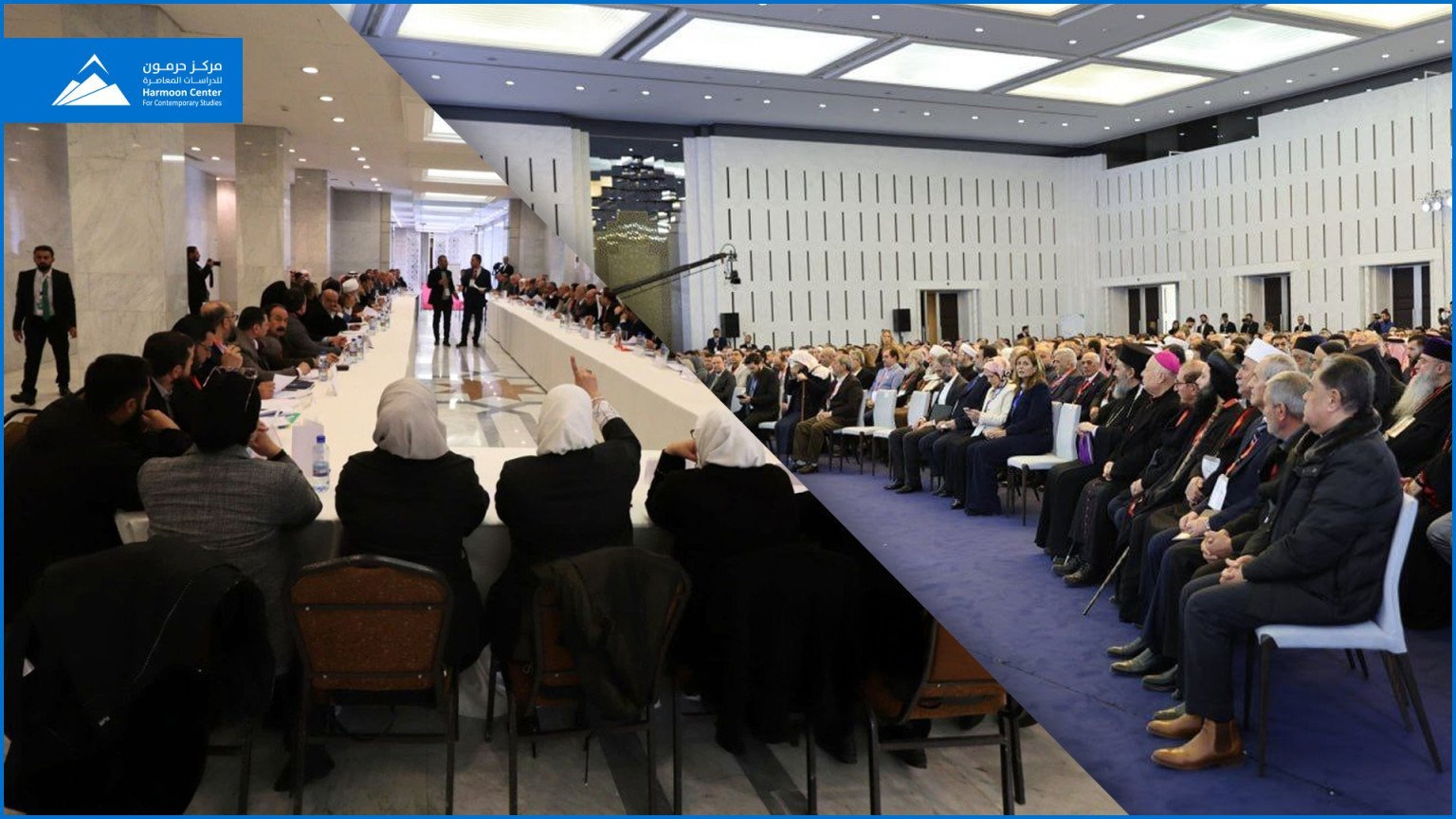
The National Dialogue conference was held in Damascus on February 25 with around 565 participants, and an attendance rate of 97%, according to the committee. The conference met the evening before for an introductory session, without substantive discussions. The following day, official sessions began at the People’s Palace, the first of which was joined by President al-Sharaa. He sent out a clear call to all armed factions to join forces in the unified national army, and stressed the unity of Syria as one land and one people.
“Syria is indivisible… its strength is in its unity. The surrender of arms to the state is not optional but a duty to the nation. The future system of government in any country is shaped by how it emerges from moments such as this, alongside the deep-rooted culture of its people. Systems that do not suit the country should not be imported; we must avoid making our society an experiment for political dreams which do not fit reality. We will work to form a transitional justice commission… and as you have accepted this victory from us, I ask you to accept its legitimacy from us,” said President al-Sharaa in his speech.
The aim of the conference was to engage all parts of Syrian society and formulate a common vision for the future of the country. It set out to lay the foundations for a transitional phase and a roadmap for the future, and to take the first step towards genuine direct dialogue between all Syrians, building trust and understanding between different sections of society.
Attendees were spread across 6 workshops held in the halls of the People’s Palace according to their relevant expertise or interests. The workshop topics covered civil society organisations, transitional justice, reforming and building institutions, personal freedoms, political life and public liberty, economic foundations, the future constitution – and at the end of the day, a final session was held to read the closing statement.
The conference hosted a variety of opposition figures, heads of civil society, local dignitaries, and members of armed opposition forces who had recently joined the political process. Most notably, it was solely attended by Syrians, without representation from any foreign nation or external actors – neither as speakers nor participants.
- The Concluding Statement
The final statement of the conference included several key themes, stressing the unity and territorial integrity of Syria and rejecting any questions of partition or the creation of separate entities within the country’s borders. It condemned Israel’s violations of Syrian territory and stressed the urgent need to fill Syria’s constitutional vacuum. The concluding statement was strongly in favour of an interim constitutional declaration to regulate governance during the transitional period and the establishment of a temporary legislative body and constitutional committee to draft the constitution to protect the continuity of institutions throughout a controlled transition period.
There was also a strong focus on transitional justice, holding criminals to account, reforming Syria’s judiciary and nurturing freely -formed political parties, and engaging civil society in the creation of a just and transparent legal system. Looking to economics, the conference called for growth-promoting policies, encouraged investment and protection for investors – and restated prior calls for the lifting of international sanctions on Syria that currently hinder reconstruction efforts in order to improve living standards and create a more stable economic environment.
The guarantee of public rights and freedoms, human rights and the role of women across Syrian society also featured heavily alongside the need to protect the rights of children and access to safe environments. The conference was keen to reflect a commitment to establish values of justice and equality in a new Syrian society, while issuing just and transparent laws to limit political activity in the national interest.
These themes appear to form a pledge by Syria’s new leaders to build a new country based on principles that reflect individual dignity, breaking down the authoritarian structures that have ruled the country for decades. The concluding statement sketched a general outline of a comprehensive vision for Syria’s future, focussing on the unity of the country, the rule of law, accountability and development.
- Evaluating the Conference Outcomes
The results of the conference represent an important step in the history of Syria’s struggle. It is the first time that such a diverse group of Syrians, at such a high level, have been able to agree on a path ahead, without outside influence. As such, this may be a turning point for Syria’s political process. Never before have so many representatives of the Syrian people from across the country gathered in the People’s Palace, walked its halls and spoken in complete freedom to discuss and exchange ideas without fear. This landmark moment strengthens the feeling that Syrians are ready and willing to rebuild the country.
However, the success of this process depends on the ability of the Syrian people – both the authorities and its citizens – to implement the agreed visions and address the remaining points of disagreement through dialogue and understanding.
Through the participation of hundreds of Syrians from across the country’s broad political and social spectrum the new authorities have, under the leadership of Ahmed al-Sharaa, gained a proper mandate for the coming period to implement its roadmap, lending additional support for the challenges when they arise. The conference has reinforced the process of unifying all of Syria’s armed groups under one national army, and the surrender of all weapons to the national authority. If this process is fully realised, it will lead to the end of the era of multiple armies on Syrian territory, strengthen the monopoly of legitimate force in the hands of the transitional state, and weaken interests in continuing violence which have played such a significant role in the perpetuation of Syria’s struggle.
The conference became a political stepping stone which has remained a stumbling block for many years. Instead of indirect talks under the auspices of international parties between the regime and the opposition, such as took place in Geneva, this opportunity for dialogue was directly from one Syrian to another, after a material shift in power on the ground.
That said, there are a number of open files which could challenge the country’s political stability in the future. At the forefront is the fate of the Syrian Democratic Forces (SDF). The conference reaffirmed the unity of Syrian lands, but did not lay a clear path forward for the future of these forces or their place on the political and military stage of Syria – which may be a major sticking point in the months to come.
The conference received broad media coverage, from local networks to international broadcasters. Reporting both praised the launch of a new political process and criticised inadequate representation and the organisational challenges of the conference. Arab and international partners were broadly supportive of the conference, although some parties viewed the conference as a reconfiguration of power inside Syria away from their spheres of direct influence.
Looking to similar experiences in other Arab countries, Yemen also established a National Dialogue Conference (from 2013 – 2014) after the overthrow of Ali Abdullah Saleh, which also produced important results. The conference produced a draft constitution, and a vision for a unified country, but the process later broke down in disagreement and descended into renewed conflict.
While the Yemeni experience bears similarities to the conference in Damascus, the key difference lies in the fact that Syria’s war preceded its current dialogue process. The war drew its own conclusions before this dialogue started, whereas in Yemen dialogue preceded the war – and failed to prevent it.
Libya also established several attempts at national dialogue, most notably the Skhirat agreement in 2015, and the Libyan Political Dialogue Forum in 2020 mediated by the United Nations, which aimed to unite the country’s institutions after years of division. Despite the success of these dialogue processes to form transitional governments, the lack of agreement on legal processes and electoral law led to a continuation of Libya’s crisis and the emergence of two competing governments. The Libyan experience proves that the dialogue process is always necessary but rarely sufficient; these transitional periods require real, continuous local and international efforts to implement agreements on the ground, and avoid any return to armed conflict.
While the Tunisian national dialogue process of 2013 can be seen as a successful example of avoiding conflict (led by a quartet of the Tunisian General Labour Union, the Union of Industry and Commerce, the Bar Association and the Tunisian League for Human Rights) it actually resulted in the resignation of the Troika government. A technocratic government was then formed, and the 2014 constitution implemented. Tunisia gained temporary stability, but was then faced with a quagmire of political and economic crises that weakened the continued democratic process.
It is clear from these examples that the success of any national dialogue depends on the commitment of all key actors to implement agreements made during dialogue processes, and to avoid reneging on their pledges. The successes of the 2025 National Dialogue Conference will be measured by the continued unity of Syria’s armed forces and a persistent determination to avoid internal disputes or clashes with forces not currently represented at the table.
Additional Reflections on the Conference
Although the conference and its outcomes were welcomed, it has also faced a range of criticisms across various aspects of the organisation and its outcomes.
It has been argued that a month-long dialogue, better organised and with greater representation, would have had a much more positive impact on the new transitional authorities in Damascus. The rush to convene the conference seems to have been driven by a need to obtain a clear mandate to issue a constitutional declaration, form a legislative council and a constitutional committee from the dialogue process.
The short preparation period did not allow the dialogue sessions across Syria’s provinces the necessary time to discuss the themes of the conference, leading to a lack of depth on substantive issues. There were no main themes that formed a throughline across the dialogue sessions either. These forums should be a place to discuss major issues that form the backbone of a new political, economic and social structure, and the foundations and principles of a new social contract – not an opportunity for more trivial issues and daily grievances.
The absence of an official platform for communication about key conference details left an information vacuum that led to much speculation throughout. Although the conference statement affirmed that it was a binding covenant, it did not set out an executive mechanism to follow up on the implementation of its decisions.
Furthermore, there were no clear principles for how participants were chosen for the sessions, and the council depended on delegates in each city to nominate attendees at their discretion, which meant that personal relations played a central role in deciding who attended the conference. This led to the absence of significant cultural, social and political players, which was seen as a failure to shape Syria’s future in a truly inclusive and representative manner. Invitations to figures associated with the former regime also drew widespread criticism, with some taking the view that this could affect the credibility of the conference and hinder its efforts to implement change.
The issue of balanced representation has been the subject of much discussion, noting the marginalisation of some Syrian actors and the lack of representation from certain regions, leading to a feeling of exclusion among some groups. The conference was criticised for not including the SDF, though this was justified as no party bearing arms was allowed to join the conference. Some voices interpreted this as an exclusion of Kurdish interests, though other Kurdish parties were in attendance. There was poor representation from among Syria’s Turkmen citizens, and the Assyrian Council issued a statement criticising the lack of representatives for their community. Similar complaints were made by some Alawite groups and communities abroad who felt that the dialogue process had not given them a fair opportunity to participate.
Some levelled the accusation that the conference was too conservative in approach, and was dominated by Islamic and traditional tribal influence, but this did not appear reflected in the final statement. While avoiding specific referrals to democracy, the concluding remarks sought to portray an image of a modern, progressive society.
The conference focussed on political and constitutional issues, without addressing the key economic crossroads for Syria. It did not discuss the necessary funding for reconstruction in light of continued sanctions against the country, leaving open questions as to Syria’s viable path to economic stability in the future.
- Conclusion
Despite all the challenges, the National Dialogue Conference has formed the basis of a consultative democratic process. It must continue to grow and establish itself on firm ground. The very existence of the conference is a landmark change in Syria’s political history, and is the beginning of renewed alliances between different factions under the framework of the state, replacing the fragmentation of the past. After the widespread welcome, both in Syria and beyond, it is now in the hands of Syrians to sustain the momentum of this process and address continued challenges through dialogue. These grand hopes must not lead to crushing disappointment, as has so often happened in other countries recovering from conflict.
The final statement was broadly satisfactory to a majority of Syrian parties. Syrians across the country now await the content of the interim constitutional declaration, and the mechanisms for selecting a legislative council. They wait to see who will be selected, and for how long. Syrians are yet to find out when the next government will be formed, how long it will last and whether it can fulfill the important pledges made at this conference. It is still unclear for all Syrians whether international sanctions will be lifted, once and for all.
What is clear, however, is that all patriotic Syrians must work with all their strength to make a success of this transition, and reach for a future that all Syrians aspire to, and for which they have made great sacrifices.