



Introduction
The collapse of Bashar al-Assad regime on December 8, 2024 marked a seismic rupture in Syria’s history. It ushered in a new era, filled with challenges and opportunities. The fall of the regime created an immediate vacuum – within which the new authorities must rebuild a nation fractured by war and authoritarian rule.
The new Syrian authorities face a complex reality. Not only do they inherit a national legacy burdened with deep structural crises, but they have come to govern over regions that had for decades been strongholds of the former regime, such as Homs, Hama, Latakia, and Tartous. These areas became the last remaining outposts of Assad’s military and security formations that refused to surrender after Damascus fell.
In response, the new authorities launched intensive security operations to snuff out the last remnants loyal to the regime – especially those who refused to lay down their arms and participate in the security settlement process. The operations focused on regaining control over predominantly rural areas where these groups had entrenched themselves. The campaigns formed part of a broader strategy to fill the security vacuum, and neutralize potential threats to stabilising the country.
However, the challenges facing the new authorities have extended beyond immediate security concerns. They have to navigate communities that had long remained loyal to the former regime, where there is deep communal mistrust. Decades of state propaganda and misinformation have left many residents skeptical of the new leadership’s intentions and objectives, creating psychological and social barriers to public acceptance. Complicating matters further, remnants of the former regime’s intelligence and military apparatus have remained embedded within these communities. These members actively worked to destabilize the transition, spreading rumors and orchestrating hostile retaliations, further obstructing efforts to establish security and lower societal tensions. Faced with these challenges, the authorities have had to adopt a multi-faceted approach, combining the use of force to eliminate security threats with holistic measures to reintegrate the local population into the new landscape of the country, with the long-term aim of fostering real stability.
It has become evident that these security campaigns serve as a key buttress to establish stability at this critical juncture – at least from the perspective of the new authorities. However, these efforts have also highlighted the profound complexities involved in achieving real national reconciliation. While the new authorities worked to assert their control, they have also faced the challenge of addressing deep societal divisions and restoring public trust in state institutions that, for many Syrians, had long been synonymous with tyranny and corruption.
Target Areas: The Coastal and Central Regions of Syria as a Case Study
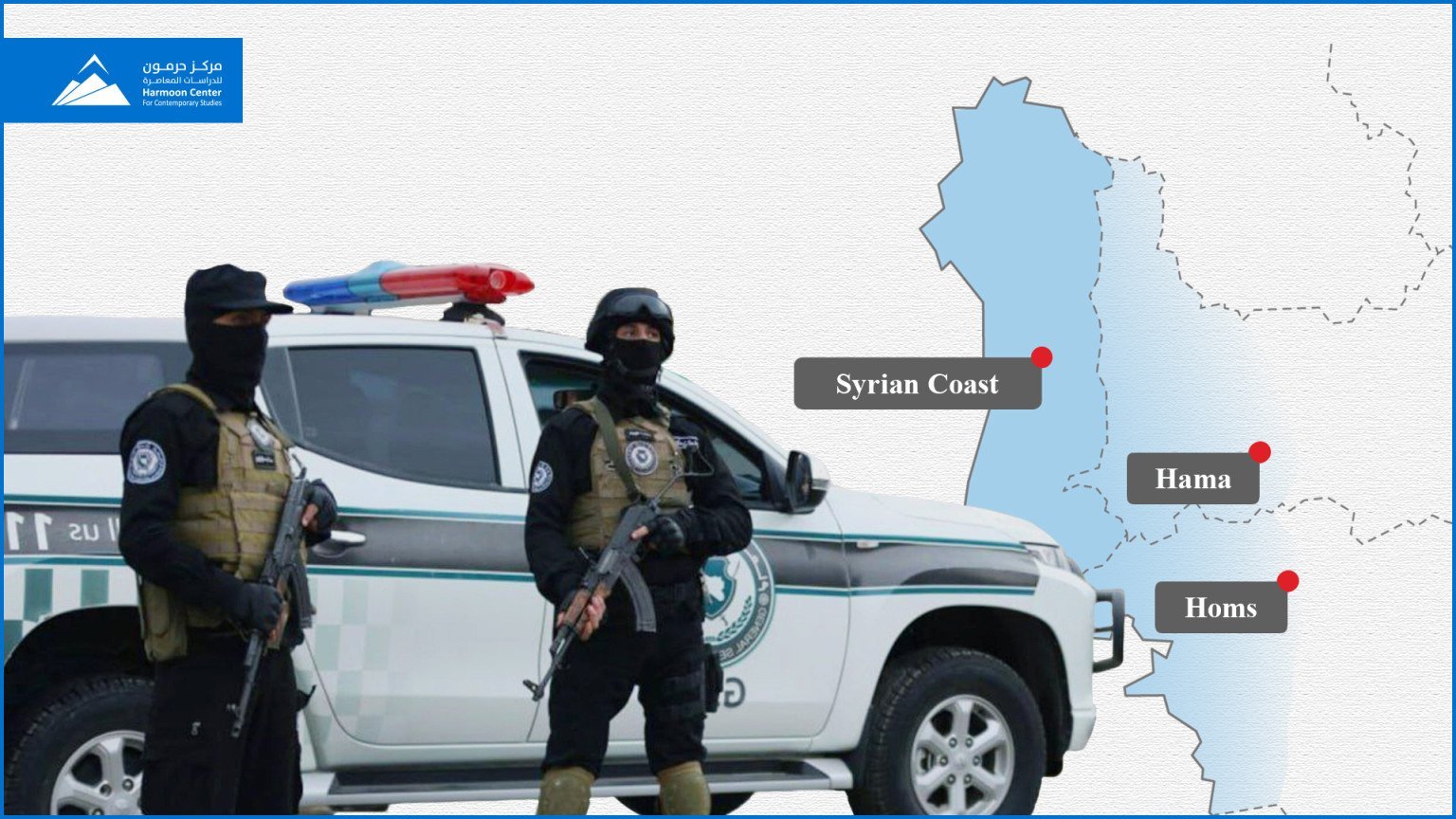
The coastal and central regions of Syria witnessed intensive security campaigns led by the new authorities, to establish full control and restore stability in areas that had long served as strongholds of the former regime. These regions, including Homs, its western countryside, the western countryside of Hama, and the rural areas of the Syrian coast, presented complex challenges shaped by political patronage and sectarian divisions. Armed groups and key figures from the former regime had also taken refuge in these areas as safe havens, further complicating the security landscape. Initial efforts sought to dismantle these groups and pursue armed members, while simultaneously trying to maintain a balance between security operations and rebuilding public trust. Following the first wave of security operations, authorities launched community engagement initiatives to try and ease tensions and reassure the local population. They included outreach campaigns, with security officials and local cadres visiting affected areas to meet with residents, address concerns, and facilitate the return to normal life.
Homs City and Its Western Countryside
- Key neighbourhoods: Security operations focused on areas including Wadi al-Dhahab, Akramah, al-Zahra, and al-Abbasiyah, all historically known for their loyalty to the former regime. The measures included systematic house searches and mass arrests to try and prevent any attempts to undermine stability. The two-day campaign began on January 4, 2025, following a complete lockdown of these neighbourhoods. On January 6, 2025, security authorities announced the conclusion of the sweep, stating that the operation had successfully met its objectives and resulted in arresting several wanted individuals[1]. On January 12, 2025, the Public Security Command in Homs announced the release of a group of detainees following the completion of preliminary investigations. Those released were asked to appear before the authorities if summoned for further inquiries. Official sources confirmed that additional groups would be released in the coming period. The first batch included more than 310 individuals who had been held in Homs Central Prison after the mass arrests in various neighbourhoods of the city.
- The western countryside of Homs holds strategic significance due to its smuggling routes between Syria and Lebanon, which were historically used by local criminal networks and Hezbollah militias under the former regime. The region also has a uniquely varied sectarian map, further complicating security dynamics. The security services successfully curtailed the influence of armed groups and their activities by conducting extensive sweeps and dismantling multiple networks that had long used the countryside as a safe haven. This has reinforced short-term stability in the region, and helped facilitate the return of displaced populations and encouraged the resumption of agricultural and economic activity. One of the most significant security operations in the region targeted the strongholds of the Shujaa’a al-Ali militia in the western countryside of Homs. The operation resulted in the elimination of Shujaa al-Ali, along with several of his fighters, while the remaining members were captured. Shujaa al-Ali was responsible for the notorious Houla massacre in Homs, which resulted in the killing of 109 civilians in 2012. He was also accused of leading an armed militia affiliated with the Military Security Branch in Homs, which was involved in the kidnapping and extortion of civilians for huge sums of money. On December 26, 2024, Shujaa al-Ali was killed during clashes with security forces loyal to the new Syrian authorities in the village of Balkasa[2].
On January 20 and 21, 2025, the western countryside of Homs Governorate witnessed a second round of security operations, resulting in the deaths of at least six people during a large-scale sweep campaign launched by the new authorities. The campaign involved raids and combing operations across several villages in the western countryside, targeting weapons depots, smuggling networks, and remaining armed groups linked to the former regime who had still refused to surrender their weapons. In the village of Ghor, near the Lebanese border, violent clashes erupted between security forces and armed members of local groups formerly associated with the Lebanese Hezbollah militia. The clashes involved the use of machine guns and heavy weapons, with security forces deploying tanks to support field operations and reinforce their positions[3].
On January 25, 2025, the group “Civil Peace in Homs” issued a statement regarding the military campaign in the town of Fahel, in the countryside of Homs. The statement reported deaths and burials over the previous two days, initially identifying some of the deceased as civilians. However, on January 26, 2025, after verifying the identities of the deceased through reliable sources, the group amended its statement, confirming that most of those killed were officers of various military ranks[4]. In light of the events in Western Ghor and the village of Fahel, it is clear that the primary objective of security operations should be the arrest of individuals linked to the former regime, particularly those who played key roles in violations and crimes committed under its rule. However, in reality on the ground, certain groups take offensive actions against security forces that may alter the nature of the mission. In such cases, what begins as a security operation focused on arrests can escalate into a direct military confrontation – necessitating the use of appropriate force to protect personnel and achieve the mission’s objectives.
The Western Countryside of Hama
On December 27, 2024, the Military Operations Command launched a large-scale security campaign in the western countryside of Hama, targeting remnants of the former regime. The operation included raids in key hotspots, such as Masyaf and Suqaylabiyah, and led to the arrest of several prominent figures – including Hussein Juma, the former police chief of Hama. On December 29, 2024, the new authorities doubled down on these efforts, focusing on dismantling networks linked to the former regime. During combing operations, security forces confiscated large quantities of weapons and ammunition, significantly reducing the risk of armed groups reorganizing and resuming their activities.
Syrian Coast
The countryside around Latakia and Tartous presented two distinct challenges for the new Syrian authorities. On one hand, these areas are a clear and present security threat to be dealt with, having served as a major stronghold of support for the former regime, both through popular backing and their established military and security infrastructure. On the other hand, the new authorities need to tread carefully to prevent an escalation of sectarian tensions, or a backlash from local communities who may feel marginalized or threatened in the post-Assad era. Security operations involved raids on covert hideouts and the arrest of security and military personnel from the former regime. These operations also led to the confiscation of advanced light and medium weaponry, as well as classified operational maps detailing various strategic locations along the Syrian coast. On December 21, 2024, the Military Operations Command announced the launch of a wide-ranging security campaign in the eastern countryside of Tartous and Latakia, following a series of attacks on its forces. The command was in pursuit of a large number of wanted individuals suspected of sabotage and possessing illegal weapons, including former fighters from the regime’s army. Security operations were conducted across multiple areas in both governorates, extending into major cities. During the campaign, security forces faced several ambushes, the most significant of which occurred in early January in the city of Latakia. An armed group launched an attack against security forces in the Awainah neighborhood, targeting Public Security Command units while they were conducting a sweep operation.
One of the most significant security incidents occurred in the mountainous areas of Latakia Governorate, in the village of Ain al-Sharqiyah, on January 13. A group of militias loyal to the former regime[5], led by Hussam Bassam al-Din, launched an attack on a barracks belonging to the Operations Command. The attack resulted in the killing of two Public Security Command officers and the kidnapping of seven others. Shortly after, Hussam Bassam al-Din appeared in a video, issuing a threat to execute the abductees unless security forces fully withdrew from the mountainous region of the governorate. A few hours later, security forces successfully carried out a counter-operation, leading to the rescue of the abductees. The operation ended with Hussam Bassam al-Din detonating himself during the clash. Previously, Al-Din had been one of the most prominent commanders of the so-called “Mountain Lions” battalion, a group that had received support from Air Force Intelligence.
Finding new strategies
To enhance the effectiveness of security operations, the new authorities employed new tactics, launching night raids and using encirclement manoeuvres. These methods were designed to minimize civilian casualties, prevent the escape of targeted individuals, and improve chances of success. Additionally, security forces have increased their use of advanced technologies, such as night vision devices and drones to improve surveillance and precision. Human intelligence and advisory support also played a critical role in successful security operations by identifying the locations of networks loyal to the former regime and uncovering weapons stockpiles. This intelligence significantly contributed to the precision of operations, enabling security forces to achieve their aims and restore order in the affected areas[6].
Raids and Encirclement
Night raids: Security forces have increasingly employed night raids to improve on the element of surprise, minimize civilian casualties, and prevent suspects from fleeing. By using advanced night vision technology and intense tactical coordination, these operations targeted high-value individuals and weapons stockpiles. The countryside of Hama was among the areas where night operations were most heavily utilized, as the region’s geography allowed swift movement and dispersal of armed groups. [7]
Encirclement tactics: By encircling their targets, security forces effectively isolated hostile members, preventing them from benefiting from reinforcements or escaping. This approach improved operational control, minimizing risks for both security forces and civilians, while ensuring greater military precision. The encirclement method allowed for systematic inspections and the establishment of security cordons, improving stability in the targeted areas even after the operation concluded. Among the most notable locations subjected to full lockdown were the neighborhoods of Al-Hadara, Akramah, and Wadi al-Dhahab in Homs. These areas were sealed off for a period of two to three days before the actual combing operation commenced. During the encirclement phase, intelligence gathering was conducted based on:
- Human Intelligence: This involved using local informants and community networks to gather intelligence on the whereabouts and activities of networks loyal to the former regime, enabling security forces to identify key targets and operational threats[8].
- Signals Intelligence: By intercepting communications between members of former regime networks, security forces were able to anticipate and neutralize potential threats. This intelligence also played a crucial role in uncovering clandestine networks and hidden weapons depots. Advanced Surveillance Technologies: The use of drones and cyber monitoring tools enabled real-time data collection and analysis, enhancing the accuracy of security operations, and significantly improving their effectiveness[9].
Preemptive Strikes
Artillery Strikes and Shaheen Drone Operations: Artillery and Shaheen drones were both used to target weapons depots and positions loyal to the former regime, aiming to disrupt potential hostile activities before they could escalate. This strategy was used across several areas in the western countryside of Homs, including Khirbet al-Hamam and multiple villages in Tal Kalakh. By utilizing satellite imagery and intelligence reports, these strikes aimed for maximum impact and minimal collateral damage. Post-strike assessments were conducted after the operations to evaluate their effectiveness, ensuring that subsequent missions were planned using refined tactics and strategies for improved outcomes.
Special Operations: Elite ‘Red Band’ strike force units were deployed for high-risk missions targeting key figures and strategic locations. serving as a tactical complement to larger military operations. These missions required meticulous planning, real-time intelligence, and close coordination with artillery and ground support to ensure operational success while safeguarding both security teams and civilians in the affected areas. The psychological impact of these missions played a crucial role in deterring pro-regime formations from launching operations in other former strongholds. This strategy was particularly useful in Homs – most notably in the neighborhoods of Al-Abbasiyah, Al-Sabeel, and Al-Zahraa, as well as in the countryside of Jableh and Baniyas and several locations in the coastal mountains.[10].
Results of Security Campaigns
Arrests
Security forces arrested hundreds of individuals, including former regime informants, intelligence operatives, and military personnel affiliated with the former regime. These arrests disrupted the activities of pro-regime factions in the targeted areas and played a key role in dismantling loyalist networks whose presence and operations posed a threat to the stability of the new administration.
Clashes
Armed confrontations erupted in several areas, including Tartous, Latakia, and the western countryside of Homs, highlighting the continued existence of well-prepared and highly organized pro-regime formations that continued to resist security operations. These engagements tested the readiness and adaptability of the security forces, prompting tactical adjustments and refinements in engagement protocols to counter the ambush tactics employed by pro-regime groups more effectively. In some instances, clashes resulted in casualties among both security personnel and loyalist formations. The continued presence of pro-regime factions in certain areas, even to a limited extent, underscores the complexity of achieving full control. This reality highlights the need for ongoing vigilance and strategic flexibility to effectively manage and neutralize any remaining threats.
Settlements
Many former regime members agreed to participate in the temporary settlement process introduced by the new Syrian authorities. This development has led to a reduction in hostilities, particularly in crimes such as theft and other criminal activities, which had appeared sporadically in the aftermath of the fall of the Assad regime. While the impact remains limited at present, these measures have contributed to a gradual improvement in societal stability. These settlements have proven particularly effective in areas where local leaders played a key role in facilitating dialogue between former regime security and military personnel and the new Syrian authorities. After the current phase of security sweeps concludes, the remaining pro-regime groups can be classified into the following categories:
- Individuals Who Have Accepted Settlements: Some have agreed to security settlements and benefited from their terms, demonstrating a willingness to reintegrate into society and adapt to the new political and security landscape. These people have taken a crucial step toward genuine national reconciliation, but their long-term reintegration depends on the availability of suitable job opportunities and the continued faith of communities in acceptance initiatives. These measures are essential to ensuring the success of the settlement process, fostering long-term stability, and preventing any relapses into hostile activities.
- Active militias loyal to the former regime: Many remain at large and present a clear threat to stability. Most of these armed groups are stationed in remote rural areas and continue to engage in hostile operations using weapons and guerrilla tactics. Some members of these groups are driven by ideological convictions, while others are primarily motivated by self-interest, seeking to exploit ongoing instability for their own benefit. Addressing this threat requires a dual approach, combining targeted military operations to disrupt these formations with parallel efforts to dismantle the logistical and financial support networks which sustain their activities.
- Opportunists engaging in random ambushes: This category presents themost complex challenge, as it may consist of individuals from both the first and second categories, or a hybrid of the two. These groups operate unpredictably, exploiting security gaps to launch sporadic attacks aimed at destabilizing the region and undermining the authority of the new administration. Their sudden and irregular tactics make them particularly difficult to track and neutralize. Opportunistic groups often function as sleeper cells, requiring enhanced rapid response capabilities and improving intelligence-sharing mechanisms to effectively detect and neutralize emerging threats. Local communities can play a crucial role in identifying and countering these threats by strengthening communication with security agencies and reporting any suspicious movements or activities.
Opportunities and threats
The areas targeted by intensive security campaigns, including Homs and its countryside, the western countryside of Hama, and the coastal regions, have experienced a notable improvement in overall stability and security conditions. Residents have seen a slight decline in criminal activity, including thefts and acts of intimidation by unidentified groups. Additionally, there has been a notable reduction in kidnappings and killings driven by long standing grudges and retributions that had emerged during the instability of the Assad regime’s rule.
Opportunities:
- Short term:The current security improvements may help strengthen the population’s sense of safety, creating more favorable conditions for sustainable economic and social recovery, provided that security efforts remain consistent and effective.
- Medium term: Success of security operations and effective oversight can help reinforce the positive image of security forces among the civilian population, ultimately building public trust in the state.
- Long term: Enhancing security stability can pave the way for promoting political dialogue and advancing national reconciliation, helping to ease tensions and foster a more conducive environment for cooperation among various factions.
Threats:
- Short term: Despite the partial improvement in security in areas targeted by security operations, reservations and concerns persist among the population, particularly in former regime strongholds. These concerns could exacerbate sectarian tensions, especially in cases where security operations became bloody and entrenched battles, negatively impacting public trust in security forces. To mitigate these challenges, it is crucial to strictly address any violations perpetrated by security forces, ensuring that security forces adhere to human rights standards and work toward rebuilding trust with local communities.
- Medium term: Social and economic grievances, including unemployment and poverty, remain key drivers of instability and could fuel further unrest if not promptly and effectively addressed.
- Long term: The killing of security and military figures linked to the former regime during operations may result in the loss of critical information regarding crimes and violations committed against civilians, potentially hindering efforts to achieve justice and accountability. It is essential to prioritize the arrest and thorough investigation of these individuals to ensure the collection of crucial evidence and hold those responsible accountable for their actions. This approach will contribute to achieving justice, preserving the rights of victims, and strengthening the rule of law.
Recommendations:
- Enhancing community participation: Encouraging community-based security initiatives such as community policing can help foster trust between security forces and the local population. Conducting awareness campaigns on disarmament and reintegration programs can also support stability and long-term reconciliation efforts. These programs can incorporate local dialogue sessions to help authorities understand community needs, address concerns, and reassure the population about the future stability and security of the nation.
- Establishing effective oversight mechanisms: It is crucial to establish independent oversight bodies tasked with monitoring the performance of security forces during, to prevent violations that could undermine public trust. These mechanisms would help ensure accountability, uphold human rights standards, and reinforce public confidence in security efforts. These bodies must be able to receive public complaints, conduct transparent investigations, and issue recommendations to address any abuses, ensuring accountability and strengthening trust between security forces and the population.
- Promoting national reconciliation: Conferences should be organized at both local and national levels, allowing broad participation from all segments of society. These gatherings must provide a space to address historical grievances, foster dialogue, and promote national unity – laying the groundwork for long-term social and political stability. Independent bodies should oversee these conferences to guarantee inclusiveness, transparency, and credibility, to ensure that all voices are heard in a fair and effective reconciliation process.
- Investment in economic development: To mitigate the immediate economic challenges of unemployment and poverty, it is essential to launch large-scale development projects, with a particular focus on conflict-affected rural areas. These initiatives must stimulate economic growth, create sustainable job opportunities, and contribute to long-term stability and recovery. This can be achieved by supporting small enterprises, encouraging investment in agriculture and local industries, and rebuilding the nation’s basic infrastructure.
- Enhancing training and development for security forces: Security forces should receive specialized training in human rights, conflict management, and community engagement. These programs will help enhance their professionalism, accountability, and ability to build trust with local communities.
- Focus on evidence gathering and accountability: Rather than killing military and security figures linked to the former regime during operations, efforts should prioritize their arrest and thorough interrogation. This approach will promote the collection of accurate evidence on past crimes and human rights violations, and will help facilitate justice, accountability, and historical documentation for future legal proceedings. This evidence can serve as a foundation for transitional justice, ensuring that those responsible for past crimes and violations are held accountable through fair and legal processes.
The transition to stability and development in Syria requires a careful balance between security measures and peaceful solutions, with an emphasis on national reconciliation and fostering a sense of inclusion and belonging for all segments of society.
Likely Scenarios
Scenario 1: Complete dismantling of pro-regime formations
The new Syrian authorities may successfully conduct comprehensive and effective security campaigns targeting pro-regime forces that remain. These efforts will rely on accurate intelligence gathering to identify the locations and activities of these groups, enabling coordinated and surprise raids that significantly weaken their presence. Operations may involve the deployment of special units trained in counter-insurgency alongside cooperation with local communities to enhance intelligence gathering and operational support.
Efforts may help dismantle the infrastructure of these groups by disrupting their financial and supply networks and confiscating weapons and equipment – further weakening their operational capabilities. The focus should be on arresting key leaders and bringing them to justice.
Scenario 2: Partial dismantling of pro-regime formations
On the other hand, the authorities may face multiple challenges and struggle to dismantle these organisations in full. They may be thwarted by lack of intelligence, fierce resistance by some groups, or internal conflicts that degrade the effectiveness of security operations. The authorities may be able to dismantle some formations and restrict their activities, but other groups may adapt to security pressures by changing tactics, operating clandestinely or integrating into local communities to evade detection. In addition, these groups may benefit from external support networks or concealed financial resources, allowing them to sustain their activities in the face of a security clampdown.
Authorities may find themselves compelled to intensify intelligence efforts and strengthen cooperation with regional and international partners to effectively counter ongoing threats. It may need to develop new strategies tailored to address the tactics of the remaining pockets of support for the former regime, with a focus on gaining local community confidence and building trust between the population and security services.
Scenario 3: Continued threats and destabilization
In the face of efforts to reduce Iranian influence in Syria, the authorities may encounter complex challenges – particularly the risk of pro-regime formations known for their loyalty to Iran transforming into sleeper cells that continue to carry out sporadic attacks. This could threaten the stability of the whole region, disrupt reconstruction efforts, and inflame sectarian tensions. If continued, these attacks may lead to the withdrawal of some international supporters, who are crucial to the new authorities’ ability to achieve key security and political objectives.
Conclusion
The fall of Bashar al-Assad’s regime marks a paradigm shift in Syria’s history, ushering in a new era that presents both significant challenges and renewed opportunities for state-building. The security campaigns launched by the new Syrian authorities have yielded tangible results in enhancing stability, dismantling pro-regime factions, the arrest of hundreds of prominent figures and former security officials, and the confiscation of large quantities of weapons and ammunition. These campaigns have curtailed hostile activities and re-established control over several strategic areas, including Homs, the Hama countryside, and the Syrian coast.
Alongside security successes, these operations have strengthened the population’s sense of safety, creating conditions for the return of internally displaced persons (IDPs) and the revival of agricultural and economic activity in liberated areas. Security settlement efforts led to the surrender of many former regime members, thereby reducing the immediate risk of hostilities. However, challenges persist, as clashes and ambushes continue to reveal pockets of resistance from pro-regime factions. Addressing these threats requires sustained security campaigns, stronger cooperation with local communities, and the implementation of development initiatives to tackle social and economic grievances.
These findings highlight the importance of balancing security measures with inclusive policies aimed at promoting national reconciliation and fostering long-term stability. While the new administration has made clear progress in achieving security, the future of Syria depends on addressing remaining challenges, upholding human rights, and strengthening trust between the state and society. Through these integrated efforts, Syria can progress toward sustainable stability and inclusive development, laying the foundation for a new era of national prosperity.
[1] “Release of a First Batch of Detainees After the End of the Homs Security Campaign,” Al-Sharq Al-Awsat, published on January 12, 2025, accessed on January 15, 2025, https://shorturl.at/PfUwx .
[2] “Shujaa al-Ali. He participated in the Houla massacre and headed the kidnapping militia at the Syrian-Lebanese border,” Al-Jazeera, published on December 29, 2024, https://shorturl.at/wXnxK
[3] “Syria: fatalities reported during a security campaign in the countryside of Homs,” al-Sharq al-Awsat, published on January 21, 2025 https://shorturl.at/bWPSk
[4] Verify-Sy, published on January 26, 2025 https://shorturl.at/v29nd
[5] “The commander of the Lions of the Mountain Battalion in Syria was killed. Who is Bassam Hussam Eddin?” An-Nahar Net, published on January 13 2025, https://shorturl.at/ivMaO
[6] The information on public reactions to security measures and the outcomes of security operations were drawn from field interviews conducted by the researcher with residents of neighborhoods and areas directly impacted by these operations. These in-person interviews took place in Syria on January 10, 12, and 13, 2025, capturing perspectives from diverse segments of the population.
[7] The information on the security mechanisms employed was gathered through field interviews conducted by the researcher with security leaders overseeing combing operations in Homs and its countryside, as well as those with direct knowledge of operations along the Syrian coast. These in-person interviews were conducted inside Syria on January 8, 9, 12, and 13, 2025.
[8]Human intelligence, often abbreviated as HUMINT and sometimes pronounced HU-MINT, refers to intelligence collected through interpersonal communication.
[9] Signals intelligence (SIGINT) is the process of gathering intelligence by intercepting various signals.
[10] “Hezbollah members trapped in Syria amid violent clashes”, Janoubia, published on December 26, 2024 https://shorturl.at/jmGdV