


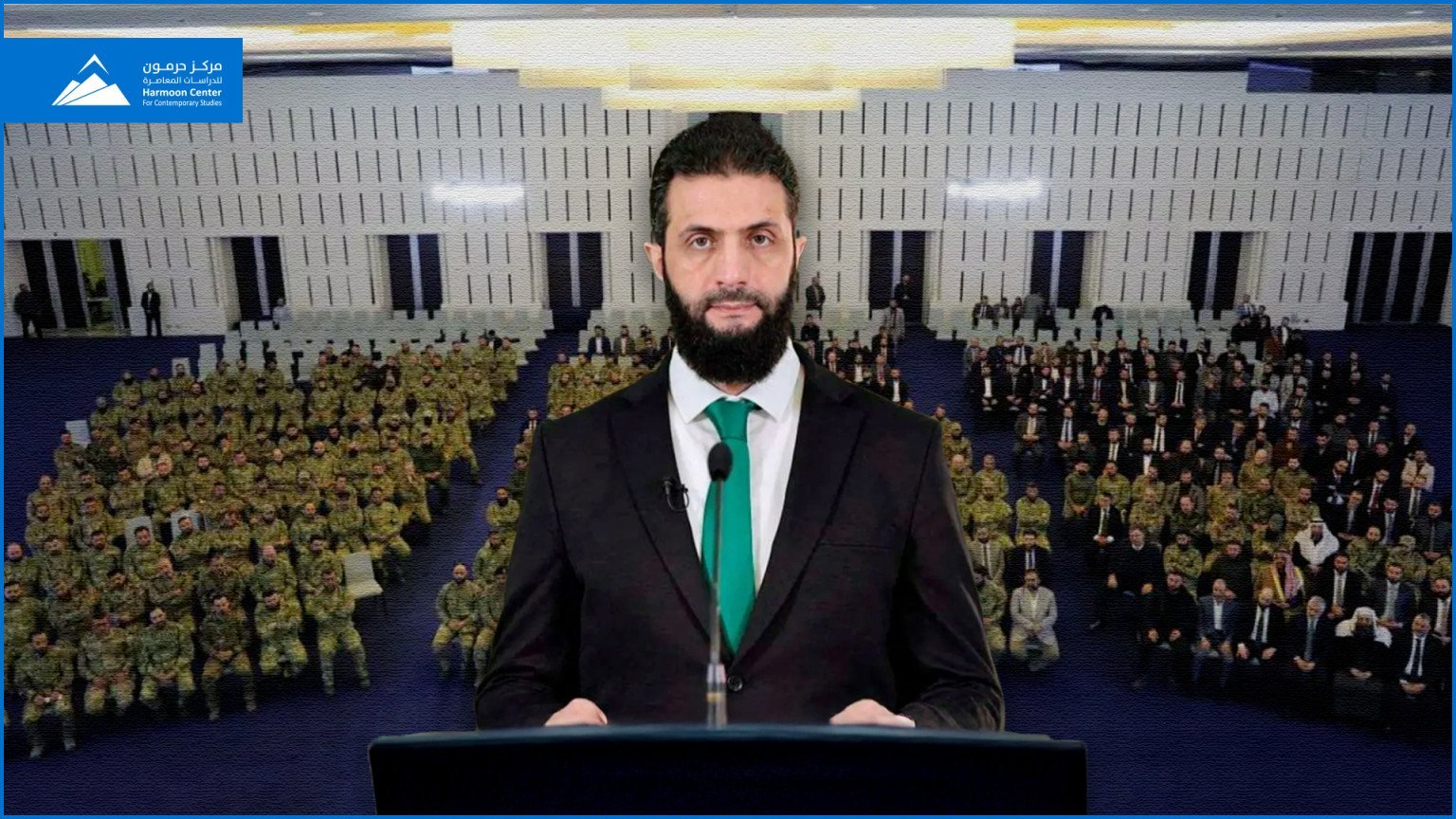
On January 29, 2025, the new Syrian leadership announced that Ahmad al-Shara would deliver a speech at the “Victory Conference”, a landmark gathering of military top brass, National Army factions, and representatives of select Daraa militia leaders. In the lead-up, anticipation grew over the conference’s ability to address the nation’s pressing questions after the fall of the regime and Bashar al-Assad’s escape – and how the leadership can lay the path forward for Syria.
The meeting was held behind closed doors. Upon its conclusion, Colonel Hassan Abdul Ghani, the spokesperson for the Military Operations Command, announced a series of key decisions. The conference dissolved the 2012 constitution, disbanded the People’s Assembly and its committees, and dismantled the army along with all security services. They also announced the dissolution of the Ba’ath Party and the National Progressive Front factions. In an expected but significant move, Ahmad al-Shara was named president, with a mandate to form a temporary legislative council for the transitional period, which will govern Syria until a permanent constitution is drafted and enacted.
In his first speech, al-Sharaa stressed that “victory is a mandate in itself.” In the address, he outlined Syria’s current priorities, focusing on filling the power vacuum by legal and legitimate means. The new president spoke of building sustainable peace through transitional justice and the prevention of reprisals, and constructing new state institutions – with a particular emphasis on military, security, and police forces to protect public safety. No details from inside this pivotal meeting in modern Syrian history have yet been made public. The meeting was not broadcast, and no official statements were issued to clarify how participants discussed and approved the decisions outlined in the public statement. On January 30, al-Shara delivered his second speech, addressing the Syrian people and presenting a roadmap for the transition.
This piece examines that long-anticipated roadmap, for which Syrians have waited 54 days, and provides an in-depth analysis of the conference statement and al-Sharaa’s two speeches to see how they can meet the needs of this transitional period.
One Statement, Two Speeches: what do they mean?
The statement and al-Shara’s speeches directly addressed the Syrian people’s questions and demands, officially kicking off the transition process. The central thread to all three was the transition from “revolutionary legitimacy” to “constitutional legitimacy.” The statement and speeches addressed key structural objectives, including governance and the distribution of power, security and stability, as well transitional justice and national reconciliation. They provided clarity on the dissolution of all prior armed factions and announced the rebuilding of the army and security institutions. They spoke at length of Syria’s reconstruction and economic recovery to facilitate the return of refugees, of foreign relations and the country’s role on the regional and international stage. The statement and speeches addressed most key questions, though some topics remained ambiguous. The following sections of this analysis will discuss specific observations in greater detail.
Ahmed al-Sharaa appointed President of the Republic
The appointment of Ahmed al-Sharaa as President of the Syrian Arab Republic filled the constitutional vacuum left by the fall of the regime and the flight of the former president. By virtue of the Military Operations Command’s decision, al-Sharaa now holds executive authority and serves as Syria’s representative on the international stage. This was underscored during the Emir of Qatar’s visit to Syria on the morning of January 30, 2025, the day after al-Shara’s speech.
Al-Sharaa’s speeches stood out for their deliberate, thoughtful writing, marked by concision, calmness and confidence. He conveyed humility and a sense of responsibility, stating: “I speak to you today, not as a ruler, but as a servant of our wounded homeland.” His speech was also characterized by the use of “white language,” blending colloquial Syrian Arabic with Media Standard Arabic to be more commonly understood across Syria. He employed gender-inclusive language when referring to “Syrians,” ensuring broader representation and inclusivity in his address.
Dissolving the Former Regime’s Institutions
In reality, the former military and security apparatus – including the police – largely disintegrated on their own, leaving Assad’s authority in a precarious state. Recognizing this reality, the Military Operations Command acted to formalize and ratify their dissolution, to make the outcome irreversible. The Victory Conference statement explicitly declared: “The army shall be disbanded, and a new army shall be rebuilt on a national basis.” They reiterated that “all security services shall be dissolved, and a new security institution shall be established” and that “the Baath Party and the parties of the National Progressive Front shall be disbanded, and their reformation under any other name shall be prohibited.” These steps were both anticipated and inevitable, but the lack of clarity regarding the fate of the members of these institutions and their means of livelihood – who number in the hundreds of thousands – could push them toward hostile acts, potentially even driving some to take up arms. It is therefore crucial to clarify the fate of these individuals, particularly to ensure a stable source of livelihood for them and their families.
Questions must also be answered over the interpretation of the commitment “prohibiting the reconstitution of the Front’s parties under another name.” This could potentially lead to accusations against any nationalist, socialist, or leftist party, labeling them as a continuation of the Baath Party and its Progressive Front. Moreover, there are concerns that this wording hints at a reluctance to permit political parties or political pluralism. This concern is reinforced by the fact that none of the statements or speeches explicitly addressed the future of political life, public freedoms, or the rights to organization, expression, and belief. Notably, the word “democracy” was absent from all discourse. Instead, al-Sharaa spoke of “building a new homeland, where justice and consultation govern together.”
Dissolution of Military Factions
One of the most significant and challenging decisions was the order to “dissolve all military factions, as well as revolutionary and civil political bodies, and integrate them into state institutions.” In previous media interviews, al-Sharaa had pledged to dismantle Hay’at Tahrir al-Sham (HTS) and all other factions, ensuring that all weapons would be exclusively controlled by the state. This step is crucial for transitioning from a state of factionalism to an actual nation-state. Based on this edict, any faction that refuses to dissolve itself will be designated as an outlaw group. This is an extremely sensitive issue. While most faction leaders and representatives attended the meeting and expressed their support for al-Sharaa, several key questions remain unanswered: What mechanism will be used to implement the dissolution of these factions? How will disputes be resolved with the As-Suwayda militia, which have set high demands, and with the Ahmad al-Awda faction? What is meant by the dissolution of revolutionary and civil bodies? Can revolutionary and civic bodies truly be integrated into state institutions, as suggested, given the emphasis on avoiding the inflation of state apparatuses?
Despite the declaration that “the unity of Syrian territory in its entirety will be restored, and its sovereignty will be imposed under one authority and within one unified territory,” the issue of the SDF remains, which so far appear to be at an impasse in negotiations. Naturally, the SDF cannot be compelled to comply as long as U.S. forces remain present east of the Euphrates, providing them with strategic backing and leverage in the negotiations.
An Openness to Power Sharing?
The first notable shift over these two days was the reference to a “National Dialogue Conference” instead of the “National Conference” that had been widely discussed in recent weeks. The National Conference, which Syrians had hoped would be broadly representative, was expected to issue key decisions, grant legitimacy to the new authority, and define the framework for the transitional period. However, events unfolded differently. The main decisions were already announced by the “Victory Conference” in what appeared to be a military council session, signposting a continuation of centralized power – at least for the time being. This approach excluded political and community power brokers, as well as other military factions that had sought a role in governance. Despite this, al-Sharaa reiterated his stance, stating: “This is a transitional stage, and it is part of a political process that requires the real participation of all Syrians, at home and abroad, to build their future in freedom and dignity, without exclusion or marginalization.” We are yet to see how he will make good his promise.
The dialogue conference itself now appears to be more of a “consolation prize”, lacking any actual executive authority with real influence over decision-making – and may serve more as a symbolic or moral authority. There is concern that this new reality may be used as a pretext by the United States and Europe to maintain sanctions, as they continue to closely monitor the situation. This, in turn, could have severe long-term consequences for Syria’s future. All Syrians hope for the multilateral lifting of sanctions, paving the way for reconstruction, the return of refugees, and an end to the continued suffering of the Syrian people.
The program of transition
In his second speech on January 30, 2025, President al-Shara briefly outlined several key elements of the transition process, including the following:
“We will work to form an inclusive transitional government that reflects the diversity of Syria – its men, women, and youth – dedicated to building new Syrian institutions until we reach the stage of free and fair elections.” Here, al-Shara acknowledged Syrian diversity in terms of gender representation (men, women, and youth) but avoided explicitly addressing the diversity of political orientations and the various ethnic and religious components of the Syrian people. While he likely intended to encompass groups such as Arabs, Kurds, Syriacs, Turkmen, Muslims, Christians, Alawites, Ismailis, and others, he did not state this directly, reflecting a common rhetorical approach in similar contexts.
The abolition of the 2012 constitution was widely expected, as its origins date back to 1972, when Hafez al-Assad tailored its provisions to consolidate absolute power. The constitution granted him full authority, placing him at the head of the legislative, executive, and judicial branches, while also designating him as commander of the army and secretary-general of the Baath Party – which was constitutionally recognized as the leader of the state and society. Following Hafez al-Assad’s death in 2000, the People’s Assembly amended the constitution to enable Bashar al-Assad – who was then a young man with no official position, experience, or qualifications – to run for the presidency solely by virtue of being his father’s son. The 2012 constitution, in both form and content, was little more than a revised version of its 1972 counterpart, with only minor amendments of little consequence. To fill the constitutional vacuum during the transitional period, President al-Sharaa will appoint a preparatory committee tasked with selecting a “mini-legislative council.” However, no details have been provided regarding its composition, responsibilities, number of members, or the criteria for its selection.
Al-Sharaa said in his speech that “in the coming days, we will announce the Preparatory Committee for the National Dialogue Conference, which will serve as a direct platform for deliberations, consultations, and listening to various views on our upcoming political program.” However, he has yet to outline a political program, and it is noteworthy that he stated, “until we reach the stage of free and fair elections,” implying that the political system will be election-based.
A key question remains: Will it explicitly guarantee public freedoms, and the crucial rights to organization, expression, and belief? Will there be a law allowing political parties to operate freely? Will a dynamic political landscape emerge, ensuring meaningful social participation and engagement? These are the questions Syrians eagerly await clear answers to. Despite early challenges, this conference does have the potential to serve as a platform for meaningful consultation, discussion and the exchange of diverse perspectives. It could also be held many times a year, fostering ongoing dialogue and engagement.
In his speech, President al-Shara also pledged that only after the conference will the leadership announce a “constitutional and legal framework for the transitional period”. This will remain pending for several more months, as no specific timeline has been set for implementing the transition step by step. Moreover, the interim constitutional declaration is the foundational document that should have been introduced at the outset, as it grants legitimacy to both the governing authorities and the transitional process. However, the complexity, sensitivity, and precision required in drafting this document – along with the inevitable divisions that will emerge over its content – seem to have made its postponement inevitable.
Conclusion
Following the fall of the Assad regime, Syria is navigating hugely precarious challenges across all parts of the country, while facing widespread popular demand for a swift resolution to all major security, economic, and service crises. Syrians are exhausted by war, and the continuation of sanctions not only constrains the actions of any current or future authority but also obstructs Syria’s path to recovery, prolonging its crisis.
Growing demands on the new Syrian leadership are overwhelming its capacity to act immediately, with calls for urgent improvements in services, job opportunities, and salaries. These pressures come alongside one major existing challenge – namely the SDF’s control over nearly a third of Syria. Meanwhile, the presence of armed factions, the issue of weapons control, and ongoing security concerns remain critical threats demanding urgent attention. The new leadership and President al-Sharaa dearly need time to steer the country onto the path of transition. It is also too soon to judge al-Shara’s policies, as the founding principles he has put forward largely align with the major demands of Syrians. However, a significant gap remains between rhetoric and actual practice – particularly regarding participation, openness, and the avoidance of power monopolization under the pretext of security and stability. Syrians are eagerly waiting and watching, to see whether this gap will begin to narrow.