


Following the fall of the Assad regime and the opposition’s subsequent control over most of Syria, Israel intensified its military operations within Syrian territory beginning on December 8, 2024. These actions were justified by Israel as a response to ’emerging security threats.’ Over the course of December 8 and 9, 2024, Israel conducted more than 185 airstrikes targeting advanced military infrastructure that had been previously secured by the Assad regime. According to Israeli statements, the objective of these operations was ‘to prevent advanced weapons and strategic sites from falling into the hands of hostile entities amid the ongoing security vacuum in Syria.
Stated Objectives of Israeli Operations
In its military and media statements justifying the raids on various sites in Syria, Israel emphasized that the primary objective of these operations was to neutralize advanced weaponry. The airstrikes specifically targeted facilities housing advanced weapons, including long- and medium-range missiles, aviation munitions, air defense systems, military research centers, radar installations, and the port of Latakia.
Israel further underscored its intent to prevent opposition factions from acquiring such weaponry, asserting that these actions aimed to ensure advanced arms did not fall into the hands of groups capable of posing significant threats should they gain control over strategic sites and facilities

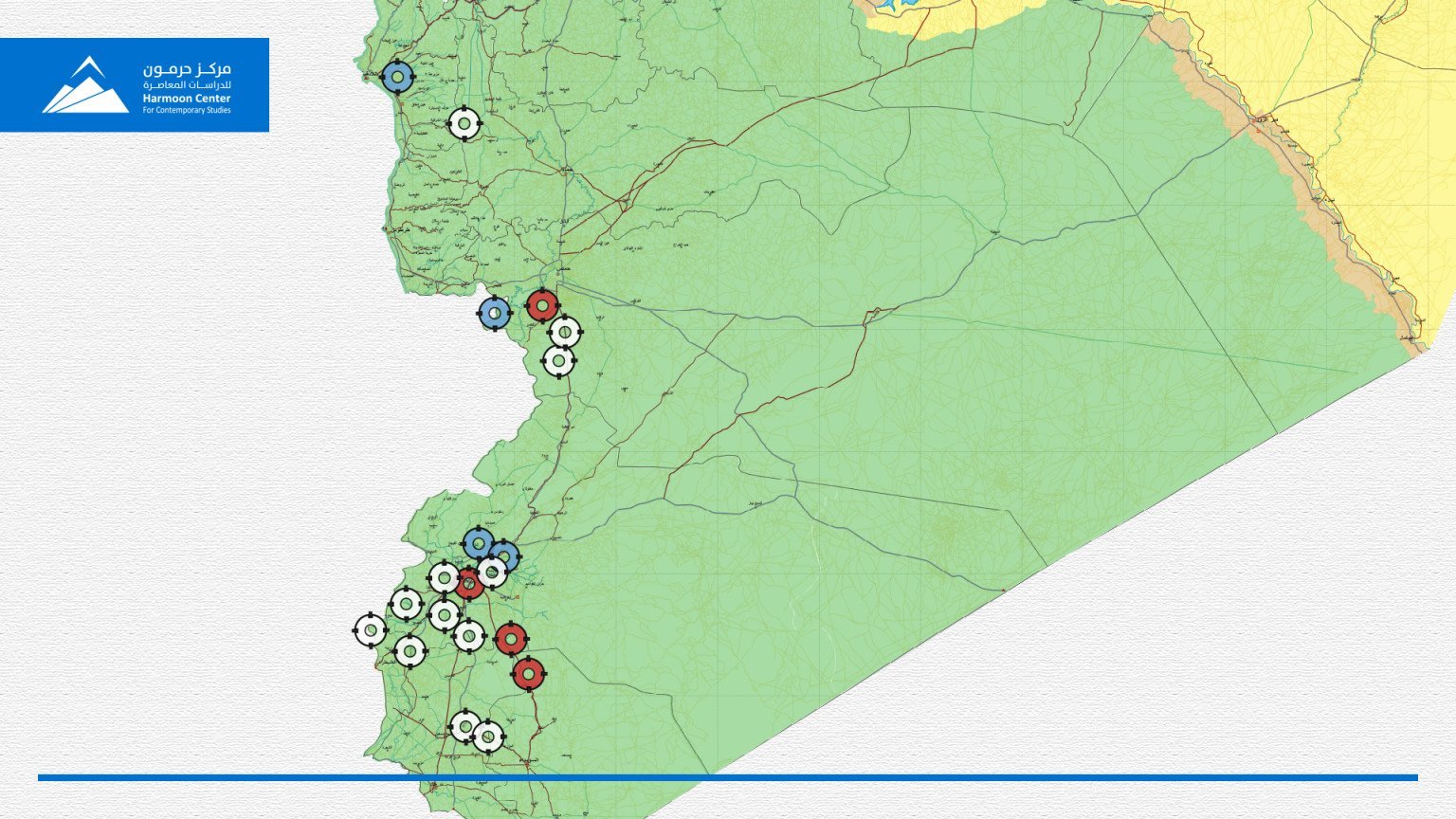
To view the map in high resolution, please click on the link
Airstrike Strategy:
The recent Israeli airstrikes targeted strategically significant military sites across various regions of Syria with marked intensity. In Damascus and its suburbs, the strikes included:
- Mezzeh Military Airport, a key facility for military operations.
- The Scientific Research Complex, a site associated with advanced military development.
- The Customs Administration building in the Kfarsusa area, located within the “security square,” a critical hub housing the primary intelligence headquarters.
In southern Syria, the airstrikes extended to the governorates of Daraa, Suwayda, and Quneitra, with key targets including:
- Khalkhalah Airport, a strategic military airbase.
- The base of the 175th Regiment in the city of Izraa, an important military installation.
- The 121st Brigade base in Kanaker, located southwest of Damascus.
This detailed and systematic targeting underscores Israel’s intent to neutralize advanced military infrastructure across Syria.
These actions marked a clear escalation against military infrastructure in the region.
In western Syria, Israel targeted the port of Latakia and the Scientific Research Complex in Masyaf, demonstrating a focused interest in sites associated with weapons development and military technology.
On the ground, Israeli forces made limited advances in the Quneitra Governorate, seizing positions near Mount Hermon. This manoeuvre indicates Israel’s intent to bolster its military presence in this strategically sensitive border area, creating an advanced defensive line within Syrian territory.
Logistically, the airstrikes inflicted significant damage on military equipment and installations, further exacerbating the security challenges in Syria, which is already struggling with the instability caused by the collapse of the former regime
In conclusion, the Israeli operations appear to be a response to perceived security challenges stemming from the new political and military realities in Syria following the regime’s collapse. These actions reflect Israel’s intent to establish new rules of engagement consistent with its security objectives. However, despite the absence of overt hostility from the Syrian opposition toward Israel, questions persist regarding the true motives behind these operations. They raise concerns about whether Israel aims to expand its regional influence rather than solely ensuring the security of its borders.
Israeli airstrikes are expected to persist as part of a broader strategy to address evolving security dynamics in Syria. However, these actions carry the risk of intensifying regional tensions and further destabilizing Syria’s fragile status as a state in transition.