


- Introduction
Since October 7, 2023, the Middle East has been witnessing military operations in various areas, beginning in Gaza and spreading to Lebanon and elsewhere. By August 2024, military activities had escalated between Israel, on one side, and Hezbollah, Iran, and Iranian-backed militias in Syria and Lebanon on the other. Israel has intensified its operations as part of its broader strategy to counter threats from these groups. These strikes were not isolated incidents but are intrinsically linked to Israel’s ongoing military operations in Lebanon.
This paper explores the potential effects of these Israeli strikes on the influence of Hezbollah and Iran in Syria, identifies Israel’s current goals, analyzes the strikes carried out from August 2024 until mid-October 2024 and anticipates possible future scenarios based on the extent to which these goals have been achieved.
- Israeli Escalation Against Hezbollah and Iran in Syria
Hezbollah and Iran are exploiting regime-controlled areas in Syria for strategic purposes, such as using them as weapons transport and storage routes and establishing bases for military operations. These regions serve as optimal locations for setting up operation centers that include various commanders from the Revolutionary Guards and Lebanese Hezbollah.
2.1 Weapons Production and Storage Facilities
Iran and Hezbollah aim to leverage the Syrian regime’s research facilities to produce and store weapons, which are targeted by Israel. A recent example is the Israeli attack on Masyaf, on September 8-9, 2024, which hosts significant facilities for military research and development. The attack targeted sites allegedly used to produce ballistic missiles and drones (UAVs) intended for Hezbollah.[1]
The execution of the Israeli strike, which was coupled with an airdrop, underscores the strategic importance of this facility. It is uncommon for Israel to conduct landings deep within Syrian territory, indicating a high level of planning. Additionally, Israel’s seizure of vital documents and equipment suggests an advanced intelligence operation aimed at undermining Iran’s military infrastructure in Syria. By obtaining this information, Israel can better understand Iran and Hezbollah’s capabilities and plans, identify more potential targets, and disrupt military development programs.[2] This aligns with Israel’s objective of hindering Hezbollah’s acquisition of advanced weapons that could alter the regional balance of power.
2.2 Smuggling Routes and Logistics Centers
The attacks on border crossings between Syria and Lebanon on September 27-28, 2024, highlight Israel’s efforts to disrupt the logistical networks of Hezbollah and Iran. The smuggling routes extend from Wadi Khaled near Tal Kalakh in Homs Governorate, pass through Al-Qusayr, and reach the western Qalamoun in Damascus Countryside Governorate.[3] These crossings are crucial for transferring weapons and equipment to Hezbollah, including advanced weapon systems and technological devices. By disrupting these routes, Israel aims to weaken Hezbollah’s operational capabilities over time, reduce the flow of weapons, and impair Hezbollah’s ability to rearm and equip its forces. The involvement of Syrian regime army members in these operations indicates complicity or direct assistance in Hezbollah’s smuggling activities.[4]
2.3 Enhancement of Military Infrastructure
Hezbollah’s efforts to bolster its military presence in southern Syria have been met with numerous Israeli strikes. On September 12, 2024, Israel eliminated Ahmed al-Jaber, a key member of Hezbollah’s “Golan File” unit, signaling Israel’s intent to prevent the opening of a new front on its northeastern border. The Golan File unit aims to exploit the security vacuum in the region to establish bases and facilities for launching attacks against Israel.[5] By removing al-Jaber, Israel disrupted Hezbollah’s strategic plans and sent a deterrent message to other factions contemplating similar actions. This demonstrates Israel’s readiness to take decisive measures to avert new security threats, even if it requires specific ground operations.
Furthermore, the attack on a villa in Yafour (near Damascus) on September 29-30, 2024, used by senior Hezbollah and IRGC officials for meetings and strategic planning, underscores Israel’s focus on targeting high-value sites. Israel’s accurate intelligence on the movements and activities of Hezbollah and IRGC leaders, as well as their associates, increases psychological pressure, diminishes their sense of security, restricts their movements, and disrupts their communication channels.[6]
3- Analysis of Israeli Strikes in Syria from August 2024 to Mid-October 2024
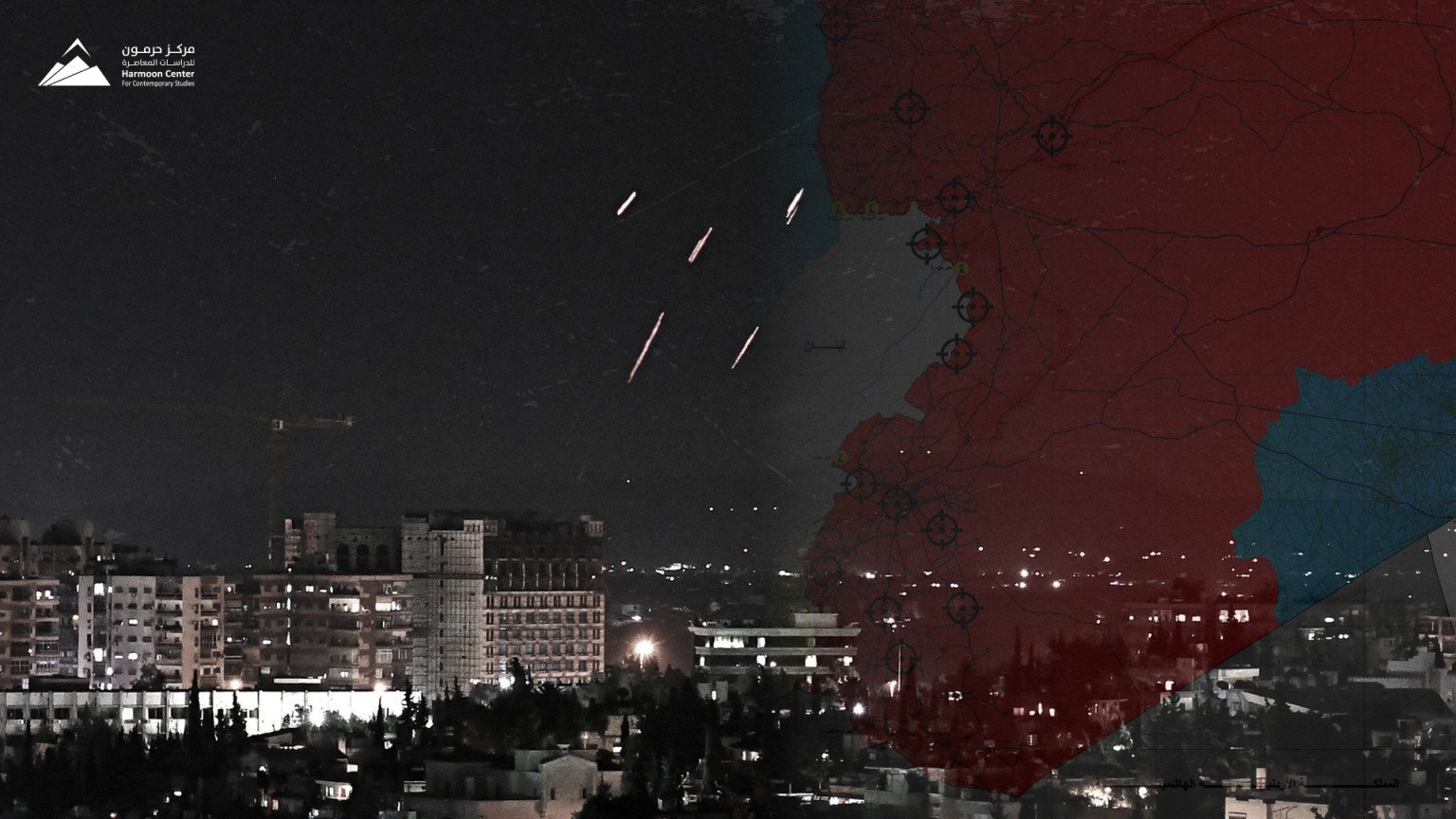
During this period, Israel conducted several strikes across various regions of Syria. These operations demonstrate a significant escalation in disrupting smuggling networks, destroying military infrastructure, and undermining the influence of Iran and Hezbollah in the region.[7]

For hd map
Table (1): Major Israeli Strikes in Syria (August 2024 to Mid-October 2024)
| Date | Location | Objective | Outcome |
| Aug. 3, 2024 | Damascus, Dimas | Targeting a vehicle on the Damascus-Beirut road | Vehicle destruction |
| Aug. 8, 2024 | Homs, Hamrat | Ammunition depots, 5 km south of Shayrat Air Base | Destruction of warehouses following a weapons shipment |
| Aug. 23, 2024 | Homs and Hama | Multiple sites, including a veterinary college | High-level coordination to disrupt military infrastructure |
| Sep. 5, 2024 | Deir Ezzor, Albu Kamal | Truck carrying weapons to central fronts | IRGC-linked local fighter killed |
| Sep. 8–9 2024 | Hama, Masyaf | Roads and buildings near the research center in Masyaf | Disruption of Hezbollah’s arms and weapons development |
| Sep. 12, 2024 | Quneitra, Khan Arnaba | Vehicle near the ceasefire line in the Golan | Prevention of direct threats |
| Sep. 20, 2024 | Rif Dimashq, Near Airport | Iraqi commander in Kataib Hezbollah near Damascus airport | Key commander coordinating Iran with militias killed |
| Sep. 26–27, 2024 | Rif Dimashq and Homs | Border crossings between Lebanon and Syria | Escalation to disrupt smuggling networks |
| Sep. 27, 2024 | Rif Dimashq, Beit Saber | House of a Hamas leader | Hamas leader and his wife killed |
| Oct. 1, 2024 | Damascus, Mezze Villas | Targeted car; Iranian military adviser Majid Diwani killed | Hezbollah-linked adviser killed |
| Oct. 1, 2024 | As-Suwayda | Three different radar locations | Destruction of radar sites |
| Oct. 1, 2024 | Daraa (Sanamayn and Izraa) | Radar sites and warehouses | Destruction of radar and warehouses |
| Oct. 2, 2024 | Damascus, Mezze Villas | Building destroyed; Hezbollah commander Hassan Nasrallah’s son-in-law killed | Hezbollah commander and family member of Hassan Nasrallah killed |
| Oct. 3, 2024 | Lattakia, Jableh | Warehouses near the Russian air base in Hmeimim | Warehouse destruction |
| Oct. 3, 2024 | Homs, Qusayr | Tunnel used by Hezbollah to smuggle weapons | Tunnel destruction |
| Oct. 6, 2024 | Homs, Hassiya | Iraqi vehicles in Red Crescent convoy | Iraqi killed in Red Crescent convoy |
| Oct. 8, 2024 | Damascus, Mezze Villas | Building 500 meters from the Iranian Embassy | Civilians and Hezbollah members killed |
| Oct. 9, 2024 | Quneitra, Khan Arnaba | Radar site | Site destruction |
| Oct. 10, 2024 | Homs, Hassiya | Ammunition depot in Hassiya – Syrian Iranian Vehicles Company | Warehouse destruction |
Analysis of Israeli Strikes:
- Geographical Distribution: Strikes were predominantly concentrated in Damascus (4 strikes) and Homs (5 strikes), which together account for approximately 50% of the total operations. Other targeted areas include As-Suwayda (3 strikes), Quneitra and Daraa (2 strikes each), and single strikes in Hama, Deir Ezzor, and Latakia. The focus on these regions indicates targeting areas vital to Iran and Hezbollah’s operations, aiming to disrupt their strategic footholds within Syria.
- Targeting Military Infrastructure: Approximately 40% of the strikes targeted military depots and facilities, including ammunition depots, tunnels, vehicles, and research centers. This underscores Israel’s intention to disrupt the transfer and storage of weapons. By attacking key infrastructure, Israel aims to hinder the ability of Iran and Hezbollah to maintain and develop their military capabilities in the region.
- Elimination of Key Individuals: Around 33.3% of the strikes focused on eliminating important figures linked to Iran and Hezbollah, such as Majid Diwani and Hassan Nasrallah’s son-in-law. The removal of these key individuals disrupts leadership structures, impedes strategic planning, and serves as a deterrent to other leaders considering similar actions against Israel.
- Multi-Objective Coordination: Approximately 13.3% of the operations involved simultaneous attacks on multiple sites, demonstrating high-level coordination and planning within Israeli military operations.
- Sensitive Strikes: Israel conducted strikes near sensitive sites such as the Russian air base in Hmeimim, indicating a willingness to engage in operations close to Russian interests without escalating to broader conflicts.
- Impact of Israeli Operations on the Influence of Hezbollah and Iran in Syria
Israel’s operations have had significant repercussions on the influence of Hezbollah and Iran, as well as their presence in Syria and Lebanon. These impacts include:
Disruption of Military Capabilities: The destruction of weapons production facilities and the elimination of key personnel weaken Hezbollah’s military capabilities. The loss of critical infrastructure limits the ability of Hezbollah and Iran to produce, store, and transport advanced weapons. Additionally, the disruption of smuggling routes creates significant logistical challenges, affecting the flow of supplies and equipment.
Psychological and Strategic Deterrence: Israel’s ability to carry out successful operations within Syrian territory demonstrates its intelligence capabilities and the extent of its military reach. This may create a state of uncertainty and fear among Hezbollah and Iran, limiting their movements within Syria. Such strategic deterrence strengthens Israel’s position in the region and reduces the possibility of uncalculated escalation.
Strained Syria-Iran Relations: The continued targeting of Syrian facilities may strain relations between Syria and Iran, especially if the leadership of the Syrian regime and Russia perceive that their alliance with Iran incurs more risks and costs. This could push Syria to reassess its relationships and alliances in an attempt to reduce losses and maintain internal stability.
- Israel’s Current Objectives: “Bank of Goals” in Syria:
Israel’s operations in Syria and Lebanon pursue several strategic objectives, including:
- Preventing the Transfer of Advanced Weapons to Hezbollah: Israel’s primary goal is to prevent Hezbollah from acquiring advanced weapons that pose a threat to Israel, including ballistic missiles, precision-guided missiles, and advanced drones.
- Dismantling Iran’s Military Infrastructure in Syria: Israel seeks to reduce Iran’s military presence in Syria by targeting IRGC facilities, military personnel and advisers, command centers, and training sites. This aims to diminish Iran’s ability to support its militias and weaken its regional influence.
- Enhancing Deterrence: Israel’s ongoing military actions maintain deterrence by demonstrating its willingness and ability to act against threats beyond its borders. By eliminating prominent elements and targeting strategic facilities, Israel sends a clear message to regional actors about the risks associated with threats to its national security.
- Potential Outcomes Based on Israel’s Achievement of Its Goals:
The repercussions of Israel’s operations in Syria depend on the extent to which its strategic objectives have been achieved. The potential outcomes can be analyzed based on two primary scenarios:
6.1 Scenario 1: Partial Calm (Successful Achievement of Objectives)
If Israel succeeds in disrupting Hezbollah’s supply chains and destroying key military infrastructure, it will significantly weaken Hezbollah’s operational capabilities, reduce its ability to launch effective attacks, and diminish the direct threat to Israel. For Iran, the loss of infrastructure and personnel could lead to a reassessment of its strategy in Syria, limiting its regional influence and forcing a redirection of its resources.
This would reduce the direct threat posed by advanced weapons and cross-border attacks by Hezbollah and Iran, and this reduction in threats will enhance Israel’s security in the short term. In addition, achieving these goals would enhance Israel’s deterrence, making adversaries reluctant to engage in hostilities given the stated risks and potential costs they would face. Furthermore, the success of these operations could enhance international support for Israel’s security concerns. As a result, the Syrian regime may face increased scrutiny and diplomatic pressure from the international community to reduce its support for Hezbollah and Iran. This diplomatic pressure should contribute to changes in regional alliances.
6.2 Scenario II: Escalation and Expansion of Fighting (Failure to Achieve Objectives)
If Israel fails to stop the transfer of advanced weapons, Hezbollah may enhance its military capabilities, increasing the likelihood of escalation. Iran would be able to support its militias more effectively, contributing to regional instability and expanding its influence. Hezbollah might escalate its military activities, including advanced missile strikes or coordinated attacks, exacerbating the conflict and compelling Israel to take more drastic actions.
On the other hand, Israel’s failure to achieve its goals may be seen as weakness, emboldening its adversaries. This perception could prompt Hezbollah, Iran, and other hostile actors to increase aggression, undermining Israel’s regional standing and increasing instability. This escalation could attract other regional powers and complicate the security landscape, making the conflict more difficult to contain.
In response to further Israeli escalation, both Hezbollah and Iran may adjust their tactics to counter mounting pressure. This includes:
- Increased Secrecy: Enhancing the concealment of their movements and activities to make detection more difficult.
- Asset Distribution: Deploying equipment and personnel across multiple locations to reduce the risk of Israeli targeting.
- Development of New Operational Modes: Devising alternative methods for transporting weapons and equipment, complicating detection efforts.
- Use of Advanced Technology: Employing modern technologies to encrypt communications and enhance information security, making it harder for Israeli intelligence to intercept.
6.3 Iranian Diplomatic Efforts in Both Scenarios
In its diplomatic efforts, the Iranian regime has sought to address the escalating tensions and gain international support during its participation in the United Nations General Assembly in New York, where Iranian Foreign Minister Abbas Araqchi indicated that Israel’s actions are aimed at expanding tensions and war in the region. He stressed that Iran is fully aware of Israel’s intentions and would not fall into any trap that leads to a wider conflict. Araqchi emphasized that Iran is ready to defend its interests and allies but prefers diplomatic solutions and avoids direct conflict. The Iranian regime is focused on spreading this message during its official visits, and it was repeated by Araqchi during his recent visit to Baghdad.[8] These diplomatic efforts were reinforced by Araqchi’s visits to Lebanon and Syria to consult on regional developments. These visits indicate Iran’s continued support for the Lebanese “resistance” and confirm that Iran, while avoiding military escalation, will not hesitate to respond if provoked. Through these meetings, Iran seeks to strengthen its regional alliances and coordinate joint responses to Israeli policies.[9]
Through these diplomatic activities, the Iranian regime is trying to show that Iran is still seeking to build a united front that includes its regional allies to counter mounting Israeli pressure. On the other hand, Iran’s adversaries believe that its approach creates more complexity and increases challenges to the stability of the region, as these alliances are expected to heighten tensions between the various regional axes.
Conclusion
Israel’s strikes in Syria constitute a strategic effort to limit Hezbollah and Iran’s military capabilities and influence. Israel seeks to protect its national security by disrupting smuggling networks, destroying military infrastructure, and targeting key individuals who threaten its security. Achieving the objectives of the Israeli occupation forces is vital to Israel’s national security and to maintaining regional stability, as operations aim to prevent Hezbollah from acquiring advanced weapons, dismantle Iran’s military infrastructure, and maintain deterrence by demonstrating Israel’s willingness to act against threats. The success of these endeavors could reduce direct threats and constrain future adversaries’ operations. However, failure may increase threats to Israeli security and elevate the risk of regional escalation. The current situation reflects a complex overlap of regional power dynamics, with significant implications for security and stability in the Middle East.
[1]Secrets of the Military Scientific Research Center and its role in developing the regime’s weapons Damascus Forum, Syria TV, 21/9/2024, accessed 9/10/2024, https://shorturl.at/261Dh
[2] Brief: Israeli Airstrike on Masyaf – September 9, 2024, Navvar Saban, 9/9/2024, Seen on 12/10/2024, https://tinyurl.com/2fty5mnz
[3] Syria Again.. Israel Targets Army Position and Kills 5 Military Personnel, Al-Arabiya Net, 27/9/2024, accessed on 11/10/2024, https://shorturl.at/gTZJF
[4] An interview conducted on 12/10/2024 with a private source, who has access to the Syrian and the Lebanese border in the west of Homs governorate.
[5] Israeli shelling kills two people in southern Syria, France 24, 12/9/2024, seen on 5/10/204, https://rb.gy/ae4dgt
[6] Targeting a villa of a squad led by Maher al-Assad.. and a message from Israel, Al-Arabiya.net, 30/9/2024, seen on 9/10/2024, https://shorturl.at/X7Nrc
[7]A special archive for the center concerned with following up the Israeli raids in Syria and analyzing their targets and locations.
[8] Iranian Foreign Minister: We do not want a war, but we are ready for it, Anadolu Agency, 14/10/2024, accessed on 15/10/2024, https://tinyurl.com/5dhea48v
[9] Coming from Lebanon.. Iran’s Foreign Minister arrives in Syria, Alhurra, 5/10/2024, seen on 14/10/2024, https://tinyurl.com/3vasrcmc