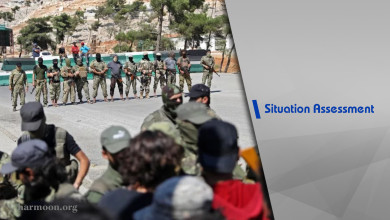




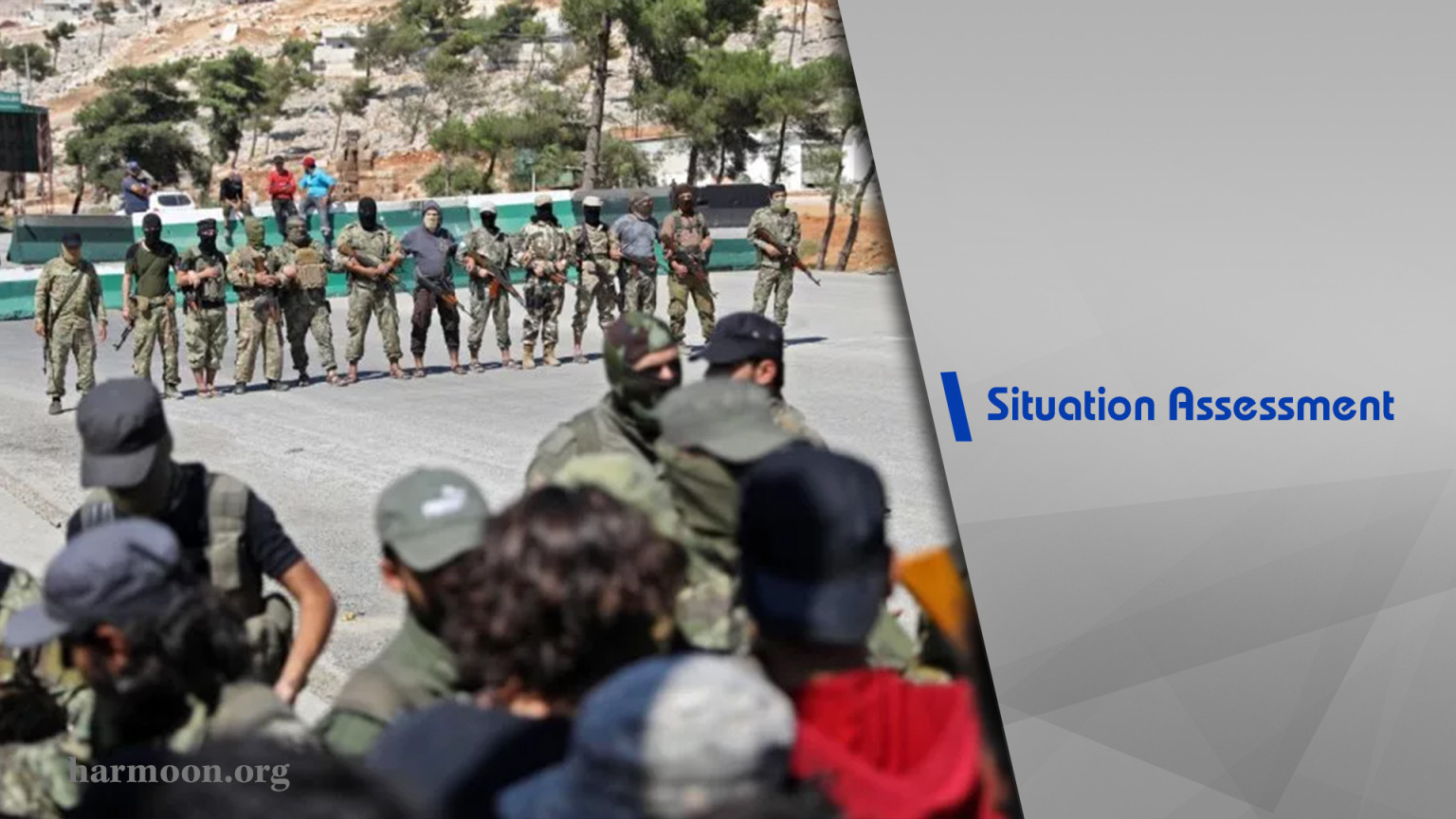
Women and children held in Hayat Tahrir al-Sham (HTS) prisons? Where torture is allegedly widespread? The man who revealed this information suddenly disappeared at the end of June, apparently arrested for being too talkative. This case has reopened the debate on prison conditions and freedom of expression in Idlib Governorate. It is a situation HTS least expected: a political crisis. The armed group, which controls at least half of the governorate of Idlib, is facing a movement that is all the more destabilizing as a result of its popularity and peacefulness.
Anger has been brewing for two years. Anti-HTS rallies were reported first in al-Sahara (Aleppo), in January 2022, before spreading to north-western Syria.[1] The fact that the first rallies did not take place in Idlib itself can be understood as resulting from a cautious attitude on the part of the demonstrators, who, not knowing how HTS would react, began to act on the outskirts of the governorate. In the following months, the number of demonstrators increased. The slogans became more incisive, calling initially for the release of prisoners and, soon after, for an improvement in living conditions in this region that has been impoverished by war. The boldest demonstrators demanded the dissolution of the General Security Service, the security arm of HTS, and free elections for the Shura Council.
At first, HTS allowed the demonstrations, which took place at the Idlib Clock Roundabout and in the towns of Binnish and Jisr al-Shughur. Public gatherings were attended by a few dozen people, mainly women, demanding the return of husbands or brothers or, at times, expressing a few professional requirements. There were no reports of violence, and the atmosphere was calm. From the first quarter of 2024 onward, the protest movement hardened due to the continued deterioration of the social climate in Idlib and the inability of HTS to propose a way out of the conflict. The towns of Al-Janodiya, Armanaz, Abin Sama’an, Atma, and Kafr Takharim, as well as the camps of Al-Karama and Al-Sahara, are now scenes of regular demonstrations, according to the Syrian Observatory for Human Rights (SOHR)
Structuring the Political Opposition
The structuring of the opposition has been very cautious, as the Syrian Salvation Government [حكومة الإنقاذ السورية], the local administration of HTS, has never taken a clear position on the right to demonstrate. HTS spokespersons say they are open to dialogue. Yet HTS accuses the demonstrators of inciting chaos.
In May 2024, the Gathering of the Revolutionary Movement was established.[2] This organization, which has no official status, is mainly made up of a mix of people from the province, as well as three associations: the Association of Knowledgeable People in Northern Syria, the Coordination Union, and the Al-Karama Initiative Assembly. Its leadership is collegial. Dr. Muhammad Farouk Kashkash is the best known among several coordinators, including men like Rami Abdul Haq, Ali Al-Alawi, Yahya Nimah, and Dalama Imad Ali, in charge of the ‘Emergency Response Team’.
As soon as the creation of the Gathering was announced, the HTS detained Farouk Kashkash for a few hours. To be released, Farouk Kashkash had to confirm that his intentions were peaceful and that he did not question HTS’ legitimacy. While the non-violence of the opposition was confirmed by Kashkash, two political lines soon emerged: One calling for the release of prisoners held by the armed group, and the other calling for a break in dialogue with HTS, as the economic situation continues to deteriorate. Seventy-five percent of Idlib’s population relies on humanitarian aid to survive; 3.3 million people are severely food insecure and 2.9 million are internally displaced. The UN has launched a “pre-catastrophe emergency appeal”.[3]
Idlib’s economy is going through an extremely difficult period. The population faces daily challenges to meet its basic needs against a backdrop of galloping inflation. Few factories have been forced to shut down for lack of energy to run their production lines.[4] As a result, unemployment continues to rise. The rebel administration in Idlib does not publish reliable figures, but the last available data from 2022 was already alarming: 85% unemployment.[5] Since then, the situation has only worsened.
Threats
For a long time, HTS thought it was dealing with a factional movement scattered throughout the areas it controlled. The Salvation Government’s interior ministry initially said it was open to the Gathering’s demands, writing “We have to listen to them and solve their problem,” on its Telegram feed.[6] HTS has set up dialogue workshops and held talks with leaders in the towns and villages where the rallies are taking place. Farouk Kashkash was even hosted by the head of HTS, Abu Mohammad al-Julani (May 26, 2024), although the meeting was unsuccessful as al-Julani rejected a proposal to stop the demonstrations in exchange for the release of prisoners.
The protest movement continued to grow. Sheikhs and preachers joined the demonstrators, including Abd al-Razzaq al-Mahdi, who posted a list of 200 prisoners to be released.[7] His sit-ins took place in the Great Mosque of Idlib and in Binnish. In response, HTS instructed the Directorate of Endowments, Appeal, and Orientation to identify and dismiss sheikhs who colluded with the opposition, such as Sheikh Munir Saif in Jericho (Southern Idlib). But this has not eased the pressure, and demonstrations continue to take place.
The head of HTS, Abu Mohammad al-Julani, now believes that the demonstrators have “deviated from their true objective.”[8] He has therefore promised to take measures to restore security.
- Threats. While the HTS leadership maintains a conciliatory tone, the message on the ground is different. Some officers have openly expressed their disapproval of the demonstrators through physical intimidation, some even threatening to cut off their hands.[9] The Ministry of the Interior has gone so far as to promise to “deal with the demonstrators with an iron fist” if the rallies continue.[10]
- Force. HTS has used tear gas, armored vehicles, and live ammunition to disperse protesters (Video).[11] The Syrian Journalists Syndicate issued a statement condemning the harassment of reporters trying to cover events. The Syrian NGO Documentation Centre on Violations lists the names of young people who have died in prison after being arrested.
- Arrests. The number of opponents arrested is difficult to determine, as it is necessary to distinguish between arrests lasting a few hours and prison sentences. HTS has carried out successive, targeted campaigns. For example, a Public Security Service official told a North Press journalist (May 27, 2024) that a security campaign had targeted more than 90 people, including six women, in the Bardaghli, Atma, and Deir Hassan camps.
The toxic climate was amplified by a series of unsolved murders. The body of Abu Omar Sio, a senior member of the Salvation Government’s Public Security Department, was found stabbed to death in his home in Jisr al-Shughur. The motive is unclear, but local sources suggest that the killing was linked to growing tensions between the population and HTS security forces.
A Political Solution?
HTS has demonstrated its willingness to find a political solution to the crisis. During Ramadan, the group promised to reform the General Security Service, the security arm of HTS, without giving any details. A general amnesty for prisoners was declared in May, provided that each prisoner has a certificate of “good conduct” and has not been convicted of murder, kidnapping, or armed robbery.[12] These provisions severely limited the number of prisoners who could be released. According to the SOHR, 420 prisoners were released, well below the number demanded by the people of Idlib.
Crisis management by HTS has had the effect of increasing divisions within the population of Idlib. Some believe that al-Julani is betting that the movement will run out of steam and is taking a strong stance, if not with violence then at least with threats. Others believe that since the armed group is in a fragile state, opening the prison doors would free activists who would embrace war against it. Another position is that HTS remains an armed group and only that, and thus is incapable of exercising power in a province like Idlib.
HTS hoped that the appointment of Muhammad al-Bashir[13] as head of the Salvation Government in January 2024 would enable it to quell the protests, but they continue to take place. A law on demonstrations is due to be presented to the Shura Council soon, but it is not yet possible to predict what direction al-Julani will take. The former Al-Qaeda and ISIS fighter is facing the most delicate exercise of his militant life: Adversarial dialogue. And while it is easy to claim to be a state expert and comment on subjects such as the price of a ton of wheat, it is a perilous exercise to speak on the independence of the judiciary or the release of prisoners, many of whom have a military background similar to al-Julani.
For the people of Idlib, the question is knowing how far is too far. People know that HTS is trapped in its normalization campaign. It cannot afford a bloodbath against the population, which would isolate it and rekindle rivalries between armed groups. It may be time to remind people that there is a public opinion in Idlib and that it can be heard. The stakes are high, given the social plight of the population. Sooner or later, the voice of the public will have to be heard. The US embassy posted on X/Twitter[14] that it “supports the rights of all Syrians to peaceful expression and assembly, including in Idlib.” Since the beginning of the year, there have been several calls from the EU and the UN for freedom of expression in Syria.
These statements place al-Julani face-to-face with his own political responsibilities. His actions will come under closer scrutiny in the coming weeks, when delegations from Damascus and Ankara are expected to meet in Baghdad to resume dialogue. On that day, the issue of the rebel province will be raised. Idlib will be back in the headlines. And so will the fate of the HTS.
[1] Khaled al-Khateb, “Idlib residents demand release of detainees in jihadist group’s prisons”, Al-Monitor, January 26, 2022.
https://tinyurl.com/2uzve5w8
[2] X/Twitter: https://t.me/hiraksy/55
[3] OCHA, “North-West Syria”, Situation Report, updated: May 15, 2024.
[4] Cham Economic Report, Sham News Network, April 27, 2024. https://tinyurl.com/y2pjxxhs
[5] « تقرير: معدل البطالة يصل إلى 85% في مناطق شمال غربي سوريا », Radio Al-Kul, November 10, 2022.
[6] X/Twitter: https://t.me/moi_syriaa/756
[7] X/Twitter: https://t.me/Abedrazzakmahddii/5519
[8] الجولاني: المظاهرات انحرفت عن مسارها.. و”الإنقاذ” تهدد “بيد من حديد”, Rozana FM, May 15, 2024
[9] X/Twitter: https://t.me/OGNEnglish/13697
[10] https://www.facebook.com/watch/?v=1849862215483246
[11] @ShaamNetwork, May 14, 2024. https://x.com/ShaamNetwork/status/1790343112843309542
[12] ضمن شروط واستثناءات عدة.. “تحرير الشام” تصدر عفواً عاماً عن السجناء بمعتقلاتها, North Press Agency, March 5, 2024. https://npasyria.com/181838/
[13] Muhammad Al-Bashir was born in 1983 in Jabal Al-Zawiya, in the south of Idlib governorate. After serving as Minister of Development and Humanitarian Affairs in the “Salvation” government in 2022/2023, he was appointed head of the “Salvation” government on 13 January 2024.
[14] https://x.com/USEmbassySyria/status/1795716674198573539