



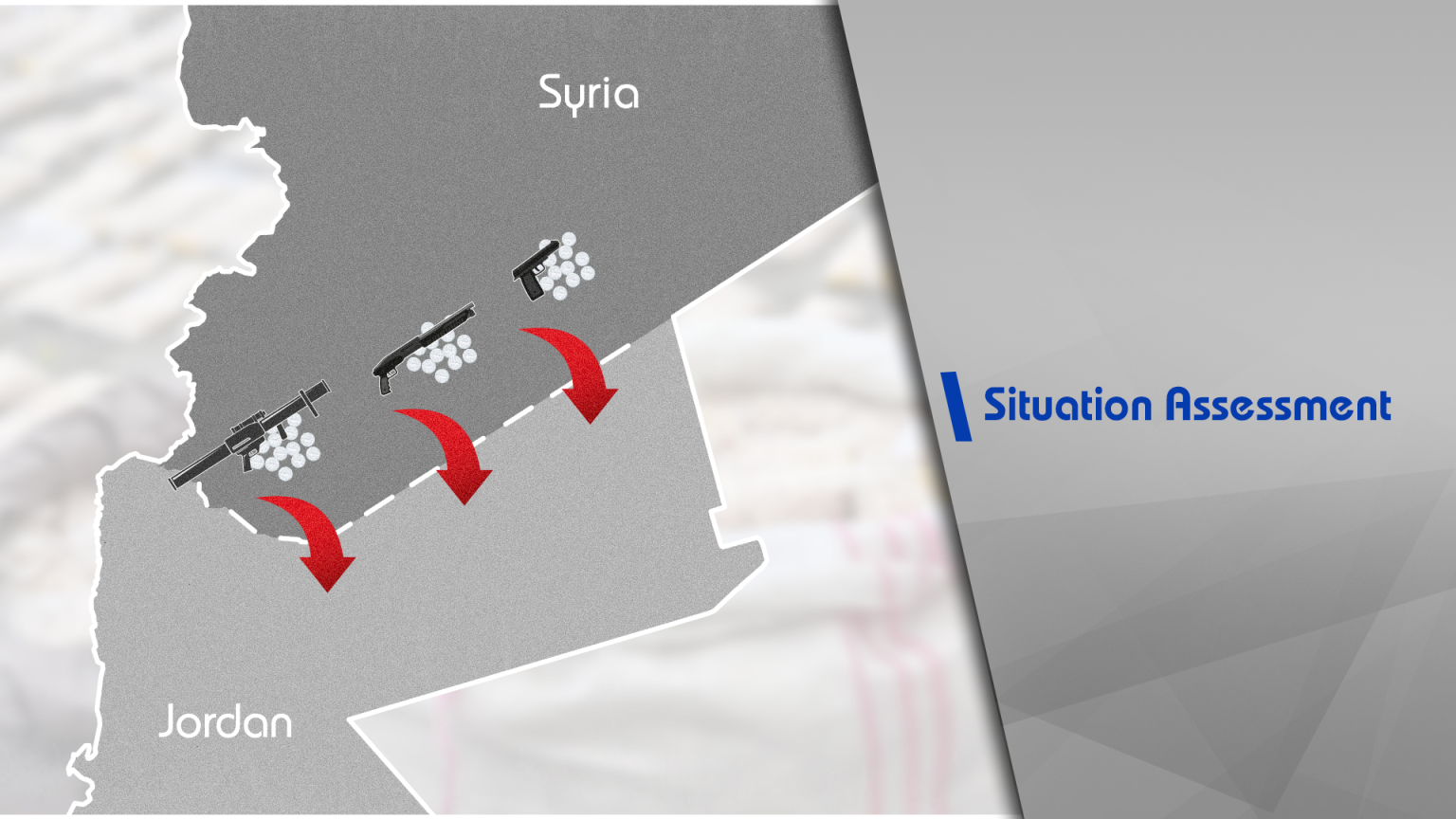
Smuggling activities between Syria and Jordan have recently witnessed a notable increase. These operations, initially associated with the trafficking of drugs and Captagon, have expanded to include the illegal transportation of sophisticated light and medium weapons. On Monday, December 18, 2023, reports surfaced regarding air strikes launched by Jordan against drug smugglers. However, Jordan promptly refuted the claims, asserting that it had not conducted any air strikes. Instead, the country officially declared that it had successfully thwarted a significant infiltration operation into its territory.
Will the Jordanian-Syrian border experience further security developments and increased military escalation in the near future? What is the objective behind this escalation at this particular juncture?
Despite Jordan’s attempt to maintain distance from the events in Syria, its geographical proximity, alliances, and the influx of nearly a million Syrian refugees since 2011 have significantly compounded its involvement. Jordan became part of the international coalition against ISIS due to these factors. Jordanian aircraft conducted numerous airstrikes in ISIS-controlled areas, including Raqqa. Unfortunately, one pilot, Muaz Al-Kasasbeh, was captured and brutally executed by the organization through burning. Additionally, Jordan played a crucial role by hosting the MOC operations room, established in 2013, contributing to the management of operations for Syrian military opposition factions in the southern front.
After the Syrian regime gained control of the southern region in 2018, there was a significant rise in drug smuggling operations. The Jordanian-Syrian border witnessed a surge in infiltration and smuggling incidents, evolving into a more organized and fortified activity, often led by armed groups. In recent times, these operations have become denser and more sophisticated, with the introduction of drones for smuggling, surveillance, and monitoring. Between the beginning of 2023 and last September, a total of 11 drones were shot down.[1] This increase in drone activity may be attributed to Jordan’s efforts to tighten its land border security, which spans approximately 378 km. Concurrently, the criminal networks involved in smuggling have enhanced their capabilities, adapting to the heightened border protection measures. Consequently, these criminal groups have escalated their confrontations with Jordanian border security forces, attempting direct penetration into Jordanian territory and adopting advanced weaponry, thereby altering the rules of engagement. The smugglers have also adopted military tactics and started navigating through challenging terrains. This shift indicates that Jordan is now contending with well-organized, trained gangs and cross-border networks, making the situation more complex and demanding a strategic approach to border security.
In early December 2023, clashes occurred, resulting in the killing of a Jordanian border guard. Further exacerbating the situation, a subsequent operation on December 18 saw smugglers attempting to enter Jordan with rocket launchers and anti-personnel mines. The confrontation with these individuals lasted for about 14 hours. This marked a significant shift from previous incidents, as criminal gangs no longer confined their activities to drug and Captagon smuggling. Instead, they had escalated to orchestrating operations involving the trafficking of modern light and medium weapons. This alarming development suggests that these operations pose a direct threat to the stability of Jordan and, potentially, even Saudi Arabia.
In response to these escalating challenges, Jordan has initiated the deployment of its air force to safeguard its borders and conduct military strikes against criminal gangs within Syrian territory. This proactive approach is aimed at fortifying the country’s security. It is noteworthy, however, that all military operations executed by Jordan are currently focused on dismantling elements involved in smuggling activities. Notably, there has been a deliberate decision to refrain from targeting the drug and Captagon networks or factories within Syrian territory. This strategic choice is influenced by the fact that a significant portion of these illicit operations are situated within military installations affiliated with the Syrian regime or militia headquarters. Moreover, the transportation of illicit drugs often occurs through military vehicles associated with the regime and militias.
Jordan’s recent arrest of numerous smugglers in a targeted operation holds the potential to unveil both local networks within Jordan and connections with networks operating within Syrian territory. Smuggling operations typically involve a receiver, a distributor, and someone overseeing the transportation of goods through Jordan to GCC countries. This intricate process necessitates the involvement of local collaborators. Currently, there are apparent cross-border networks engaged in drug and Captagon trade, with Jordan serving as one of their transit hubs.
Many of the gangs involved in smuggling or production operations are closely linked to Iran, either through affiliation or direct support. Jordan has recently acknowledged this connection, publicly stating that the perpetrators behind these gangs are sectarian militias receiving backing from a regional state. This marks a notable shift in Jordan’s stance, which had previously refrained from explicitly making such declarations. The change is underscored by the statement of the Jordanian Foreign Minister during his meeting with the Iranian Foreign Minister at the Global Refugee Forum held in Geneva in mid-December 2023. During this meeting, Jordan declared its intention to explore all available options to halt these illicit operations.
The Arab countries presented the Syrian regime with the Arab Initiative, which Jordan actively promoted. Jordan played a significant role in advocating for the rehabilitation of the regime. In return, Assad was expected to assist in curbing the smuggling of Captagon and drugs. A step-for-step approach was proposed to accomplish various objectives, with a focus on progress in drug control. The agreement encompassed security cooperation and coordination among countries to combat drug-related activities. Financial incentives were offered to persuade the regime to cooperate. Despite numerous security meetings between Jordan and the Syrian regime aimed at fostering collaboration and coordination in this area, the Syrian government evaded its obligations. However, it tacitly allowed Jordan to take action against drug smugglers in border regions. It is widely known that the trade of drugs and Captagon generates more revenue for the regime (estimated at over $5 billion annually in 2021)[2] than any financial incentives from Arab countries. This income has become a crucial resource for the regime, especially given the sanctions imposed on it and the loss of control over oil-rich and agriculturally prosperous regions. In the face of these challenges, the regime considers the drug trade both a financial lifeline and a leverage point. It is unwilling to easily relinquish this tool to Arab countries, intending to use it as a bargaining chip in negotiations (offering normalization in exchange for halting Captagon-related activities). The regime aims to exert pressure on the United States to lift sanctions imposed by the Caesar Act and potentially seeks support for reconstruction efforts. Furthermore, the regime utilizes smuggling operations to suggest that its increased distance from the border, a consequence of past events in Daraa and current Suwayda demonstrations, is the main cause of the surge in smuggling operations. Bashar al-Assad consistently attributes the rise in such activities to chaos, insecurity, and corruption, denying any official involvement at the government level.
In the current scenario, the primary influence in the southern region of Syria rests with Iran and its militias. This prominence has been accentuated by Russia’s partial withdrawal from the area, a consequence of diverting part of its forces following the Ukraine war. This shift in dynamics has allowed for an upsurge in Iranian activity within the region. It is noteworthy that Israeli airstrikes targeting Iranian or regime sites appear to be more symbolic than impactful. Consequently, Iran and its militias operate with a considerable degree of freedom in these areas.
The United States is actively collaborating with Jordan in the battle against drug trafficking. The U.S. Treasury has imposed sanctions on several Syrian individuals involved in this illicit trade, underlining its commitment to addressing the issue. Additionally, the U.S. and Jordan have entered into a joint agreement to collectively combat drug-related activities. Despite the considerable growth in smuggling operations, there have not been any direct American military interventions against them thus far. However, the involvement of U.S. forces stationed in Al-Tanf or within Jordan could significantly contribute to curtailing this trade and smuggling. The United States has the potential to enhance these efforts by providing advanced military equipment, particularly day and night vision cameras, to stay ahead of the evolving tactics employed by smuggling groups. Moreover, the U.S. can offer specialized training and financial support to Jordan as part of a comprehensive strategy to address the challenges posed by drug trafficking.
The surge in smuggling operations witnessed a significant escalation amid recent events in Gaza and the tumultuous regional landscape. This escalation heightened Jordan’s apprehensions regarding its national security, as it perceived the developments on its northern borders as draining its forces and resources. Particularly concerning was the issue of weapons smuggling, accompanied by the persistent challenges posed by Captagon and drug trafficking. There was a growing suspicion that the drug trade might be a facade concealing the more sinister activity of weapons smuggling. Simultaneously, the situation coincided with the arrival of Iraqi crowds associated with certain factions linked to Iran. These groups crowded along the Jordanian-Iraqi border, ostensibly expressing a desire to travel to Palestine to engage in conflict against Israel. The convergence of these factors led Jordan to believe that there were overarching regional plans aimed at undermining its security and stability. The suspicion was that militias supported by Iran were orchestrating these activities, with the underlying objective of sowing chaos in Jordan. This, in turn, was perceived as a strategy employed by Iran to indirectly target the United States and Israel by destabilizing Jordanian territory.
In light of these conditions, the following two scenarios can be expected:
The first scenario predicts that smuggling operations will continue, particularly as gangs, armed militias associated with the Syrian regime and Iran, and even certain army divisions aligned with the Syrian regime, heavily depend on smuggling, drug trade, and Captagon dealings for a significant portion of their funding. This situation may prompt Jordan to reconsider its rules of engagement with these groups. Jordan may adopt a more resolute stance, intensify border control measures, and potentially block the passage of Syrian trucks traveling from Syria to GCC countries through Jordan.
Jordan may also escalate efforts to target these gangs and networks within Syria. However, it will exercise caution to avoid striking any military sites affiliated with the regime or Iranian militias. Simultaneously, Jordan may heighten military engagements with these groups along the border. Despite Jordan’s skepticism about the regime’s willingness to cooperate, it will maintain communication with the Syrian regime. The goal is to coordinate efforts in combating smuggling operations originating from Syria. While Jordan remains unconvinced of the regime’s sincerity, it anticipates the possibility that the regime might provide location coordinates or information about certain individuals, particularly smaller traffickers or those expendable within their cooperation network. This strategic move allows Jordan to neutralize these elements while enabling the regime to portray a facade of cooperation in combating smuggling in the region.
Jordan may exert pressure to halt its step-by-step commitments and the Arab Initiative, aiming to compel the Syrian regime to take decisive measures and enhance cooperation in controlling smuggling operations. Simultaneously, there is an anticipation that Jordan will escalate its efforts on both media and political fronts. Despite reservations about making direct accusations at the official level against the regime, Hezbollah, and Iran regarding the production and smuggling of drugs and weapons, Jordan is likely to assert that its campaign against drug traffickers serves not only to protect its people and borders but also to safeguard all GCC countries. Jordan emphasizes that 85% of the seized drugs are intended for smuggling beyond its borders,[3] as the Jordanian market is relatively small, with limited purchasing capabilities among its citizens. The primary target of this illicit trade is the markets of the GCC countries, with Jordan positioned as the crucial first gateway to obstruct this trafficking route. Consequently, it is expected that Jordan may receive financial and military aid from the US and certain GCC countries to bolster its efforts in countering this transnational threat.
Regarding the second scenario, its realization currently faces unmet conditions. However, it is conceivable in the long term for Jordan to engage with the American administration in establishing a buffer zone in southern Syria. This becomes imperative due to the challenging nature of border control and the difficulty in completely preventing smuggling. Such an endeavor necessitates international approval, as well as financial and military support. The establishment of a buffer zone is likely to result in confrontations with the Syrian regime, its affiliated militias, and Iran. Despite the challenges, however, it is not an insurmountable task if the United States is willing to pursue this course of action, signifying a shift in its policy towards the Syrian issue. Notably, Jordan maintains a defense cooperation agreement with the United States, signed in 2021, wherein it provided 15 sites for American forces. Under this agreement, the American side exercises control over entry and exit processes, as well as the possession and carrying of weapons. Crucially, the presence of American forces in Al-Tanf and east of the Euphrates, along with the Free Syrian Army in Al-Tanf, can potentially play a significant role in realizing this scenario. The recent increase in America’s interest in the region further adds momentum to the feasibility of such an initiative. However, the success of this endeavor hinges on the willingness of the United States to modify its approach to the Syrian issue and actively pursue the establishment of a buffer zone in collaboration with Jordan.
Jordan is currently grappling with a significant challenge, particularly the influx of advanced weapons, drugs, and Captagon into the country. Smuggling gangs have become increasingly audacious, daring to infiltrate and engage in direct clashes with Jordanian forces. This situation is unfolding against the backdrop of a potential Iranian desire to sow chaos in the region, which includes targeting Jordan.
[1] On September 27, 2023, Jordan intercepted and shot down two drones transporting narcotics from Syria, as reported by Anadolu Agency. Last accessed on December 21, 2023: https://bit.ly/3RTbx5l
[2] See Al-Arabi Al-Jadeed, accessed on December 22, 2023: https://bit.ly/487ixRW
[3] See Al-Jazeera website. Last accessed December 21, 2023. https://bit.ly/48wLvKR