


From a military perspective, the Syrian revolution against the regime of Bashar Al Assad has almost ended. The Assad regime has won the battle for survival. However, it is besieged and isolated and has lost control over large parts of the country.
Those who attempted to undermine the power of the Assad regime are not in the best predicament either. Most of the brave leaders of the Syrian revolution who fought against the regime are isolated and deserted. Those who remained in Syria are impoverished, while others who defected from the regime and fled to Europe as refugees are keeping their heads down for fear of the possibility of being tried as war criminals. The leaders who are exiled in Turkey are forced to comply with Turkish demands, or face being abandoned altogether.
Every day, at an early hour, a minibus stops at the gate of the officers’ camp near Antakya in Turkey. A group of camp dwellers – all defected officers – hurry to board the bus wearing suits. They are not going to their military barracks, but to nearby farms to work as crop pickers. Some defected officers in Jordan are working in the same profession – as farm labourers. That is the only option that is left to many of the former leaders of the Free Syrian Army (FSA) in Turkey and Jordan: to work on farms or else die of starvation with their families.
Near Antakya, a former civilian commander of a major rebel group in Aleppo has just started his own business: a dairy farm. He is one of the lucky ones. He was able to take some cash with him when he was expelled from Aleppo by the Al Qaeda affiliate, Hay’at Tahrir al-Sham (HTS). That cash was all that remained of what was once generous international support for his rebel group. He did well by returning to his past profession and being able to secure a future for his family. A colleague of his, who once led 20,000 revolutionaries in Idlib, was not as lucky. He was stripped of everything when he left Syria, and has to depend on his sons to support him financially.
A former chief of staff of the FSA – a general – is now running a restaurant in Turkey, while a former opposition defense minister is living as a refugee in Europe, seeking safety and keeping low profile as he anxiously follows the news of trials for defected officers in Europe. There are many like him in the West who are panicked and worry that they might be interrogated one day as potential war criminals.
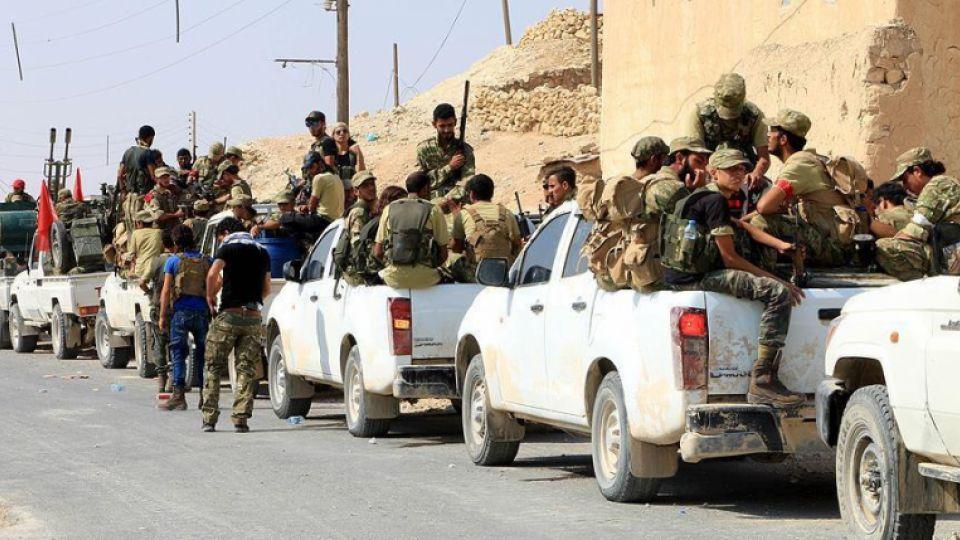
Some defected officers and former civilian revolutionary commanders have succeeded in adapting to the new situation in order to stay “relevant.” Many have sought new jobs in the Syrian National Army (SNA) militia that was established by Turkey from the remnants of the FSA. However, for those working for the SNA, unlike their former experience in the revolution and the FSA, they know that there is little that is truly “national” about their new role, contrary to the name that has been given to their new militia. However, these leaders say they have chosen the lesser of two evils, and that while Turkey, like all members of the international community, ignores the interests of the Syrian people, it is still the only power that shares any real common interests with opposition base of the Syrian people and the former leaders of the revolution.
With all the negativity that engulfs the Syrian issue, it is still the responsibility of these leaders, together with the Syrian people in general, to keep fighting for their cause because it is just and patriotic, however great their frustration may be. Syrian revolutionary leaders may find it useful to come together, after all these years, to establish something like a “Veterans of the Revolution Association” as an umbrella group that brings them together and helps them to plan for a new phase in struggle against the regime. The grimness of their personal situations and the dire circumstances in which they now find themselves in should not prevent them from carrying out their public duty. Bashar Al Assad is still in his palace in Damascus and letting him feel relaxed might only embolden him further – a development that few inside or outside Syria wants to happen.
Where are the leaders of the Syrian revolution?
Leave a comment